


Page 603 - Concise Pathology for Exam Preparation ( PDFDrive )
P. 603
588    SECTION II  Diseases of Organ Systems


                       •	 The cyst expands the bone, causing thinning of the overlying cortex.
                       •	 Pathogenesis is unknown.
                       •	 SBC may remain asymptomatic or present with pain and pathological fracture.
                       Gross	pathology
                       Generally unilocular with smooth inner lining; filled with yellow or amber coloured
                         fluid.
                        Microscopy
                       •	 Cyst wall consists of thin collagenous tissue having scattered osteoclastic giant cells
                         and newly formed reactive bony trabeculae.
                       •	 Fracture  may  alter  the  appearance  with  secondary  haemorrhage,  haemosiderin
                         deposits and macrophages in the cyst wall.
                       2.  Aneurysmal	bone	cyst	(ABC)
                        •	 ABC is an expanding osteolytic lesion filled with blood (aneurysm 5 dilatation).
                        •	 Common in young patients under 30	years of age.
                        •	 Most frequently involved is metaphysis	of	long	bones or the	vertebral	column.
                        X-Ray
                        Characteristic ballooned-out, expansile lesion located underneath the periosteum
                        Pathogenesis
                        Not clear; probably arises from persistent alteration in the local haemodynamics
                        Clinical	features
                        Enlarges over a period of years to produce pain, tenderness and sometimes pathological
                          fracture
                        Gross	pathology
                        Seen as a large haemorrhagic mass covered over by thinned out reactive bone
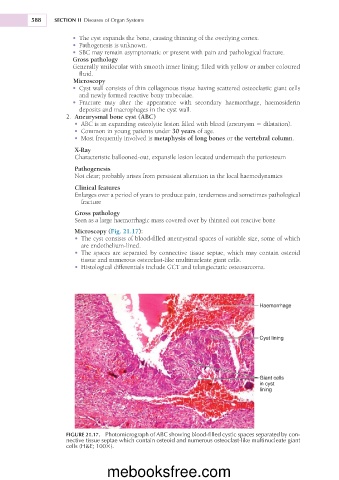
                        Microscopy	(Fig.	21.17):
                        •	 The cyst consists of blood-filled aneurysmal spaces of variable size, some of which
                          are endothelium-lined.
                        •	 The spaces are separated by connective tissue septae, which may contain osteoid
                          tissue and numerous osteoclast-like multinucleate giant cells.
                        •	 Histological differentials include GCT and telangiectatic osteosarcoma.


                                                                                 Haemorrhage


                                                                                 Cyst lining


                                                                                 Giant cells
                                                                                 in cyst
                                                                                 lining


                     FIGURE 21.17.  Photomicrograph of ABC showing blood-filled cystic spaces separated by con-
                     nective tissue septae which contain osteoid and numerous osteoclast-like multinucleate giant
                     cells (H&E; 1003).


                                  mebooksfree.com

