


Page 1043 - Hematology_ Basic Principles and Practice ( PDFDrive )
P. 1043
926    Part VII  Hematologic Malignancies


                                                  20% Blasts in marrow and/or blood  OR   20% Blasts
                                                         Acute leukemia

                         Morphology              MPO positive in  3% of blasts and/or
                        cytochemistry         presence of Auer Rods is diagnostic for AML.
                     immunohistochemistry  Absence of any of these features does not rule out AML.
                                                                                             IF
                                         Stage/Lineage            Marker
                                       Percursor     CD34, CD38, CD117, CD133, HLA-DR
                                       Granulocytic  CD13, CD15, CD16, CD33, CD65, cMPO
                      Immunophenotyping
                                       Monocytic     NSE, CD11c, CD14, CD64, lysozyme, CD4,
                                                     CD11b, CD36, NG2 homologue
                                       Megakaryocytic  CD41(gp IIb/IIIa), CD61(gp IIIa), CD42 (gp1b)
                                       Erythroid     CD235a (glycophorin A)

                                                   AML with recurrent cytogenetic
                         Karyotyping                                                    t(8;21)(q22;q22)
                                                abnormalities as defined by WHO 2008
                                                                                        inv(16)(p13;q22)
                    Gene mutation analysis  Testing for FLT3, NPM1, CEBPA (KIT in CBF AML)  t(16;16)(p13;q22)
                                          Morphology: absence or presence of dysplasia  t(15;17)(q23;q12)
                      Additional features  History: previous exposure to chemotherapy   radiation  11q23 (MLL)
                                                antecedent hematologic disorder (AHD)
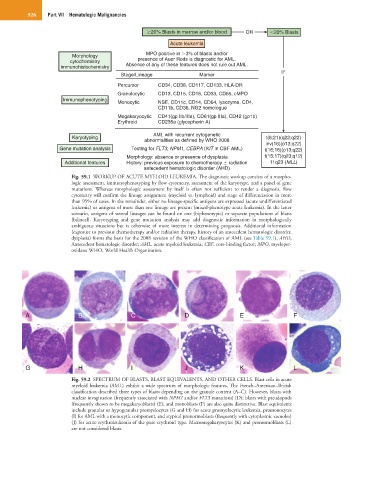
                        Fig. 59.1  WORKUP OF ACUTE MYELOID LEUKEMIA. The diagnostic workup consists of a morpho-
                        logic assessment, immunophenotyping by flow cytometry, assessment of the karyotype, and a panel of gene
                        mutations.  Whereas  morphologic  assessment  by  itself  is  often  not  sufficient  to  render  a  diagnosis,  flow
                        cytometry will confirm the lineage assignment (myeloid vs. lymphoid) and stage of differentiation in more
                        than 95% of cases. In the remainder, either no lineage-specific antigens are expressed (acute undifferentiated
                        leukemia) or antigens of more than one lineage are present (mixed-phenotype acute leukemia). In the latter
                        scenario, antigens of several lineages can be found on one (biphenotypic) or separate populations of blasts
                        (bilineal).  Karyotyping  and  gene  mutation  analysis  may  add  diagnostic  information  in  morphologically
                        ambiguous  situations  but  is  otherwise  of  more  interest  in  determining  prognosis.  Additional  information
                        (exposure to previous chemotherapy and/or radiation therapy, history of an antecedent hematologic disorder,
                        dysplasia) forms the basis for the 2008 revision of the WHO classification of AML (see Table 59.1). AHD,
                        Antecedent hematologic disorder; AML, acute myeloid leukemia; CBF, core-binding factor; MPO, myeloper-
                        oxidase; WHO, World Health Organization.


         A                 B                C                D                 E                 F


         G                 H                I                J                 K                 L

                        Fig. 59.2  SPECTRUM OF BLASTS, BLAST EQUIVALENTS, AND OTHER CELLS. Blast cells in acute
                        myeloid leukemia (AML) exhibit a wide spectrum of morphologic features. The French–American–British
                        classification described three types of blasts depending on the granule content (A–C). However, blasts with
                        nuclear invagination (frequently associated with NPM1 and/or FLT3 mutations) (D); blasts with pseudopods
                        (frequently shown to be megakaryoblasts) (E); and monoblasts (F) are also quite distinctive. Blast equivalents
                        include granular or hypogranular promyelocytes (G and H) for acute promyelocytic leukemia, promonocytes
                        (I) for AML with a monocytic component, and atypical pronormoblasts (frequently with cytoplasmic vacuoles)
                        (J) for acute erythroleukemia of the pure erythroid type. Micromegakaryocytes (K) and pronormoblasts (L)
                        are not considered blasts.

