


Page 1044 - Hematology_ Basic Principles and Practice ( PDFDrive )
P. 1044
Chapter 59  Clinical Manifestations and Treatment of Acute Myeloid Leukemia  927


                          MPO                  MPO               ANAE                COES


                          A                    B                 C                   D
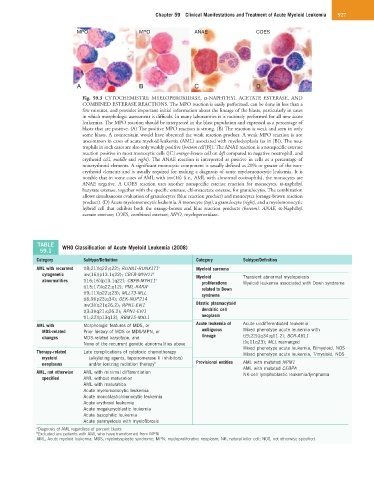
                            Fig.  59.3  CYTOCHEMISTRY:  MYELOPEROXIDASE,  α-NAPHTHYL  ACETATE  ESTERASE,  AND
                            COMBINED ESTERASE REACTIONS. The MPO reaction is easily performed, can be done in less than a
                            few minutes, and provides important initial information about the lineage of the blasts, particularly in cases
                            in which morphologic assessment is difficult. In many laboratories it is routinely performed for all new acute
                            leukemias. The MPO reaction should be interpreted in the blast population and expressed as a percentage of
                            blasts that are positive. (A) The positive MPO reaction is strong. (B) The reaction is weak and seen in only
                            some blasts. A counterstain would have obscured the weak reaction product. A weak MPO reaction is not
                            uncommon in cases of acute myeloid leukemia (AML) associated with myelodysplasia (as in [B]). The neu-
                            trophils in such cases are also only weakly positive (bottom cell [B]). The ANAE reaction is a nonspecific esterase
                            reaction positive in most monocytic cells ([C] orange-brown cell on left compared to negative neutrophil, and
                            erythroid cell, middle and right). The ANAE reaction is interpreted as positive in cells as a percentage of
                            nonerythroid elements. A significant monocytic component is usually defined as 20% or greater of the non-
                            erythroid elements and is usually required for making a diagnosis of acute myelomonocytic leukemia. It is
                            notable that in some cases of AML with inv(16) (i.e., AML with abnormal eosinophils), the monocytes are
                            ANAE  negative.  A  COES  reaction  uses  another  nonspecific  esterase  reaction  for  monocytes,  α-naphthyl
                            butyrate esterase, together with the specific esterase, chloroacetate esterase, for granulocytes. The combination
                            allows simultaneous evaluation of granulocytes (blue reaction product) and monocytes (orange-brown reaction
                            product). (D) Acute myelomonocytic leukemia. A monocyte (top), a granulocyte (right), and a myelomonocytic
                            hybrid cell that exhibits both the orange-brown and blue reaction products (bottom). ANAE, α-Naphthyl
                            acetate esterase; COES, combined esterase; MPO, myeloperoxidase.


             TABLE   WHO Classification of Acute Myeloid Leukemia (2008)
              59.1
             Category       Subtype/Definition                   Category        Subtype/Definition
             AML with recurrent   t(8;21)(q22;q22); RUNX1-RUNX1T1 a  Myeloid sarcoma
               cytogenetic   inv(16)(p13.1q22); CBFB-MYH11 a     Myeloid         Transient abnormal myelopoiesis
               abnormalities  t(16;16)(p13.1q22); CBFB-MYH11 a     proliferations   Myeloid leukemia associated with Down syndrome
                            t(15;17)(q22;q12); PML-RARA a          related to Down
                            t(9;11)(p22;q23); MLLT3-MLL            syndrome
                            t(6;9)(p23;q34); DEK-NUP214
                            inv(3)(q21q26.2); RPN1-EVI1          Blastic plasmacytoid
                            t(3;3)(q21;q26.2); RPN1-EVI1           dendritic cell
                            t(1;22)(p13q13); RBM15-MKL1            neoplasm
             AML with       Morphologic features of MDS, or      Acute leukemia of   Acute undifferentiated leukemia
               MDS-related   Prior history of MDS or MDS/MPN, or   ambiguous     Mixed phenotype acute leukemia with
               changes      MDS-related karyotype, and             lineage       t(9;22)((q34;q11.2); BCR-ABL1
                            None of the recurrent genetic abnormalities above    t(v;11q23); MLL rearranged
                                                                                 Mixed phenotype acute leukemia, B/myeloid, NOS
             Therapy-related   Late complications of cytotoxic chemotherapy      Mixed phenotype acute leukemia, T/myeloid, NOS
               myeloid        (alkylating agents, topoisomerase II inhibitors)
               neoplasms      and/or ionizing radiation therapy b  Provisional entities  AML with mutated NPM1
                                                                                 AML with mutated CEBPA
             AML, not otherwise   AML with minimal differentiation               NK-cell lymphoblastic leukemia/lymphoma
               specified    AML without maturation
                            AML with maturation
                            Acute myelomonocytic leukemia
                            Acute monoblastic/monocytic leukemia
                            Acute erythroid leukemia
                            Acute megakaryoblastic leukemia
                            Acute basophilic leukemia
                            Acute panmyelosis with myelofibrosis
             a Diagnosis of AML regardless of percent blasts
             b Excluded are patients with AML who have transformed from MPN
             AML, Acute myeloid leukemia; MDS, myelodysplastic syndrome; MPN, myeloproliferative neoplasm; NK, natural killer cell; NOS, not otherwise specified.

