


Page 1048 - Hematology_ Basic Principles and Practice ( PDFDrive )
P. 1048
Chapter 59  Clinical Manifestations and Treatment of Acute Myeloid Leukemia  931


                           A A                             BB               CC                    DD
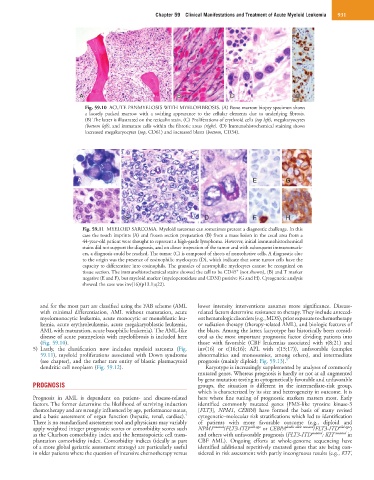
                             Fig. 59.10  ACUTE PANMYELOSIS WITH MYELOFIBROSIS. (A) Bone marrow biopsy specimen shows
                             a  loosely  packed  marrow  with  a  swirling  appearance  to  the  cellular  elements  due  to  underlying  fibrosis.
                             (B) The latter is illustrated on the reticulin stain. (C) Proliferations of erythroid cells (top left), megakaryocytes
                             (bottom left), and immature cells within the fibrotic areas (right). (D) Immunohistochemical staining shows
                             increased megakaryocytes (top, CD61) and increased blasts (bottom, CD34).


                          A                                                         E         G


                          B               C C                       D               F         H
                            Fig. 59.11  MYELOID SARCOMA. Myeloid sarcomas can sometimes present a diagnostic challenge. In this
                            case the touch imprints (A) and frozen section preparation (B) from a mass lesion in the cecal area from a
                            44-year-old patient were thought to represent a high-grade lymphoma. However, initial immunohistochemical
                            stains did not support the diagnosis, and on closer inspection of the tumor and with subsequent immunomark-
                            ers, a diagnosis could be reached. The tumor (C) is composed of sheets of noncohesive cells. A diagnostic clue
                            to the origin was the presence of eosinophilic myelocytes (D), which indicate that some tumor cells have the
                            capacity to differentiate into eosinophils. The granules of neutrophilic myelocytes cannot be recognized on
                                                                              +
                            tissue section. The immunohistochemical stains showed the cell to be CD45  (not shown), (B) and T marker
                            negative (E and F), but myeloid marker (myeloperoxidase and CD33) positive (G and H). Cytogenetic analysis
                            showed the case was inv(16)(p13.1;q22).


              and for the most part are classified using the FAB scheme (AML   lower  intensity  interventions  assumes  more  significance.  Disease-
              with  minimal  differentiation,  AML  without  maturation,  acute   related factors determine resistance to therapy. They include anteced-
              myelomonocytic leukemia, acute monocytic or monoblastic leu-  ent hematologic disorders (e.g., MDS), prior exposure to chemotherapy
              kemia, acute erythroleukemia, acute megakaryoblastic leukemia,   or radiation therapy (therapy-related AML), and biologic features of
              AML with maturation, acute basophilic leukemia). The AML-like   the blasts. Among the latter, karyotype has historically been consid-
              disease of acute panmyelosis with myelofibrosis is included here   ered as the most important prognostic factor dividing patients into
              (Fig. 59.10).                                       those  with  favorable  (CBF  leukemias  associated  with  t(8;21)  and
            5)  Lastly,  the  classification  now  includes  myeloid  sarcoma  (Fig.   inv(16)  or  t(16;16);  APL  with  t(15;17)),  unfavorable  (complex
              59.11),  myeloid  proliferations  associated  with  Down  syndrome   abnormalities  and  monosomies,  among  others),  and  intermediate
              (see chapter), and the rather rare entity of blastic plasmacytoid   prognosis (mainly diploid; Fig. 59.13). 5
              dendritic cell neoplasm (Fig. 59.12).                 Karyotype is increasingly supplemented by analyses of commonly
                                                                  mutated genes. Whereas prognosis is hardly or not at all augmented
                                                                  by gene mutation testing in cytogenetically favorable and unfavorable
            PROGNOSIS                                             groups,  the  situation  is  different  in  the  intermediate-risk  group,
                                                                  which is characterized by its size and heterogeneity in outcome. It is
            Prognosis  in  AML  is  dependent  on  patient-  and  disease-related   here  where  fine  tuning  of  prognostic  markers  matters  most.  Early
            factors. The former determine the likelihood of surviving induction   identified  commonly  mutated  genes  (FMS-like  tyrosine  kinase-3
            chemotherapy and are strongly influenced by age, performance status,   [FLT3],  NPM1,  CEBPA)  have  formed  the  basis  of  many  revised
                                                              4
            and a basic assessment of organ function (hepatic, renal, cardiac).    cytogenetic–molecular risk stratifications which led to identification
            There is no standardized assessment tool and physicians may variably   of  patients  with  more  favorable  outcome  (e.g.,  diploid  and
            apply weighted integer prognostic scores or comorbidity scores such   NPM1 mutated /FLT3-ITD wild-type  or CEBPA double allele mutated /FLT3-ITD wild-type )
            as the Charlson comorbidity index and the hematopoietic cell trans-  and others with unfavorable prognosis (FLT3-ITD mutated ; KIT  mutated  in
            plantation comorbidity index. Comorbidity indices (ideally as part   CBF  AML).  Ongoing  efforts  at  whole-genome  sequencing  have
            of a more global geriatric assessment strategy) are particularly useful   identified additional repetitively mutated genes that are being con-
            in older patients where the question of intensive chemotherapy versus   sidered in risk assessment with partly incongruous results (e.g., KIT,

