


Page 1047 - Hematology_ Basic Principles and Practice ( PDFDrive )
P. 1047
930    Part VII  Hematologic Malignancies


                       A                  C                   E                   G


                       B                  D                   F                   H
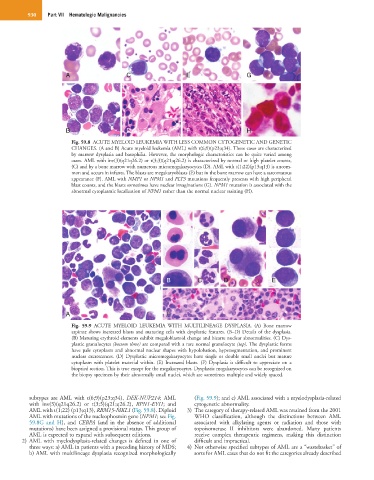
                        Fig. 59.8  ACUTE MYELOID LEUKEMIA WITH LESS COMMON CYTOGENETIC AND GENETIC
                        CHANGES. (A and B) Acute myeloid leukemia (AML) with t(6;9)(p23;q34). These cases are characterized
                        by marrow dysplasia and basophilia. However, the morphologic characteristics can be quite varied among
                        cases. AML with inv(3)(q21q26.2) or t(3;3)(q21;q26.2) is characterized by normal or high platelet counts,
                        (C) and by a bone marrow with numerous micromegakaryocytes (D). AML with t(1;22)(p13;q13) is uncom-
                        mon and occurs in infants. The blasts are megakaryoblasts (E) but in the bone marrow can have a sarcomatous
                        appearance (F). AML with NMP1 or NPM1 and FLT3 mutations frequently presents with high peripheral
                        blast counts, and the blasts sometimes have nuclear invaginations (G). NPM1 mutation is associated with the
                        abnormal cytoplasmic localization of NPM1 rather than the normal nuclear staining (H).


                                                       B          C       D               E


                       A                               F F

                        Fig.  59.9  ACUTE  MYELOID  LEUKEMIA  WITH  MULTILINEAGE  DYSPLASIA.  (A)  Bone  marrow
                        aspirate shows increased blasts and maturing cells with dysplastic features. (B–D) Details of the dysplasia.
                        (B) Maturing erythroid elements exhibit megaloblastoid change and bizarre nuclear abnormalities. (C) Dys-
                        plastic granulocytes (bottom three) are compared with a rare normal granulocyte (top). The dysplastic forms
                        have  pale  cytoplasm  and  abnormal  nuclear  shapes  with  hypolobation,  hypersegmentation,  and  prominent
                        nuclear  excrescences.  (D)  Dysplastic  micromegakaryocytes  have  single  or  double  small  nuclei  but  mature
                        cytoplasm  with  platelet  material  within.  (E)  Increased  blasts.  (F)  Dysplasia  is  difficult  to  appreciate  on  a
                        biopsied section. This is true except for the megakaryocytes. Dysplastic megakaryocytes can be recognized on
                        the biopsy specimen by their abnormally small nuclei, which are sometimes multiple and widely spaced.


           subtypes  are  AML  with  t(6;9)(p23;q34),  DEK-NUP214;  AML   (Fig. 59.9); and c) AML associated with a myelodysplasia-related
           with  inv(3)(q21q26.2)  or  t(3;3)(q21;q26.2),  RPN1-EVI1;  and   cytogenetic abnormality.
           AML with t(1;22) (p13;q13), RBM15-MKL1 (Fig. 59.8). Diploid   3)  The category of therapy-related AML was retained from the 2001
           AML with mutations of the nucleophosmin gene (NPM1; see Fig.   WHO  classification,  although  the  distinctions  between  AML
           59.8G  and  H),  and  CEBPA  (and  in  the  absence  of  additional   associated  with  alkylating  agents  or  radiation  and  those  with
           mutations) have been assigned a provisional status. This group of   topoisomerase  II  inhibitors  were  abandoned.  Many  patients
           AML is expected to expand with subsequent editions.   receive  complex  therapeutic  regimens,  making  this  distinction
        2)  AML  with  myelodysplasia-related  changes  is  defined  in  one  of   difficult and impractical.
           three ways: a) AML in patients with a preceding history of MDS;   4)  Not otherwise specified subtypes of AML are a “wastebasket” of
           b) AML with multilineage dysplasia recognized morphologically   sorts for AML cases that do not fit the categories already described

