


Page 1045 - Hematology_ Basic Principles and Practice ( PDFDrive )
P. 1045
928    Part VII  Hematologic Malignancies


                                                     B


                       A                             C
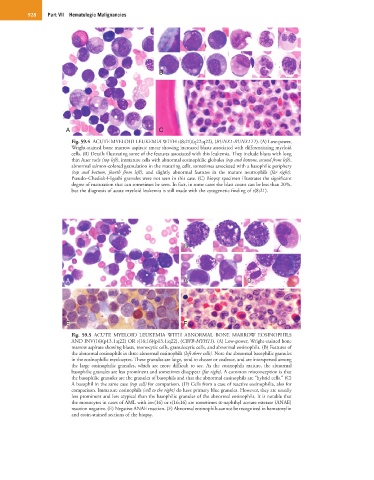
                        Fig. 59.4  ACUTE MYELOID LEUKEMIA WITH t(8;21)(q22;q22), (RUNX1-RUNX1T1). (A) Low-power,
                        Wright-stained bone marrow aspirate smear showing increased blasts associated with differentiating myeloid
                        cells. (B) Details illustrating some of the features associated with this leukemia. They include blasts with long
                        thin Auer rods (top left), immature cells with abnormal eosinophilic globules (top and bottom, second from left),
                        abnormal salmon-colored granulation in the maturing cells, sometimes associated with a basophilic periphery
                        (top  and  bottom,  fourth  from  left),  and  slightly  abnormal  features  in  the  mature  neutrophils  (far  right).
                        Pseudo–Chediak-Higashi granules were not seen in this case. (C) Biopsy specimen illustrates the significant
                        degree of maturation that can sometimes be seen. In fact, in some cases the blast count can be less than 20%,
                        but the diagnosis of acute myeloid leukemia is still made with the cytogenetic finding of t(8;21).


                                                             B B


                       A                                     C C                  DD


                       E E                                   F

                        Fig.  59.5  ACUTE  MYELOID  LEUKEMIA  WITH  ABNORMAL  BONE  MARROW  EOSINOPHILS
                        AND INV(16)(p13.1;q22) OR t(16;16)(p13.1;q22), (CBFB-MYH11). (A) Low-power, Wright-stained bone
                        marrow aspirate showing blasts, monocytic cells, granulocytic cells, and abnormal eosinophils. (B) Features of
                        the abnormal eosinophils in three abnormal eosinophils (left three cells). Note the abnormal basophilic granules
                        in the eosinophilic myelocytes. These granules are large, tend to cluster or coalesce, and are interspersed among
                        the  large  eosinophilic  granules,  which  are  more  difficult  to  see.  As  the  eosinophils  mature,  the  abnormal
                        basophilic granules are less prominent and sometimes disappear (far right). A common misconception is that
                        the basophilic granules are the granules of basophils and that the abnormal eosinophils are “hybrid cells.” (C)
                        A basophil in the same case (top cell) for comparison. (D) Cells from a case of reactive eosinophilia, also for
                        comparison. Immature eosinophils (cell to the right) do have primary blue granules. However, they are usually
                        less prominent and less atypical than the basophilic granules of the abnormal eosinophils. It is notable that
                        the monocytes in cases of AML with inv(16) or t(16;16) are sometimes α-naphthyl acetate esterase (ANAE)
                        reaction negative. (E) Negative ANAE reaction. (F) Abnormal eosinophils cannot be recognized in hematoxylin
                        and eosin-stained sections of the biopsy.

