


Page 1050 - Hematology_ Basic Principles and Practice ( PDFDrive )
P. 1050
Chapter 59  Clinical Manifestations and Treatment of Acute Myeloid Leukemia  933


                                             Acute myeloid leukemia


                                                              Yes    • ATRA plus arsenic trioxide(  anthracycline)
                                                    APL
                                                                     • ATRA plus anthracycline
                                                       No
                                                              Yes    • High-dose cytarabine
                                                  CBF AML
                                                                     -FLAG   anthracycline or gemtuzumab
                            • Age                      No     Age
                            • Performance status              60 yrs
                            • Comorbidities       Other AML          • Cytarabine/anthracycline-based
                            • Karyotype
                            • Genotype                 Age   60 yrs
                                          • Low-dose cytarabine
                                          • Hypomethylating agents
                                          • Cytarabine/anthracycline-based
                                          • Clinical study
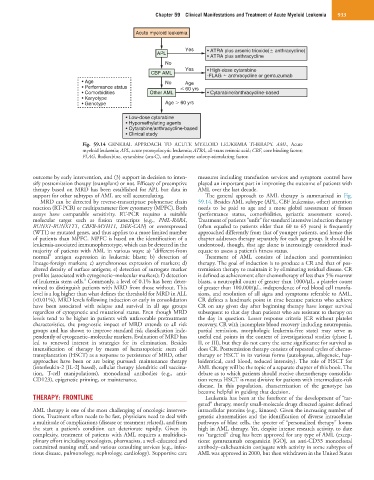
                            Fig.  59.14  GENERAL  APPROACH  TO  ACUTE  MYELOID  LEUKEMIA  THERAPY.  AML,  Acute
                            myeloid leukemia; APL, acute promyelocytic leukemia; ATRA, all-trans retinoic acid; CBF, core binding factor;
                            FLAG, fludarabine, cytarabine (ara-C), and granulocyte colony-stimulating factor.


            outcome by early intervention, and (3) support in decision to inten-  measures including transfusion services and symptom control have
            sify postremission therapy (transplant) or not. Efficacy of preemptive   played an important part in improving the outcome of patients with
            therapy based on MRD has been established for APL but data in   AML over the last decade.
            support for other subtypes of AML are still accumulating.  The  general  approach  to  AML  therapy  is  summarized  in  Fig.
              MRD can be detected by reverse-transcriptase polymerase chain   59.14. Besides AML subtype (APL, CBF leukemias, other) attention
            reaction (RT-PCR) or multiparameter flow cytometry (MPFC). Both   needs  to  be  paid  to  age  and  a  more  global  assessment  of  fitness
            assays  have  comparable  sensitivity.  RT-PCR  requires  a  suitable   (performance  status,  comorbidities,  geriatric  assessment  scores).
            molecular  target  such  as  fusion  transcripts  (e.g.,  PML-RARA,   Treatment of patients “unfit” for standard intensive induction therapy
            RUNX1-RUNX1T1,  CBFB-MYH11,  DEK-CAN)  or  overexpressed   (often equaled to patients older than 60 to 65 years) is frequently
            (WT1) or mutated genes, and thus applies to a more limited number   approached differently from that of younger patients, and hence this
            of patients than MPFC. MPFC is based on the identification of a   chapter addresses therapy separately for each age group. It should be
            leukemia-associated immunophenotype, which can be detected in the   understood, though, that age alone is increasingly considered inad-
            majority of patients with AML in various ways: a) “different-from   equate to assess a patient’s fitness status.
            normal”  antigen  expression  in  leukemic  blasts;  b)  detection  of   Treatment  of  AML  consists  of  induction  and  postremission
            lineage-foreign markers; c) asynchronous expression of markers; d)   therapy. The goal of induction is to produce a CR and that of pos-
            altered density of surface antigens; e) detection of surrogate marker   tremission therapy to maintain it by eliminating residual disease. CR
            profiles (associated with cytogenetic–molecular markers); f) detection   is defined as achievement after chemotherapy of less than 5% marrow
                             8
            of leukemia stem cells.  Commonly, a level of 0.1% has been deter-  blasts, a neutrophil count of greater than 1000/µL, a platelet count
            mined to distinguish patients with MRD from those without. This   of greater than 100,000/µL, independence of red blood cell transfu-
            level is a log higher than what defines the threshold for MRD in ALL   sions, and resolution of all signs and symptoms referable to AML.
            (<0.01%). MRD levels following induction or early in consolidation   CR defines a landmark point in time because patients who achieve
            have  been  associated  with  relapse  and  survival  in  all  age  groups   CR on any given day after beginning therapy have longer survival
            regardless of cytogenetic and mutational status. Even though MRD   subsequent to that day than patients who are resistant to therapy on
            levels tend to be higher in patients with unfavorable pretreatment   the  day  in  question.  Lesser  response  criteria  (CR  without  platelet
            characteristics,  the  prognostic  impact  of  MRD  extends  to  all  risk   recovery, CR with incomplete blood recovery including neutropenia,
            groups and has shown to improve standard risk classification inde-  partial  remission,  morphologic  leukemia-free  state)  may  serve  as
            pendently of cytogenetic–molecular markers. Evaluation of MRD has   useful end points in the context of investigational studies (phase I,
            led  to  renewed  interest  in  strategies  for  its  elimination.  Besides   II, or III), but they do not carry the same significance for survival as
            intensification  of  therapy  by  means  of  hematopoietic  stem  cell   does CR. Postremission therapy consists of repeated cycles of chemo-
            transplantation (HSCT) as a response to persistence of MRD, other   therapy or HSCT in its various forms (autologous, allogeneic, hap-
            approaches  have  been  or  are  being  pursued:  maintenance  therapy   loidentical, cord blood, reduced intensity). The role of HSCT for
            (interleukin-2 [IL-2] based), cellular therapy (dendritic cell vaccina-  AML therapy will be the topic of a separate chapter of this book. The
            tion,  T-cell  manipulations),  monoclonal  antibodies  (e.g.,  anti-  debate as to which patients should receive chemotherapy consolida-
            CD123), epigenetic priming, or maintenance.           tion versus HSCT is most divisive for patients with intermediate-risk
                                                                  disease.  In  this  population,  characterization  of  the  genotype  has
                                                                  become helpful in guiding that decision.
            THERAPY: FRONTLINE                                      Leukemia has been at the forefront of the development of “tar-
                                                                  geted” therapy, mostly small-molecule drugs directed against defined
            AML therapy is one of the most challenging of oncologic interven-  intracellular proteins (e.g., kinases). Given the increasing number of
            tions. Treatment often needs to be fast, physicians need to deal with   genetic abnormalities and the identification of diverse intracellular
            a multitude of complications (disease or treatment related), and from   pathways of blast cells, the specter of “personalized therapy” looms
            the  start  a  patient’s  condition  can  deteriorate  rapidly.  Given  its   high in AML therapy. Yet, despite intense research activity, to date
            complexity, treatment of patients with AML requires a multidisci-  no “targeted” drug has been approved for any type of AML (excep-
            plinary effort including oncologists, pharmacists, a well-educated and   tions:  gemtuzumab  ozogamicin  [GO],  an  anti-CD33  monoclonal
            committed nursing staff, and various consulting services (e.g., infec-  antibody–calicheamicin conjugate with activity in some subtypes of
            tious disease, pulmonology, nephrology, cardiology). Supportive care   AML was approved in 2000, but then withdrawn in the United States

