


Page 1051 - Hematology_ Basic Principles and Practice ( PDFDrive )
P. 1051
934    Part VII  Hematologic Malignancies


        in 2010; decitabine, a DNA methyltransferase inhibitor, was approved   the marrow continues to show blasts and is cellular, a reinduction is
        in 2013 for older patients with AML in Europe, but not in the United   usually given. The reinduction may be an attenuated repetition of the
        States).                                              induction  (“2  +  5”)  or  an  intensification  with  intermediate-dose
                                                              cytarabine (IDAC) or high-dose cytarabine (HiDAC). If the day 14
        Induction Therapy                                     or 21 marrow is hypoplastic and hence appropriately chemoablated,
                                                              hematopoietic growth factors (granulocyte colony-stimulating factor
                                                              [G-CSF]) are initiated and supportive care continues. Marrow studies
        Patients Less Than 60 Years of Age                    are repeated 2 weeks later and then weekly if necessary until it becomes
                                                              clear whether the patient is going into CR or not. If in CR, postremis-
        Induction therapy is still built on the same two drugs as 40 years ago:   sion therapy starts shortly thereafter, whereas in case of no response
        cytarabine and anthracycline. Cytarabine, an analogue of a physiologic   (“primary refractory”), treatment is often changed. Remissions fol-
        pyrimidine nucleoside, is an antimetabolite that requires intracellular   lowing reinductions are usually shorter lasting than remission after
        conversion to its triphosphate compound, ara-CTP, and incorpora-  one induction cycle. The degree of neutrophil and platelet recovery
        tion into DNA to become active. When given by itself at standard   at the time of remission has prognostic significance. Higher neutrophil
                           2
        doses of 100–200 mg/m  intravenously (IV) daily for 5–7 days, it   and platelet counts at the time of remission are predictive of better
        produces  CR  rates  of  around  40%.  Anthracyclines  (daunorubicin,   relapse-free survival. In some cases a regenerating marrow may have
        idarubicin, mitoxantrone, aclarubicin) act by stabilizing the normally   an increased number of blasts, which may look like persistent leuke-
        occurring complex between DNA and the enzyme topoisomerase II,   mia. Immunophenotyping by flow cytometry often helps to make
        thereby leading to apoptotic cell death. Daunorubicin, the anthracy-  that distinction. Further follow-up marrow studies will show reduc-
        cline that was first available, achieves similar CR rates as does cyta-  tion in blasts concomitant with a rise of neutrophils and platelets.
                                                      2
        rabine alone. The combination of cytarabine 100–200 mg/m  as a   Many modifications to the 3 + 7 regimen have been tried over the
        continuous IV infusion (its serum half-life is only 15 minutes) daily   years. Giving 10 instead of 7 days of cytarabine (3 + 10), increasing
                                                                                             2
                                                                                                             2
                                        2
        for 7 days and daunorubicin 45–60 mg/m  IV daily for 3 days on   the  dose  of  cytarabine  from  100 mg/m /day  to  200 mg/m /day,
        days 1–3 has become known as the “3 + 7” regimen and, for more   adding a third drug (e.g., etoposide, thioguanine, topotecan, fluda-
        than 40 years, has been the standard induction combination for most   rabine) or modulators of drug resistance, and priming leukemic blasts
        patients with AML. Remission rates range from 60% to 80%, and   with  hematopoietic  growth  factors  (G-CSF  and  granulocyte-
        long-term disease-free survival is about 35%. 9       macrophage colony stimulating factor) have not proven superior.
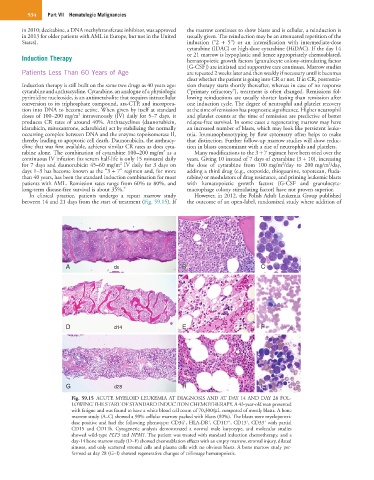
           In  clinical  practice,  patients  undergo  a  repeat  marrow  study   However, in 2012, the Polish Adult Leukemia Group published
        between 14 and 21 days from the start of treatment (Fig. 59.15). If   the outcome of an open-label, randomized study where addition of


                       A              dx                     B B                      C


                       D              d14                    E                        F


                       G              d28                    H                        I I

                        Fig. 59.15  ACUTE MYELOID LEUKEMIA AT DIAGNOSIS AND AT DAY 14 AND DAY 28 FOL-
                        LOWING THE START OF STANDARD INDUCTION CHEMOTHERAPY. A 43-year-old man presented
                        with fatigue and was found to have a white blood cell count of 70,300/µL composed of mostly blasts. A bone
                        marrow study (A–C) showed a 90% cellular marrow packed with blasts (80%). The blasts were myeloperoxi-
                                                                                       +
                                                                                  +
                                                                     +
                                                             +
                                                                            +
                        dase positive and had the following phenotype: CD34 , HLA-DR , CD117 , CD13 , CD33  with partial
                        CD15  and  CD11b.  Cytogenetic  analysis  demonstrated  a  normal  male  karyotype,  and  molecular  studies
                        showed wild-type FLT3 and NPM1. The patient was treated with standard induction chemotherapy, and a
                        day-14 bone marrow study (D–F) showed chemoablation effects with an empty marrow, stromal injury, dilated
                        sinuses, and only scattered stromal cells and plasma cells with no obvious blasts. A bone marrow study per-
                        formed at day 28 (G–I) showed regenerative changes of trilineage hematopoiesis.

