


Page 1173 - Hematology_ Basic Principles and Practice ( PDFDrive )
P. 1173
Chapter 65  Clinical Manifestations and Treatment of Childhood Acute Lymphoblastic Leukemia  1021


            children exposed to radiation in utero. This experience contrasts with   be of therapeutic interest given the increased toxicity with standard
            other reports of an increased incidence of ALL in children exposed   chemotherapy in this patient population. Genome sequencing of other
            to  medical  diagnostic  radiation  both  in  utero  and  in  childhood.   Ph-like cases identified structural alterations and mutations activating
            Other  evidence  linking  most  environmental  exposures  to  risk  of   kinase  and  cytokine  receptor  signaling,  including  EBF1-PDGFRB,
            childhood ALL has largely been inconsistent. Causation pathways are   NUP214-ABL1,  RANBP2-ABL1,  BCR-JAK2,  STRN3-JAK2,  and
            likely to be multifactorial and it is probable that the risk of ALL from   activating mutations of IL7R or FLT3. Importantly, preclinical studies
            environmental exposure is influenced by germline genetic variations   showed  that  primary  leukemic  cells  harboring  PDGFRB  or  ABL1
            through the co-inheritance of multiple low-risk variants.  fusion responded to ABL1 tyrosine kinase inhibitors, and those harbor-
                                                                  ing BCR-JAK2 or mutated IL7R responded to JAK2 inhibitor, suggest-
                                                                  ing that these patients would benefit from the targeted therapy. 10
            PATHOBIOLOGY                                            Historically,  association  studies  of  ALL  based  on  the  candidate
                                                                  gene approach have implicated a few genes involved in the metabo-
            Acute leukemias comprise a group of clonal disorders of maturation   lism  of  carcinogens,  folate  metabolism,  protection  of  DNA  from
            at an early phase of hematopoietic differentiation. ALL subtypes are   carcinogen-induced damage, and cell-cycle regulation in the develop-
            a heterogeneous group of malignancies with distinctive immunophe-  ment of ALL. However, none of these genes can be confirmed by the
            notype  and  molecular  pathogenesis  that  result  in  varying  clinical   recent genome-wide association studies that instead have identified
            characteristics  and  response  to  therapy.  Accurate  pathobiologic   polymorphic  variants  in  several  other  genes  (including  ARID5B,
            diagnosis is not only important for prognostic stratification, but can   CEBPE, GATA3, CDKN2A, BMI1-PIP4K2A, and IKZF1) that are
                                                                                                                   11
            also help define patient-specific therapeutic approaches. 7  associated with an increased risk of ALL or specific ALL subtypes.
              Lymphoblastic leukemias can arise from either B- or T-cell mutant   Rare germline mutations in PAX5 and ETV6 are linked to familial
                                                                      12
            hematopoietic  progenitor  cells  capable  of  indefinite  self-renewal.   ALL.  In addition to identifying common, low-penetrance suscepti-
            T-cell ALL can be classified into several distinct genetic subgroups   bility  alleles,  these  data  provide  insights  into  disease  causation  by
            that correspond to specific T-cell development stages, and is frequently   identifying risk variants annotating genes involved in transcriptional
            associated with translocations of T-cell receptor genes on chromo-  regulation and differentiation of B-cell progenitors.
            some 14q11 or 7q34 with other gene partners. Early T-cell precursor
            (ETP) ALL comprises 12% to 15% of T-ALL and is characterized by
            immature genetic and immunophenotypic features (CD1a-negative,   CLINICAL MANIFESTATIONS
            CD8-negative, and CD5-weak and the coexpression of stem-cell or
            myeloid markers), and gene expression reminiscent of double-negative   Children  with  ALL  present  with  nonspecific  symptoms  and  signs
            1 thymocyte that retains the ability to differentiate into both T-cell   reflecting the degree of disruption in bone marrow (BM) function
            and myeloid, but not B-cell lineages. The discovery of its mutational   and  the  extent  of  extramedullary  infiltration.  The  most  common
            spectrum  recapitulated  that  of  acute  myeloid  leukemia  (AML)  by   presenting  symptoms  are  fever,  fatigue,  pallor,  petechiae,  bruising,
            whole genome sequencing and global transcription profile similar to   bleeding from mucosal surfaces, and pain. Patients, especially young
            that of normal hematopoietic stem cells, and granulocyte macrophage   children, may present with bone pain, arthralgia, or refusal to walk
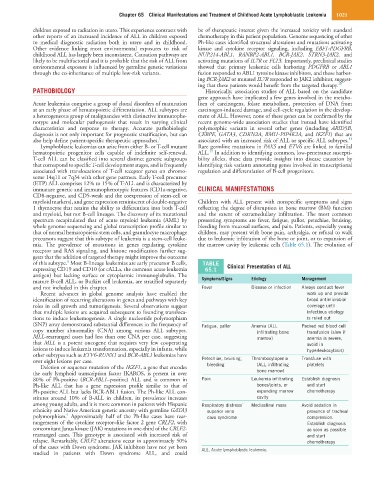
            precursors suggest that this subtype of leukemia is a stem-cell leuke-  due to leukemic infiltration of the bone or joint, or to expansion of
            mia.  The  prevalence  of  mutations  in  genes  regulating  cytokine   the marrow cavity by leukemic cells (Table 65.1). The evolution of
            receptor and RAS signaling, and histone modification further sug-
            gests that the addition of targeted therapy might improve the outcome
                       8
            of this subtype.  Most B-lineage leukemias are early precursor B cells,   TABLE   Clinical Presentation of ALL
            expressing CD19 and CD10 (or cALLa, the common acute leukemia   65.1
            antigen)  but  lacking  surface  or  cytoplasmic  immunoglobulin. The
            mature B-cell ALL, or Burkitt cell leukemia, are stratified separately   Symptoms/Signs  Etiology  Management
            and not included in this chapter.                      Fever           Disease or infection  Always conduct fever
              Recent  advances  in  global  genome  analysis  have  enabled  the                     work up and provide
            identification of recurring alterations in genes and pathways with key                   broad antimicrobial
            roles in cell growth and tumorigenesis. Several observations suggest                     coverage until
            that multiple lesions are acquired subsequent to founding transloca-                     infectious etiology
            tions to induce leukemogenesis. A single nucleotide polymorphism                         is ruled out
            (SNP) array demonstrated substantial differences in the frequency of   Fatigue, pallor  Anemia (ALL   Packed red blood cell
            copy  number  abnormality  (CNA)  among  various  ALL  subtypes.         infiltrating bone   transfusion (slow if
            MLL-rearranged cases had less than one CNA per case, suggesting          marrow)         anemia is severe,
            that MLL is a potent oncogene that requires very few cooperating                         avoid in
            lesions to induce leukemia transformation, especially in infants, while                  hyperleukocytosis)
            other subtypes such as ETV6-RUNX1 and BCR-ABL1 leukemias have
            over eight lesions per case.                           Petechiae, bruising,   Thrombocytopenia   Transfuse with
              Deletion or sequence mutation of the IKZF1, a gene that encodes   bleeding  (ALL infiltrating   platelets
            the early lymphoid transcription factor IKAROS, is present in over       bone marrow)
            80%  of  Ph-positive  (BCR-ABL1–positive)  ALL  and  is  common  in   Pain  Leukemia infiltrating   Establish diagnosis
            Ph-like  ALL  that  has  a  gene  expression  profile  similar  to  that  of   bones/joints, or   and start
            Ph-positive ALL but lacks BCR-ABL1 fusion. The Ph-like ALL con-          expanding marrow   chemotherapy
            stitutes  around  10%  of  B-ALL  in  children,  its  prevalence  increases   cavity
            among young adults, and it is more common in patients with Hispanic   Respiratory distress/  Mediastinal mass  Avoid sedation in
            ethnicity and Native American genetic ancestry with germline GATA3   superior vena       presence of tracheal
                       9
            polymorphism.   Approximately  half  of  the  Ph-like  cases  have  rear-  cava syndrome  compression.
            rangements of the cytokine receptor–like factor 2 gene CRLF2, with                       Establish diagnosis
            concomitant Janus kinase (JAK) mutations in one-third of the CRLF2-                      as soon as possible
            rearranged  cases. This  genotype  is  associated  with  increased  risk  of             and start
            relapse. Remarkably, CRLF2 alterations occur in approximately 50%                        chemotherapy
            of the cases with Down syndrome. JAK inhibitors have not yet been   ALL, Acute lymphoblastic leukemia.
            studied  in  patients  with  Down  syndrome  ALL,  and  could

