


Page 1194 - Hematology_ Basic Principles and Practice ( PDFDrive )
P. 1194
1042   Part VII  Hematologic Malignancies


          TABLE   Clinical Trials Evaluating Role of Myeloablative Allogeneic Stem Cell Transplant in Acute Lymphoblastic Leukemia
          66.7
                                       Age in Years,   Conditioning Regimen/
         Trial         Patients (n)    Median (Range)  Donor        TRM             DFS/OS        Comments
         GOELAL02 13   41 (HR)         34 (15–52)  Etoposide/       15%             DFS: 75% at 6   Showed improved
                                                     cyclophosphamide/                years; OS:    survival with
                                                     TBI (12 Gy in six                75% at 6      aSCT compared
                                                     fractions)                       years         with ASCT
                                                   MSD
         LALA 94 6     100 (HR ALL     33 (15–55) for   Cyclophosphamide/  18% at 3 years  3-year DFS: 47%  For HR ALL, aSCT
                         excluding Ph   +  the entire   TBI (10 Gy as a                             was superior to
                         ALL)            study cohort   single dose or                              an ASCT
                                         of 922      12 Gy in six
                                         patients    fractions)
                                                   MRD
         PETHEMA-93 11  222 HR patient   27 (15–50)  Cyclophosphamide/              5-year OS: 35%  No benefit of an
                         underwent MSD               TBI (12 Gy in six                              MSD transplant
                         (if available); if          fractions)                                     for HR patients
                         not, randomized           MSD                                              (compared with
                         to ASCT vs.                                                                ASCT or
                         chemotherapy                                                               chemotherapy
                                                                                                    only approach)
         MRC UKALLXII/  Patients assigned to   15–64  Etoposide/TBI   NRM HR (36%   5-year OS: HR   Beneficial effect of
           ECOG E2993 10  aSCT if an MSD             (13.2 Gy in six   donor; 14%     (41% donor,   all-SCT limited
                         available (donor            fractions)       no-donor); SR   35% no donor)  to SR group only;
                         group); those             MSD                (20% donor; 7%   SR (62% donor   relapse rate
                         without donors                               no donor)       vs. 52% donor)  decreased with
                         randomized to                                                              aSCT in both HR
                         ASCT vs.                                                                   and SR groups
                         chemotherapy
         HOVON 14      ALL in CR1      Donor 31    Cyclophosphamide/  HR: NRM at 5 years   HR: OS at 5   Similar to the MRC
                         according to    (16–55)     TBI (12 Gy in six   (15% donor vs.   years (53%   UKALLXII/ECOG
                         sibling donor vs.           fractions)       4% no-donor)    donor vs. 41%   E2993 trial,
                         no-donor                  MRD              SR: NRM at 5 years   no donor)  benefit of aSCT
                         comparison                                   (16% donor vs.   SR: OS at 5 years   seems limited to
                       HR: 46 donor; 73                               2% no-donor, p =   (69% donor vs.   SR patients
                         no donor                                     .01)            49% no donor,
                       SR: 50 donor; 88                                               p = .05)
                         no donor
         ALL, Acute lymphoblastic leukemia; aSCT, allogeneic stem cell transplantation; ASCT, autologous stem cell transplantation; CR1, first complete remission;
         DFS, disease-free survival; HR, high risk; MRD, minimal residual disease; MSD, matched sibling donor; NRM, non-relapse mortality; OS, overall survival;
         Ph, philadelphia chromosome; SCT, stem cell transplantation; SR, standard risk; TBI, total-body irradiation; TRM, transplant-related mortality.


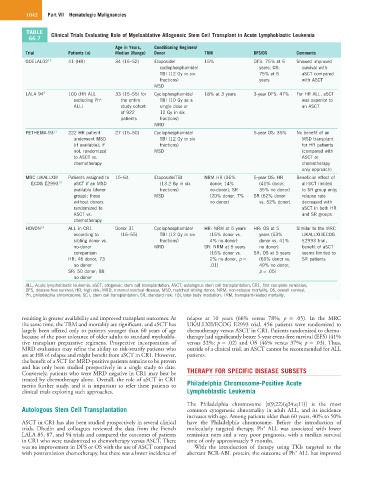
        resulting in greater availability and improved transplant outcomes. At   relapse  at  10  years  (66%  versus  78%;  p  =  .05).  In  the  MRC
        the same time, the TRM and mortality are significant, and aSCT has   UKALLXII/ECOG  E2993  trial,  456  patients  were  randomized  to
        largely been offered only to patients younger than 60 years of age   chemotherapy versus ASCT in CR1. Patients randomized to chemo-
        because of the poor tolerance of older adults to standard myeloabla-  therapy had significantly better 5-year event-free survival (EFS) (41%
        tive  transplant  preparative  regimens.  Prospective  incorporation  of   versus  32%;  p  =  .02)  and  OS  (46%  versus  37%;  p  =  .03). Thus,
        MRD evaluation may refine the ability to risk-stratify patients who   outside of a clinical trial, an ASCT cannot be recommended for ALL
        are at HR of relapse and might benefit from aSCT in CR1. However,   patients.
        the benefit of a SCT for MRD-positive patients remains to be proven
        and has only been studied prospectively in a single study to date.
        Conversely, patients who were MRD negative in CR1 may best be   THERAPY FOR SPECIFIC DISEASE SUBSETS
        treated by chemotherapy alone. Overall, the role of aSCT in CR1
        merits further study, and it is important to refer these patients to   Philadelphia Chromosome-Positive Acute
        clinical trials exploring such approaches.            Lymphoblastic Leukemia

                                                              The  Philadelphia  chromosome  [t(9;22)(q34;q11)]  is  the  most
        Autologous Stem Cell Transplantation                  common  cytogenetic  abnormality  in  adult  ALL,  and  its  incidence
                                                              increases with age. Among patients older than 60 years, 40% to 50%
        ASCT in CR1 has also been studied prospectively in several clinical   have  the  Philadelphia  chromosome.  Before  the  introduction  of
                                                                                       +
        trials.  Dhedin  and  colleagues  reviewed  the  data  from  the  French   molecularly  targeted  therapy,  Ph   ALL  was  associated  with  lower
        LALA 85, 87, and 94 trials and compared the outcomes of patients   remission rates and a very poor prognosis, with a median survival
        in CR1 who were randomized to chemotherapy versus ASCT. There   time of only approximately 9 months.
        was no improvement in DFS or OS with the use of ASCT compared   With  the  introduction  of  therapy  using  TKIs  targeted  to  the
                                                                                                  +
        with postremission chemotherapy, but there was a lower incidence of   aberrant BCR-ABL protein, the outcome of Ph  ALL has improved

