


Page 1196 - Hematology_ Basic Principles and Practice ( PDFDrive )
P. 1196
1044   Part VII  Hematologic Malignancies


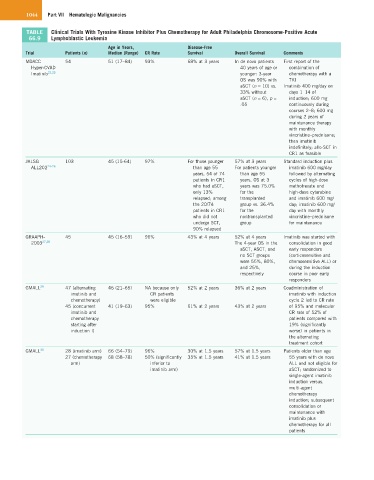
          TABLE   Clinical Trials With Tyrosine Kinase Inhibitor Plus Chemotherapy for Adult Philadelphia Chromosome-Positive Acute
          66.9    Lymphoblastic Leukemia
                                    Age in Years,             Disease-Free
         Trial        Patients (n)  Median (Range)  CR Rate   Survival        Overall Survival  Comments
         MDACC        54            51 (17–84)  93%           68% at 3 years  In de novo patients   First report of the
           Hyper-CVAD                                                           40 years of age or   combination of
           Imatinib  22,23                                                      younger: 3-year   chemotherapy with a
                                                                                OS was 90% with   TKI
                                                                                aSCT (n = 10) vs.   Imatinib 400 mg/day on
                                                                                33% without     days 1–14 of
                                                                                aSCT (n = 6), p =   induction; 600 mg
                                                                                .05             continuously during
                                                                                                courses 2–8; 600 mg
                                                                                                during 2 years of
                                                                                                maintenance therapy
                                                                                                with monthly
                                                                                                vincristine–prednisone;
                                                                                                then imatinib
                                                                                                indefinitely; allo-SCT in
                                                                                                CR1 as feasible
         JALSG        103           45 (15-64)  97%           For those younger   57% at 3 years  Standard induction plus
           ALL202 24–26                                         than age 55   For patients younger   imatinib 600 mg/day
                                                                years, 54 of 74   than age 55   followed by alternating
                                                                patients in CR1   years, OS at 3   cycles of high-dose
                                                                who had aSCT,   years was 75.0%   methotrexate and
                                                                only 13%        for the         high-dose cytarabine
                                                                relapsed; among   transplanted   and imatinib 600 mg/
                                                                the 20/74       group vs. 36.4%   day; imatinib 600 mg/
                                                                patients in CR1   for the       day with monthly
                                                                who did not     nontransplanted   vincristine–prednisone
                                                                undergo SCT,    group           for maintenance
                                                                90% relapsed
         GRAAPH-      45            45 (16–59)  96%           43% at 4 years  52% at 4 years  Imatinib was started with
           2003 27,28                                                         The 4-year OS in the   consolidation in good
                                                                                aSCT, ASCT, and   early responders
                                                                                no SCT groups   (corticosensitive and
                                                                                were 55%, 80%,   chemosensitive ALL) or
                                                                                and 25%,        during the induction
                                                                                respectively    course in poor early
                                                                                                responders
         GMALL 29     47 (alternating   46 (21–65)  NA because only   52% at 2 years  36% at 2 years  Coadministration of
                        imatinib and              CR patients                                   imatinib with induction
                        chemotherapy)             were eligible                                 cycle 2 led to CR rate
                      45 (concurrent   41 (19–63)  95%        61% at 2 years  43% at 2 years    of 95% and molecular
                        imatinib and                                                            CR rate of 52% of
                        chemotherapy                                                            patients compared with
                        starting after                                                          19% (significantly
                        induction I)                                                            worse) in patients in
                                                                                                the alternating
                                                                                                treatment cohort
         GMALL 30     28 (imatinib arm)  66 (54–79)  96%      30% at 1.5 years  57% at 1.5 years  Patients older than age
                      27 (chemotherapy   68 (58–78)  50% (significantly   35% at 1.5 years  41% at 1.5 years  55 years with de novo
                        arm)                      inferior to                                   ALL and not eligible for
                                                  imatinib arm)                                 aSCT; randomized to
                                                                                                single-agent imatinib
                                                                                                induction versus.
                                                                                                multi-agent
                                                                                                chemotherapy
                                                                                                induction; subsequent
                                                                                                consolidation or
                                                                                                maintenance with
                                                                                                imatinib plus
                                                                                                chemotherapy for all
                                                                                                patients

