


Page 1195 - Hematology_ Basic Principles and Practice ( PDFDrive )
P. 1195
Chapter 66  Acute Lymphoblastic Leukemia in Adults  1043


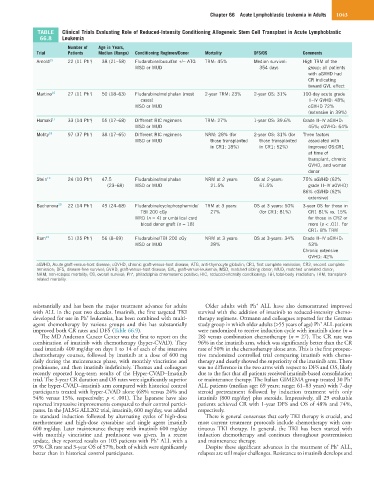
             TABLE   Clinical Trials Evaluating Role of Reduced-Intensity Conditioning Allogeneic Stem Cell Transplant in Acute Lymphoblastic
              66.8   Leukemia
                       Number of   Age in Years,
             Trial     Patients  Median (Range)  Conditioning Regimen/Donor  Mortality  DFS/OS      Comments
                              +
             Arnold 15  22 (11 Ph )  38 (21–58)  Fludarabine/busulfan +/− ATG  TRM: 45%  Median survival:   High TRM of the
                                             MSD or MUD                               354 days        group; all patients
                                                                                                      with aGVHD had
                                                                                                      CR indicating
                                                                                                      toward GVL effect
                              +
             Martino 16  27 (11 Ph )  50 (18–63)  Fludarabine/melphalan (most   2-year TRM: 23%  2-year OS: 31%  100-day acute grade
                                               cases)                                                 II–IV GVHD: 48%;
                                             MSD or MUD                                               cGVHD 72%
                                                                                                      (extensive in 39%)
                              +
             Hamaki 17  33 (14 Ph )  55 (17–68)  Different RIC regimens  TRM: 27%   1-year OS: 39.6%  Grade II–IV aGVHD:
                                             MSD or MUD                                               45%; cGVHD: 64%
                              +
             Mohty 18  97 (37 Ph )  38 (17–65)  Different RIC regimens  NRM: 28% (for   2-year OS: 31% (for   Three factors
                                             MSD or MUD               those transplanted   those transplanted   associated with
                                                                      in CR1: 18%)    in CR1: 52%)    improved OS:CR1
                                                                                                      at time of
                                                                                                      transplant, chronic
                                                                                                      GVHD, and woman
                                                                                                      donor
                              +
             Stein 19  24 (10 Ph )  47.5     Fludarabine/melphalan  NRM at 2 years:   OS at 2-years:   75% aGVHD (62%
                                    (23–68)  MSD or MUD               21.5%           61.5%           grade II–IV aGVHD)
                                                                                                    86% cGVHD (62%
                                                                                                      extensive)
                              +
             Bachanova 20  22 (14 Ph )  49 (24–68)  Fludarabine/cyclophosphamide/  TRM at 3 years:   OS at 3 years: 50%   3-year OS for those in
                                               TBI 200 cGy            27%             (for CR1: 81%)  CR1 81% vs. 15%
                                             MRD (n = 4) or umbilical cord                            for those in CR2 or
                                               blood donor graft (n = 18)                             more (p < .01). For
                                                                                                      CR1: 8% TRM
                              +
             Ram 21    51 (25 Ph )  56 (8–69)  Fludarabine/TBI 200 cGy  NRM at 3 years:   OS at 3-years: 34%  Grade II–IV aGVHD:
                                             MSD or MUD               28%                             53%
                                                                                                    Chronic extensive
                                                                                                      GVHD: 42%
             aGVHD, Acute graft-versus-host disease; cGVHD, chronic graft-versus-host disease; ATG, anti-thymocyte globulin; CR1, first complete remission; CR2, second complete
             remission; DFS, disease-free survival; GVHD, graft-versus-host disease; GVL, graft-versus-leukemia; MSD, matched sibling donor; MUD, matched unrelated donor;
                                            +
             NRM, non-relapse mortality; OS, overall survival; Ph , philadelphia chromosome positive; RIC, reduced-intensity conditioning; TBI, total-body irradiation; TRM, transplant-
             related mortality.


                                                                                     +
            substantially and has been the major treatment advance for adults   Older  adults  with  Ph   ALL  have  also  demonstrated  improved
            with ALL in the past two decades. Imatinib, the first targeted TKI   survival with the addition of imatinib to reduced-intensity chemo-
                             +
            developed for use in Ph  leukemias, has been combined with multi-  therapy regimens. Ottmann and colleagues reported for the German
                                                                                                          +
            agent  chemotherapy  by  various  groups  and  this  has  substantially   study group in which older adults (>55 years of age) Ph  ALL patients
            improved both CR rates and DFS (Table 66.9).          were randomized to receive induction cycle with imatinib alone (n =
              The MD Anderson Cancer Center was the first to report on the   28) versus combination chemotherapy (n = 27). The CR rate was
            combination of imatinib with chemotherapy (hyper-CVAD). They   96% in the imatinib arm, which was significantly better than the CR
            used imatinib 400 mg/day on days 1 to 14 of each of the intensive   rate of 50% in the chemotherapy alone arm. This is the first prospec-
            chemotherapy  courses,  followed  by  imatinib  at  a  dose  of  600 mg   tive  randomized  controlled  trial  comparing  imatinib  with  chemo-
            daily during the maintenance phase, with monthly vincristine and   therapy and clearly showed the superiority of the imatinib arm. There
            prednisone, and then imatinib indefinitely. Thomas and colleagues   was no difference in the two arms with respect to DFS and OS, likely
            recently  reported  long-term  results  of  the  Hyper-CVAD–Imatinib   due to the fact that all patients received imatinib-based consolidation
                                                                                                                    +
            trial. The 3-year CR duration and OS rates were significantly superior   or maintenance therapy. The Italian GIMEMA group treated 30 Ph
            in the hyper-CVAD–imatinib arm compared with historical control   ALL patients (median age: 69 years; range: 61–83 years) with 7-day
            participants treated with hyper-CVAD alone (68% versus 24% and   steroid  pretreatment  followed  by  induction  treatment  with  only
            54%  versus  15%,  respectively;  p  <  .001). The  Japanese  have  also   imatinib (800 mg/day) plus steroids. Impressively, all 29 evaluable
            reported impressive improvements compared to their control partici-  patients achieved CR with 1-year DFS and OS of 48% and 74%,
            pants. In the JALSG ALL202 trial, imatinib, 600 mg/day, was added   respectively.
            to  standard  induction  followed  by  alternating  cycles  of  high-dose   There is general consensus that early TKI therapy is crucial, and
            methotrexate  and  high-dose  cytarabine  and  single  agent  imatinib   most current treatment protocols include chemotherapy with con-
            600 mg/day. Later maintenance therapy with imatinib 600 mg/day   tinuous  TKI  therapy.  In  general,  the  TKI  has  been  started  with
            with  monthly  vincristine  and  prednisone  was  given.  In  a  recent   induction  chemotherapy  and  continues  throughout  postremission
                                                    +
            update, they reported results on 103 patients with Ph  ALL with a   and maintenance therapy.
                                                                                                               +
            97% CR rate and 3-year OS of 57%, both of which were significantly   Despite these significant advances in the treatment of Ph  ALL,
            better than in historical control participants.       relapses are still major challenges. Resistance to imatinib develops and

