


Page 1197 - Hematology_ Basic Principles and Practice ( PDFDrive )
P. 1197
Chapter 66  Acute Lymphoblastic Leukemia in Adults  1045


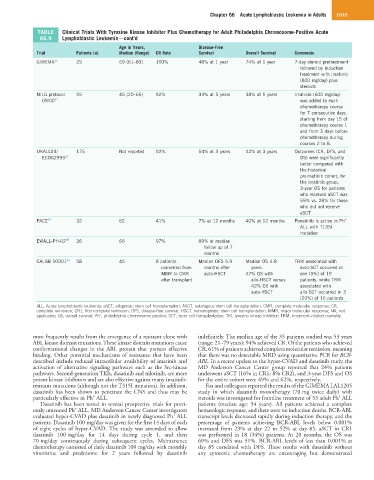
             TABLE   Clinical Trials With Tyrosine Kinase Inhibitor Plus Chemotherapy for Adult Philadelphia Chromosome-Positive Acute
              66.9   Lymphoblastic Leukemia—cont’d
                                        Age in Years,             Disease-Free
             Trial        Patients (n)  Median (Range)  CR Rate   Survival       Overall Survival  Comments
             GIMEMA 31    29            69 (61–83)  100%          48% at 1 year  74% at 1 year   7-day steroid pretreatment
                                                                                                   followed by induction
                                                                                                   treatment with imatinib
                                                                                                   (800 mg/day) plus
                                                                                                   steroids
             NILG protocol   59         45 (20–66)  92%           39% at 5 years  38% at 5 years  Imatinib (600 mg/day)
               09/00 32                                                                            was added to each
                                                                                                   chemotherapy course
                                                                                                   for 7 consecutive days,
                                                                                                   starting from day 15 of
                                                                                                   chemotherapy course 1
                                                                                                   and from 3 days before
                                                                                                   chemotherapy during
                                                                                                   courses 2 to 8.
             UKALLXII/    175           Not reported  92%         54% at 3 years  42% at 3 years  Outcomes (CR, DFS, and
               ECOG2993 33                                                                         OS) were significantly
                                                                                                   better compared with
                                                                                                   the historical
                                                                                                   preimatinib cohort; for
                                                                                                   the imatinib group,
                                                                                                   3-year OS for patients
                                                                                                   who received aSCT was
                                                                                                   59% vs. 28% for those
                                                                                                   who did not receive
                                                                                                   aSCT
                                                                                                                  +
             PACE 34      32            62          41%           7% at 12 months  40% at 12 months  Ponatinib is active in Ph
                                                                                                   ALL with T135I
                                                                                                   mutation
             EWALL-PH-02 35  36         66          97%           89% at median
                                                                    follow up of 7
                                                                    months
             CALGB 10001 36  58         45          8 patients    Median DFS 5.9   Median OS 4.8   TRM associated with
                                                      converted from   months after   years.       auto-SCT occurred in
                                                      MMR to CMR    auto-HSCT    47% OS with       one (5%) of 19
                                                      after transplant             allo-HSCT versus   patients, while TRM
                                                                                   42% OS with     associated with
                                                                                   auto-HSCT       allo-SCT occurred in 3
                                                                                                   (20%) of 15 patients
             ALL, Acute lymphoblastic leukemia; aSCT, allogeneic stem cell transplantation; ASCT, autologous stem cell transplantation; CMR, complete molecular response; CR,
             complete remission; CR1, first complete remission; DFS, disease-free survival; HSCT, hematopoietic stem cell transplantation; MMR, major molecular response; NA, not
                                  +
             applicable; OS, overall survival; Ph , philadelphia chromosome positive; SCT, stem cell transplantation; TKI, tyrosine kinase inhibitor; TRM, treatment–related mortality.

            most frequently results from the emergence of a resistant clone with   indefinitely. The median age of the 35 patients studied was 53 years
            ABL kinase domain mutations. These kinase domain mutations cause   (range: 21–79 years); 94% achieved CR. Of the patients who achieved
            conformational  changes  in  the  ABL  protein  that  prevent  effective   CR, 61% of patients achieved complete molecular remission, meaning
            binding.  Other  potential  mechanisms  of  resistance  that  have  been   that there was no detectable MRD using quantitative PCR for BCR-
            described include reduced intracellular availability of imatinib and   ABL. In a recent update to the hyper-CVAD and dasatinib study, the
            activation  of  alternative  signaling  pathways  such  as  the  Src-kinase   MD  Anderson  Cancer  Center  group  reported  that  24%  patients
            pathways. Second-generation TKIs, dasatinib and nilotinib, are more   underwent aSCT (16% in CR1; 8% CR2), and 3-year DFS and OS
            potent kinase inhibitors and are also effective against many imatinib-  for the entire cohort were 49% and 62%, respectively.
            resistant mutations (although not the T315I mutation). In addition,   Foa and colleagues reported the results of the GIMEMA LAL1205
            dasatinib has been shown to penetrate the CNS and thus may be   study  in  which  dasatinib  monotherapy  (70 mg  twice  daily)  with
                                                                                                                +
                               +
            particularly effective in Ph  ALL.                    steroids was investigated for frontline treatment of 53 adult Ph  ALL
              Dasatinib has been tested in several prospective trials for previ-  patients  (median  age:  54  years).  All  patients  achieved  a  complete
                         +
            ously untreated Ph  ALL. MD Anderson Cancer Center investigators   hematologic response, and there were no induction deaths. BCR-ABL
                                                          +
            evaluated hyper-CVAD plus dasatinib in newly diagnosed Ph  ALL   transcript levels decreased rapidly during induction therapy, and the
            patients. Dasatinib 100 mg/day was given for the first 14 days of each   percentage  of  patients  achieving  BCR-ABL  levels  below  0.001%
            of  eight  cycles  of  hyper-CVAD. The  study  was  amended  to  allow   increased  from  23%  at  day  22  to  52%  at  day  85.  aSCT  in  CR1
            dasatinib  100 mg/day  for  14  days  during  cycle  1,  and  then    was  performed  in  18  (34%)  patients.  At  20  months,  the  OS  was
            70 mg/day  continuously  during  subsequent  cycles.  Maintenance   69% and DFS was 51%. BCR-ABL levels of less than 0.001% at
            chemotherapy consisted of daily dasatinib 100 mg/day with monthly   day  85  correlated  with  DFS. These  results  with  dasatinib  without
            vincristine  and  prednisone  for  2  years  followed  by  dasatinib   any  cytotoxic  chemotherapy  are  encouraging  but  demonstrated

