


Page 1289 - Hematology_ Basic Principles and Practice ( PDFDrive )
P. 1289
Chapter 70  Primary Myelofibrosis  1135


               A                                                 B

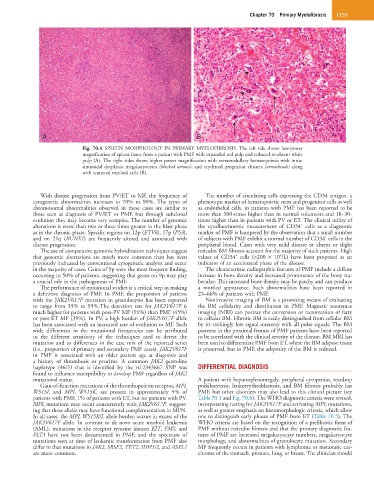
                            Fig.  70.4  SPLEEN MORPHOLOGY IN PRIMARY MYELOFIBROSIS. The left side shows low-power
                            magnification of spleen tissue from a patient with PMF with expanded red pulp and reduced-to-absent white
                            pulp (A). The right sides shows higher power magnification with extramedullary hematopoiesis with intra-
                            sinusoidal dysplastic megakaryocytes (blocked arrows), and erythroid progenitor clusters (arrowheads) along
                            with scattered myeloid cells (B).


              With disease progression from PV/ET to MF, the frequency of   The number of circulating cells expressing the CD34 antigen, a
            cytogenetic  abnormalities  increases  to  70%  to  90%. The  types  of   phenotypic marker of hematopoietic stem and progenitor cells as well
            chromosomal  abnormalities  observed  in  these  cases  are  similar  to   as endothelial cells, in patients with PMF has been reported to be
            those  seen  at  diagnosis  of  PV/ET  or  PMF,  but  through  subclonal   more than 300-times higher than in normal volunteers and 18–30-
            evolution they may become very complex. The number of genomic   times higher than in patients with PV or ET. The clinical utility of
                                                                                                   +
            alterations is more than two or three times greater in the blast phase   the  cytofluorimetric  measurement  of  CD34   cells  as  a  diagnostic
            as in the chronic phase. Specific regions on 12p (ETV6), 17p (P53),   marker of PMF is hampered by the observation that a small number
                                                                                                           +
            and  on  21q  (RUNX1)  are  frequently  altered  and  associated  with   of subjects with PMF exhibit a normal number of CD34  cells in the
            disease progression.                                  peripheral  blood.  Cases  with  very  mild  disease  or  absent  or  slight
              The use of comparative genomic hybridization techniques suggest   reticulin BM fibrosis account for the majority of such patients. High
                                                                              +
                                                                                             6
            that  genomic  aberrations  are  much  more  common  than  has  been   values  of  CD34   cells  (>200  ×  10 /L)  have  been  proposed  as  an
            previously indicated by conventional cytogenetic analysis and occur   indicator of an accelerated phase of the disease.
            in the majority of cases. Gains of 9p were the most frequent finding,   The characteristic radiographic features of PMF include a diffuse
            occurring in 50% of patients, suggesting that genes on 9p may play   increase in bone density and increased prominence of the bony tra-
            a crucial role in the pathogenesis of PMF.            beculae. This increased bone density may be patchy and can produce
              The performance of mutational studies is a critical step in making   a  mottled  appearance.  Such  abnormalities  have  been  reported  in
            a definitive diagnosis of PMF. In PMF, the proportion of patients   25–66% of patients with PMF.
            with  the  JAK2V617F  mutation  in  granulocytes  has  been  reported   Noninvasive imaging of BM is a promising means of evaluating
            to  range  from  35%  to  95%.The  detection  rate  for  JAK2V617F  is   the  BM  cellularity  and  distribution  in  PMF.  Magnetic  resonance
            much higher for patients with post-PV MF (91%) than PMF (45%)   imaging (MRI) can portray the conversion or reconversion of fatty
            or post-ET MF (39%). In PV, a high burden of JAK2V617F allele   to cellular BM. Fibrotic BM is easily distinguished from cellular BM
            has been associated with an increased rate of evolution to MF. Such   by its strikingly low signal intensity with all pulse signals. The BM
            wide  differences  in  the  mutational  frequencies  can  be  attributed   patterns in the proximal femurs of PMF patients have been reported
            to  the  different  sensitivity  of  the  techniques  used  to  detect  the   to be correlated with the clinical severity of the disease. BM MRI has
            mutation and to differences in the case mix of the reported series   been used to differentiate PMF from ET, where the BM adipose tissue
            (i.e., proportion of primary and secondary PMF cases). JAK2V617F   is preserved, but in PMF, the adiposity of the BM is reduced.
            in  PMF  is  associated  with  an  older  patient  age  at  diagnosis  and
            a  history  of  thrombosis  or  pruritus.  A  common  JAK2  germ-line
            haplotype  (46/1)  that  is  identified  by  the  rs12343867  SNP  was   DIFFERENTIAL DIAGNOSIS
            found to influence susceptibility to develop PMF regardless of JAK2
            mutational status.                                    A patient with hepatosplenomegaly, peripheral cytopenias, teardrop
              Gain-of-function mutations of the thrombopoietin receptor, MPL   poikilocytosis, leukoerythroblastosis, and BM fibrosis probably has
            W515L  and  MPL  W515K,  are  present  in  approximately  5%  of   PMF, but other disorders may also lead to this clinical picture (see
            patients with PMF, 1% of patients with ET, but no patients with PV.   Table 70.1 and Fig. 70.6). The WHO diagnostic criteria were revised,
            MPL mutations may occur concurrently with JAK2V617F, suggest-  incorporating testing for JAK2V617F and activating MPL mutations,
            ing that these alleles may have functional complementation in MPN.   as well as greater emphasis on histomorphologic criteria, which allow
            In all cases, the MPL W515K/L allele burden occurs in excess of the   one to distinguish early phases of PMF from ET (Table 70.5). The
            JAK2V617F allele. In contrast to de novo acute myeloid leukemia   WHO criteria are based on the recognition of a prefibrotic form of
            (AML), mutations in the receptor tyrosine kinases KIT, FMS, and   PMF without reticulin fibrosis and that the primary diagnostic fea-
            FLT3  have  not  been  documented  in  PMF,  and  the  spectrum  of   tures of PMF are increased megakaryocyte numbers, megakaryocyte
            mutations seen at time of leukemic transformation from PMF also   morphology, and abnormalities of granulocyte mutation. Secondary
            differ in that mutations in JAK2, SRSF2, TET2, IDH1/2, and ASXL1   MF frequently occurs in patients with lymphoma or metastatic car-
            are more common.                                      cinoma of the stomach, prostate, lung, or breast. The clinician should

