


Page 1288 - Hematology_ Basic Principles and Practice ( PDFDrive )
P. 1288
1134   Part VII  Hematologic Malignancies


           A                                                  B

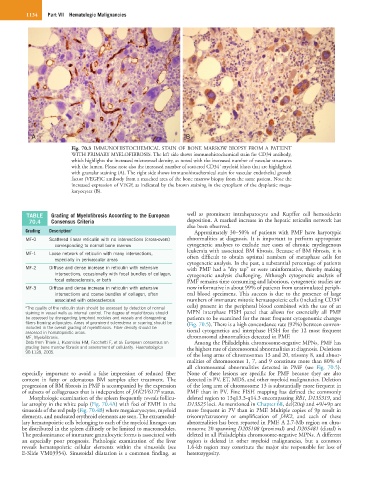
                        Fig. 70.3  IMMUNOHISTOCHEMICAL STAIN OF BONE MARROW BIOPSY FROM A PATIENT
                        WITH PRIMARY MYELOFIBROSIS. The left side shows immunohistochemical stain for CD34 antibody,
                        which highlights the increased microvessel density, as noted with the increased number of vascular structures
                                                                         +
                        with the lumen. Please note also the increased number of scattered CD34  myeloid blasts that are highlighted
                        with granular staining (A). The right side shows immunohistochemical stain for vascular endothelial growth
                        factor (VEGF)C antibody from a matched area of the bone marrow biopsy from the same patient. Note the
                        increased expression of VEGF, as indicated by the brown staining in the cytoplasm of the dysplastic mega-
                        karyocytes (B).


          TABLE   Grading of Myelofibrosis According to the European   well  as  prominent  intrahepatocyte  and  Kupffer  cell  hemosiderin
          70.4    Consensus Criteria                          deposition. A marked increase in the hepatic reticulin network has
                                                              also been observed.
         Grading  Description a                                  Approximately  30–50%  of  patients  with  PMF  have  karyotypic
         MF-0    Scattered linear reticulin with no intersections (cross-overs)   abnormalities  at  diagnosis.  It  is  important  to  perform  appropriate
                   corresponding to normal bone marrow        cytogenetic  analyses  to  exclude  rare  cases  of  chronic  myelogenous
                                                              leukemia with associated BM fibrosis. Because of BM fibrosis, it is
         MF-1    Loose network of reticulin with many intersections,   often  difficult  to  obtain  optimal  numbers  of  metaphase  cells  for
                   especially in perivascular areas
                                                              cytogenetic analysis. In the past, a substantial percentage of patients
         MF-2    Diffuse and dense increase in reticulin with extensive   with PMF had a “dry tap” or were uninformative, thereby making
                   intersections, occasionally with focal bundles of collagen,   cytogenetic  analysis  challenging.  Although  cytogenetic  analysis  of
                   focal osteosclerosis, or both              PMF remains time consuming and laborious, cytogenetic studies are
         MF-3    Diffuse and dense increase in reticulin with extensive   now informative in about 99% of patients from unstimulated periph-
                   intersections and coarse bundles of collagen, often   eral  blood  specimens. This  success  is  due  to  the  presence  of  large
                                                                                                                +
                   associated with osteosclerosis             numbers of immature mitotic hematopoietic cells (including CD34
         a The quality of the reticulin stain should be assessed by detection of normal   cells) present in the peripheral blood combined with the use of an
         staining in vessel walls as internal control. The degree of myelofibrosis should   MPN  interphase  FISH  panel  that  allows  for  essentially  all  PMF
         be assessed by disregarding lymphoid nodules and vessels and disregarding   patients to be examined for the most frequent cytogenomic changes
         fibers framing adipocytes. Areas of prominent scleredema or scarring should be   (Fig. 70.5). There is a high concordance rate (92%) between conven-
         included in the overall grading of myelofibrosis. Fiber density should be   tional cytogenetics and interphase FISH for the 12 most frequent
         assessed in hematopoietic areas.
         MF, Myelofibrosis.                                   chromosomal abnormalities detected in PMF.
         Data from Thiele J, Kvasnicka HM, Facchetti F, et al: European consensus on   Among the Philadelphia chromosome-negative MPNs, PMF has
         grading bone marrow fibrosis and assessment of cellularity. Haematologica   the highest rate of chromosomal abnormalities at diagnosis. Deletions
         90:1128, 2005.
                                                              of the long arms of chromosomes 13 and 20, trisomy 8, and abnor-
                                                              malities of chromosomes 1, 7, and 9 constitute more than 80% of
                                                              all  chromosomal  abnormalities  detected  in  PMF  (see  Fig.  70.5).
        especially  important  to  avoid  a  false  impression  of  reduced  fiber   None  of  these  lesions  are  specific  for  PMF  because  they  are  also
        content  in  fatty  or  edematous  BM  samples  after  treatment.  The   detected in PV, ET, MDS, and other myeloid malignancies. Deletion
        progression of BM fibrosis in PMF is accompanied by the expression   of the long arm of chromosome 13 is substantially more frequent in
        of subsets of collagenases that is independent of JAK2V617F status.  PMF than in PV. Fine FISH mapping has defined the commonly
           Morphologic examination of the spleen frequently reveals follicu-  deleted region to 13q13.3-q14.3 encompassing RB1, D13S319, and
        lar atrophy in the white pulp (Fig. 70.4A) with foci of EMH in the   D13S25 loci. As mentioned in Chapter 68, del(20q) and +9/+9p are
        sinusoids of the red pulp (Fig. 70.4B) where megakaryocytes, myeloid   more frequent in PV than in PMF. Multiple copies of 9p result in
        elements, and nucleated erythroid elements are seen. The extramedul-  trisomy/tetrasomy  or  amplification  of  JAK2,  and  each  of  these
        lary hematopoietic cells belonging to each of the myeloid lineages can   abnormalities has been reported in PMF. A 2.7-Mb region on chro-
        be distributed in the spleen diffusely or be limited to macronodules.   mosome 20 spanning D20S108 (proximal) and D20S481 (distal) is
        The predominance of immature granulocytic forms is associated with   deleted in all Philadelphia chromosome-negative MPNs. A different
        an  especially  poor  prognosis.  Pathologic  examination  of  the  liver   region  is  deleted  in  other  myeloid  malignancies,  but  a  common
        reveals  hematopoietic  cellular  elements  within  the  sinusoids  (see   1.6-kb region may constitute the major site responsible for loss of
        E-Slide VM03954). Sinusoidal dilatation is a common finding, as   heterozygosity.

