


Page 1290 - Hematology_ Basic Principles and Practice ( PDFDrive )
P. 1290
1136   Part VII  Hematologic Malignancies


                                     Chromosomal Findings Associated With a Favorable Prognosis
                        der(6)t(1;6)      +9          del(13)    del(20)         Normal karyotype
                                                     (q12q14.2)  (q11q13)


                                    Chromosomal Findings Associated With an Unfavorable Prognosis
                          dup(1q)           der(9)t(1;9)  inv(3)  del(5q)  del(7q)  +8
                                                        (q21q6)


                      Abnormal    del(12)        inv(12)       i(17)(q10)     Monosomal and complex
                     11q23/MLL   (p11p13)       (p13q21)                           karyotype


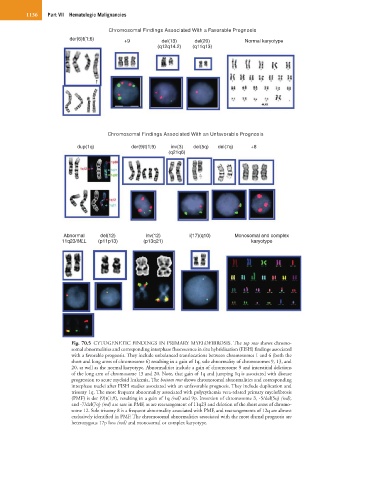
                        Fig. 70.5  CYTOGENETIC FINDINGS IN PRIMARY MYELOFIBROSIS. The top row shows chromo-
                        somal abnormalities and corresponding interphase fluorescence in situ hybridization (FISH) findings associated
                        with a favorable prognosis. They include unbalanced translocations between chromosomes 1 and 6 (both the
                        short and long arms of chromosome 6) resulting in a gain of 1q, sole abnormality of chromosomes 9, 13, and
                        20, as well as the normal karyotype. Abnormalities include a gain of chromosome 9 and interstitial deletions
                        of the long arm of chromosome 13 and 20. Note, that gain of 1q and jumping 1q is associated with disease
                        progression to acute myeloid leukemia. The bottom row shows chromosomal abnormalities and corresponding
                        interphase nuclei after FISH studies associated with an unfavorable prognosis. They include duplication and
                        trisomy 1q. The most frequent abnormality associated with polycythemia vera-related primary myelofibrosis
                        (PMF) is der (9)t(1;9), resulting in a gain of 1q (red) and 9p. Inversion of chromosome 3, -5/del(5q) (red),
                        and -7/del(7q) (red) are rare in PMF, as are rearrangement of 11q23 and deletion of the short arms of chromo-
                        some 12. Sole trisomy 8 is a frequent abnormality associated with PMF, and rearrangements of 12q are almost
                        exclusively identified in PMF. The chromosomal abnormalities associated with the most dismal prognosis are
                        heterozygous 17p loss (red) and monosomal or complex karyotype.

