


Page 1291 - Hematology_ Basic Principles and Practice ( PDFDrive )
P. 1291
Chapter 70  Primary Myelofibrosis  1137


                                                                          C


                      A                          B                       D              E


                      F                    G                         H                     I
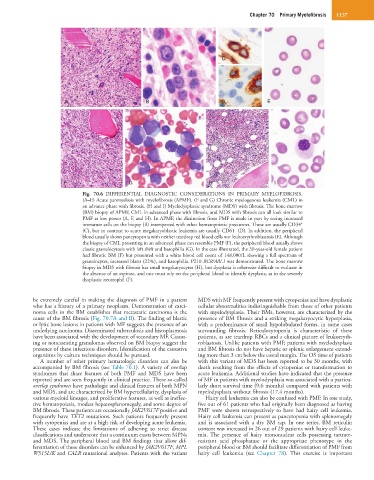
                            Fig.  70.6  DIFFERENTIAL  DIAGNOSTIC  CONSIDERATIONS  IN  PRIMARY  MYELOFIBROSIS.
                            (A–E) Acute panmyelosis with myelofibrosis (APMF). (F and G) Chronic myelogenous leukemia (CML) in
                            an advance phase with fibrosis. (H and I) Myelodysplastic syndrome (MDS) with fibrosis. The bone marrow
                            (BM) biopsy of APMF, CML in advanced phase with fibrosis, and MDS with fibrosis can all look similar to
                            PMF at low power (A, F, and H). In APMF, the distinction from PMF is made in part by seeing increased
                                                                                                   +
                            immature cells on the biopsy (B) interspersed with other hematopoietic precursors. These are usually CD34
                                                                              –
                            (C), but in contrast to acute megakaryoblastic leukemia are usually CD61  (D). In addition, the peripheral
                            blood usually shows pancytopenia with neither teardrop red blood cells nor leukoerythroblastosis (E). Although
                            the biopsy of CML presenting in an advanced phase can resemble PMF (F), the peripheral blood usually shows
                            classic granulocytosis with left shift and basophilia (G). In the case illustrated, the 30-year-old female patient
                            had fibrotic BM (F) but presented with a white blood cell count of 148,000/L showing a full spectrum of
                            granulocytes, increased blasts (22%), and basophilia. P210 BCR/ABL1 was demonstrated. The bone marrow
                            biopsy in MDS with fibrosis has small megakaryocytes (H), but dysplasia is otherwise difficult to evaluate in
                            the absence of an aspirate, and one must rely on the peripheral blood to identify dysplasia, as in the severely
                            dysplastic neutrophil (F).


            be extremely careful in making the diagnosis of PMF in a patient   MDS with MF frequently present with cytopenias and have dysplastic
            who has a history of a primary neoplasm. Demonstration of carci-  cellular abnormalities indistinguishable from those of other patients
            noma cells in the BM establishes that metastatic carcinoma is the   with myelodysplasia. Their BMs, however, are characterized by the
            cause of the BM fibrosis (Fig. 70.7A and B). The finding of blastic   presence of BM fibrosis and a striking megakaryocytic hyperplasia,
            or lytic bone lesions in patients with MF suggests the presence of an   with a predominance of small hypolobulated forms, in some cases
            underlying carcinoma. Disseminated tuberculosis and histoplasmosis   surrounding  fibrosis.  Reticulocytopenia  is  characteristic  of  these
            have been associated with the development of secondary MF. Caseat-  patients, as are teardrop RBCs and a clinical picture of leukoeryth-
            ing or noncaseating granulomas observed on BM biopsy suggest the   roblastosis. Unlike patients with PMF, patients with myelodysplasia
            presence of these infectious disorders. Identification of the causative   and BM fibrosis do not have hepatic or splenic enlargement extend-
            organisms by culture techniques should be pursued.    ing more than 3 cm below the costal margin. The OS time of patients
              A  number  of  other  primary  hematologic  disorders  can  also  be   with this variant of MDS has been reported to be 30 months, with
            accompanied by BM fibrosis (see Table 70.1). A variety of overlap   death resulting from the effects of cytopenias or transformation to
            syndromes  that  share  features  of  both  PMF  and  MDS  have  been   acute leukemia. Additional studies have indicated that the presence
            reported and are seen frequently in clinical practice. These so-called   of MF in patients with myelodysplasia was associated with a particu-
            overlap syndromes have pathologic and clinical features of both MPN   larly short survival time (9.6 months) compared with patients with
            and MDS, and are characterized by BM hypercellularity, dysplasia of   myelodysplasia without fibrosis (17.4 months).
            various myeloid lineages, and proliferative features, as well as ineffec-  Hairy cell leukemia can also be confused with PMF. In one study,
            tive hematopoiesis, modest hepatosplenomegaly, and some degree of   five out of 61 patients who had originally been diagnosed as having
            BM fibrosis. These patients are occasionally JAK2V617F positive and   PMF  were  shown  retrospectively  to  have  had  hairy  cell  leukemia.
            frequently have TET2 mutations. Such patients frequently present   Hairy cell leukemia can present as pancytopenia with splenomegaly
            with cytopenias and are at a high risk of developing acute leukemia.   and  is  associated  with  a  dry  BM  tap.  In  one  series,  BM  reticulin
            These  cases  indicate  the  limitations  of  adhering  to  strict  disease   content was increased in 26 out of 29 patients with hairy cell leuke-
            classifications and underscore that a continuum exists between MPNs   mia.  The  presence  of  hairy  mononuclear  cells  possessing  tartrate-
            and  MDS. The  peripheral  blood  and  BM  findings  that  allow  dif-  resistant  acid  phosphatase  or  the  appropriate  phenotype  in  the
            ferentiation of these disorders can be enhanced by JAK2V617F, MPL   peripheral blood or BM should facilitate differentiation of PMF from
            W515L/K and CALR mutational analyses. Patients with the variant   hairy  cell  leukemia  (see  Chapter  78).  This  exercise  is  important

