


Page 1333 - Hematology_ Basic Principles and Practice ( PDFDrive )
P. 1333
Chapter 72  Mast Cells and Mastocytosis  1179


            myeloid  neoplasm,  including  evaluation  of  MC  content.  Other
            causes  of  effusion  should  be  excluded  including  infection,  heart   1
            failure,  and  drugs  such  as  dasatinib  that  have  been  used  to  treat
            advanced SM.                                                             2
                                                                                            Del417-418-419insNA ±
                                                                                     3      Del417-418-419insI ±
            Hematologic Organ Involvement                                  Ig 1             Del417-418-419insY ±
                                                                                     4      Del419 ±
            The etiology of cytopenias in advanced SM includes compromise of   Ig 2         InsFF419 ±
            normal  marrow  reserve  by  infiltration  with  neoplastic  MCs  (often   5    C443Y ±
            seen in ASM and MCL), ineffective hematopoiesis in the context of               S451C ±
            SM with an associated myeloid neoplasm, hypersplenism, and other         6      S476I ±
            causes  such  as  recent  myelosuppressive  therapy  or  gastrointestinal   Ig 3  ITD501-502 +
            bleeding. The coexistence of another myeloid neoplasm (AHN) often        7
            makes  it  difficult  to  ascertain  the  specific  cause  of  the  low  blood   ITD502-503 +
            counts. This distinction is not relevant to ISM, where the relatively   Ig 4  8  ITD504 ±
            lower MC burden is not expected to contribute to the development                ITD505-508 ±
            of cytopenias.                                                           9      K509I ±
                                                                           Ig 5             F522C ±
            Molecular Features of SM                                                 10     A533D ±
                                                                            TM       11     K550N ±
            Following the discovery of the somatic KIT D816V mutation in MC                 V559I ±
                                   20
            neoplasms  in  the  mid-1990s,   it  has  become  evident  that  this   JM  12  V560IG ±
            molecular abnormality is found in approximately 80% to 90% of SM                Del564-576 ±
            patients. KIT D816V serves as a minor diagnostic criterion for the              D572A ±
            disease, and is considered a major driver of SM pathogenesis. Rare       13     R634W ±
            codon 816 variants such as D816F/H/I/Y have also been described                 L799F ±
            and  are  considered  functionally  equivalent  to  D816V.  Mutations   TK1  14  InsVI815-816 ±
            affecting codon 816 are located in exon 17 and affect the second TK                   ∗
            domain (TK2) that contains the phosphotransferase site and activa-       15     D816Y ±
            tion loop of KIT. Other mutations that have been identified in exon             D816F ±
            17, for example in cases of ASM and MC sarcoma, include D820G            16     D816I ± ∗
            and N822K. KIT mutations in exons 8–9 of the extracellular region               D816V +++
            (del419, S451C, ITD 502–503) and the TM region (exon 10; e.g.,           17     D816H ±
            F522C), and JM domain (exon 11; e.g., V560G/I) comprise some    TK2             I817V ±
            of the additional rare mutations in KIT that have been observed (Fig.    18     V819Y ±
                21
            72.6).   With  a  few  exceptions  (e.g.,  V559I),  mutations  affecting        D820G ±
            these  domains  are  more  likely  to  exhibit  sensitivity  to  imatinib,   19
            whereas codon 816 variants are imatinib resistant. Contrary to other            N822I/K ±
            SM subtypes, MCL less frequently exhibits the KIT D816V muta-            20     E839K ±
            tion; in a review of MCL, D816V was found in 13 of 28 (46%)                     S840N ±
            evaluable patients. MCL patients may exhibit other variants within       21     S849I ±
            KIT, or sequencing of the entire KIT gene may reveal no mutations.
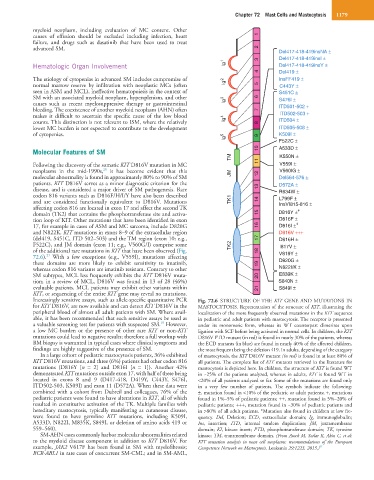
            Increasingly sensitive assays, such as allele-specific quantitative PCR   Fig. 72.6  STRUCTURE OF THE KIT GENE AND MUTATIONS IN
            for KIT D816V, are now available and can detect KIT D816V in the   MASTOCYTOSIS. Representation of the structure of KIT, illustrating the
            peripheral blood of almost all adult patients with SM. Where avail-  localization of the more frequently observed mutations in the KIT sequence
            able, it has been recommended that such sensitive assays be used as   in pediatric and adult patients with mastocytosis. The receptor is presented
                                                      19
            a valuable screening test for patients with suspected SM.  However,   under  its  monomeric  form,  whereas  its  WT  counterpart  dimerizes  upon
            a  low  MC  burden  or  the  presence  of  other  rare  KIT  or  non-KIT   ligation with SCF before being activated in normal cells. In children, the KIT
            mutations could lead to negative results; therefore a full workup with   D816V PTD mutant (in red) is found in nearly 30% of the patients, whereas
            BM biopsy is warranted in typical cases where clinical symptoms and   the ECD mutants (in blue) are found in nearly 40% of the affected children,
            findings are highly suggestive of the presence of SM.  the most frequent being the deletion 419. In adults, depending of the category
              In a large cohort of pediatric mastocytosis patients, 36% exhibited   of mastocytosis, the KIT D816V mutant (in red) is found in at least 80% of
            KIT D816V mutations, and three (6%) patients had other codon 816   all patients. The complete list of KIT mutants retrieved in the literature for
            mutations  (D816Y  [n  =  2]  and  D816I  [n  =  1]).  Another  42%   mastocytosis is depicted here. In children, the structure of KIT is found WT
            demonstrated KIT mutations outside exon 17, with half of these being   in ~25% of the patients analyzed, whereas in adults, KIT is found WT in
            located  in  exons  8  and  9  (D417-418,  D419Y,  C443Y,  S476I,   <20% of all patients analyzed so far. Some of the mutations are found only
            ITD502-503, K509I) and exon 11 (D572A). When these data were   in  a  very  few  number  of  patients.  The  symbols  indicate  the  following:
            combined with a cohort from Dubreil and colleagues, 76% of the   ±, mutation found in <10% of the pediatric or adult patients; +, mutations
            pediatric patients were found to have alterations in KIT, all of which   found in 1%–5% of pediatric patients; ++, mutation found in 5%–20% of
            resulted in constitutive activation of the TK. Multiple families with   pediatric patients; +++, mutation found in ~30% of pediatric patients and
            hereditary mastocytosis, typically manifesting as cutaneous disease,   in >80% of all adult patients. *Mutation also found in children at low fre-
            were  found  to  have  germline  KIT  mutations,  including  K509I,   quency.  Del,  Deletion;  ECD,  extracellular  domain;  Ig,  immunoglobulin;
            A533D, N822I, M835K, S849I, or deletion of amino acids 419 or   Ins,  insertion;  ITD,  internal  tandem  duplication;  JM,  juxtamembrane
            559–560).                                             domain; KI, kinase insert; PTD, phosphotransferase domain; TK, tyrosine
              SM-AHN cases commonly harbor molecular abnormalities related   kinase; TM, transmembrane domain. (From Arock M, Sotlar K, Akin C, et al:
            to the myeloid disease component in addition to KIT D816V. For   KIT  mutation  analysis  in  mast  cell  neoplasms:  recommendations  of  the  European
            example,  JAK2 V617F  has  been  found  in  SM  with  myelofibrosis;   Competence Network on Mastocytosis. Leukemia 29:1223, 2015.) 21
            BCR-ABL1 in rare cases of concurrent SM-CML; and in SM-AML,

