


Page 1335 - Hematology_ Basic Principles and Practice ( PDFDrive )
P. 1335
Chapter 72  Mast Cells and Mastocytosis  1181


            diagnose MCAS, and to document (other) primary and secondary   or  progressively  increasing,  or  organomegaly  and/or  blood  count
            causes of MC expansion or MC activation.              abnormalities emerge.
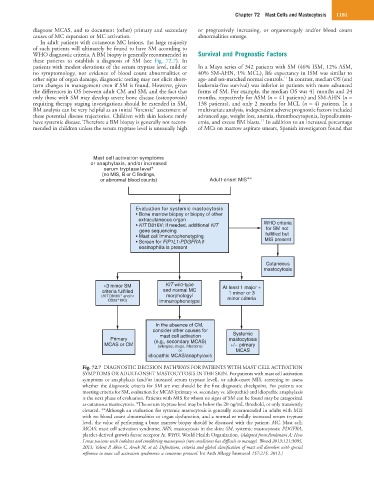
              In adult patients with cutaneous MC lesions, the large majority
            of such patients will ultimately be found to have SM according to
            WHO diagnostic criteria. A BM biopsy is generally recommended in   Survival and Prognostic Factors
            these  patients  to  establish  a  diagnosis  of  SM  (see  Fig.  72.7).  In
            patients with modest elevations of the serum tryptase level, mild or   In a Mayo series of 342 patients with SM (46% ISM, 12% ASM,
            no  symptomology,  nor  evidence  of  blood  count  abnormalities  or   40% SM-AHN, 1% MCL), life expectancy in ISM was similar to
                                                                                              11
            other signs of organ damage, diagnostic testing may not elicit short-  age- and sex-matched normal controls.  In contrast, median OS (and
            term changes in management even if SM is found. However, given   leukemia-free survival) was inferior in patients with more advanced
            the differences in OS between adult CM and SM, and the fact that   forms of SM. For example, the median OS was 41 months and 24
            only those with SM may develop severe bone disease (osteoporosis)   months, respectively for ASM (n = 41 patients) and SM-AHN (n =
            requiring therapy staging investigations should be extended in SM,   138 patients), and only 2 months for MCL (n = 4) patients. In a
            BM analysis can be very helpful as an initial “forensic” assessment of   multivariate analysis, independent adverse prognostic factors included
            these potential disease trajectories. Children with skin lesions rarely   advanced age, weight loss, anemia, thrombocytopenia, hypoalbumin-
                                                                                      11
            have systemic disease. Therefore a BM biopsy is generally not recom-  emia, and excess BM blasts.  In addition to an increased percentage
            mended in children unless the serum tryptase level is unusually high   of MCs on marrow aspirate smears, Spanish investigators found that


                                Mast cell activation symptoms
                               or anaphylaxis, and/or increased
                                   serum tryptase level ∗
                                  (no MIS, B or C findings,
                                  or abnormal blood counts)           Adult-onset MIS ∗∗


                                             Evaluation for systemic mastocytosis
                                             • Bone marrow biopsy or biopsy of other
                                               extracutaneous organ
                                             • KIT D816V; if needed, additional KIT    WHO criteria
                                               gene sequencing                          for SM not
                                             • Mast cell lmmunophenotyping              fulfilled but
                                             • Screen for FIP1L1-PDGFRA if              MIS present
                                              eosinophilia is present

                                                                                        Cutaneous
                                                                                       mastocytosis


                                   <3 minor SM         KIT wild-type      At least 1 major +
                                  criteria fulfilled  and normal MC         1 minor or 3
                                  (KIT D816V +  and/or  morphology/
                                    CD25 +  MC)      immunophenotype       minor criteria


                                                    In the absence of CM,
                                                   consider other causes for
                                                     mast cell activation    Systemic
                                     Primary       (e.g., secondary MCAS)   mastocytosis
                                   MCAS or CM        (allergies, drugs, infections)  +/− primary
                                                           or                 MCAS
                                                  idiopathic MCAS/anaphylaxis
                            Fig. 72.7  DIAGNOSTIC DECISION PATHWAYS FOR PATIENTS WITH MAST CELL ACTIVATION
                            SYMPTOMS OR ADULT-ONSET MASTOCYTOSIS IN THE SKIN. For patients with mast cell activation
                            symptoms  or  anaphylaxis  (and/or  increased  serum  tryptase  level),  or  adult-onset  MIS,  screening  to  assess
                            whether the diagnostic criteria for SM are met should be the first diagnostic checkpoint. For patients not
                            meeting criteria for SM, evaluation for MCAS (primary vs. secondary vs. idiopathic) and idiopathic anaphylaxis
                            is the next phase of evaluation. Patients with MIS for whom no signs of SM can be found may be categorized
                            as cutaneous mastocytosis. *The serum tryptase level may be below the 20 ng/mL threshold, or only transiently
                            elevated. **Although an evaluation for systemic mastocytosis is generally recommended in adults with MIS
                            with no blood count abnormalities or organ dysfunction, and a normal or mildly increased serum tryptase
                            level, the value of performing a bone marrow biopsy should be discussed with the patient. MC, Mast cell;
                            MCAS, mast cell activation syndrome; MIS, mastocytosis in the skin; SM, systemic mastocytosis; PDGFRA,
                            platelet-derived growth factor receptor A; WHO, World Health Organization. (Adapted from:Pardanani A: How
                            I treat patients with indolent and smoldering mastocytosis (rare conditions but difficult to manage). Blood 2013;121:3085,
                            2013; Valent P, Akin C, Arock M, et al: Definitions, criteria and global classification of mast cell disorders with special
                            reference to mast cell activation syndromes: a consensus protocol. Int Arch Allergy Immunol 157:215, 2012.)

