


Page 1334 - Hematology_ Basic Principles and Practice ( PDFDrive )
P. 1334
1180   Part VII  Hematologic Malignancies


        the  t(8;21)(q22;q22)  RUNX1/RUNX1T  rearrangement  is  a  well-  Clinicopathologic Features of Eosinophilia-Associated
        known  association.  In  cases  of  KIT  D816V-positive  SM,  several   TABLE   FIP1L1-PDGFRA–Rearranged Myeloid Neoplasms
        reports  have  now  detailed  the  coexistence  of  additional  myeloid   72.9  Versus KIT D816V-Positive Systemic Mastocytosis
        neoplasm-related mutations, which are implicated in differentiation,
        epigenetic regulation, and control of the spliceosome machinery. The   FIP1L1-PDGFRA–
        common themes that have emerged are: (1) ISM tends to be more a   Features  Rearranged  KIT D816V–Positive
        pure KIT D816V-driven disease with absence of, or low frequency of   Gender  Overwhelmingly male  Less gender skewing
        additional (known) molecular abnormalities; (2) TET2, SRSF2, and
        ASXL1  are  the  most  common  of  the  myeloid  neoplasm-associated   Bone marrow mast   Loose clusters/  Dense aggregates
        mutated genes (~20%–35% of patients), but mutations in DNMT3A,   cell aggregates  interstitial
        CBL, K/NRAS, UA2F1, ZRSF2 EZH2, RUNX1, ETV6, and SETBP1   AEC/tryptase ratio  >100    ≤100
        have also been identified; and (3) the presence of one or more of these   Treatment  Imatinib sensitive  Imatinib-resistant;
        genes mutations are usually associated with more advanced disease                       second-generation TKIs
        subtypes, particularly SM-AHN. Schwaab et al found that the pres-                       (e.g., midostaurin)
        ence of one or more of these mutations in addition to KIT D816V
                                   22
        was associated with inferior survival,  and a separate analysis found   Symptom profile  Cardiac/pulmonary  Gastrointestinal/urticaria
        that  mutation  of  ASXL1  had  a  significant  negative  impact  on  OS                pigmentosa/anaphylaxis
        among  a  cohort  of  62  patients  with  SM-AHN.  Mutations  in  the   Vitamin B 12  level  Elevated  Often normal
        ethanolamine kinase gene ETNK1 were recently found to be enriched   AEC, Absolute eosinophil count; TKI, tyrosine kinase inhibitor.
        in SM patients with eosinophilia, but are commonly present with   Modified from Maric I, Robyn J, Metcalfe DD, et al:  KIT D816V-associated
        KIT  D816V  or  other  myeloid  disease-associated  mutations  (Dr.   systemic mastocytosis with eosinophilia and FIP1L1/PDGFRA-associated
        Andreas  Reiter,  personal  communication).  Mutations  in  ETNK1   chronic eosinophilic leukemia are distinct entities. J Allergy Clin Immunol
                                                               120(3):680-687, 2007.
        were also identified in ~9% of patients with atypical CML and in
        <5% of patients with CMML. The basis for the restriction of ETNK1
        mutations to these diseases and how they contribute to their patho-
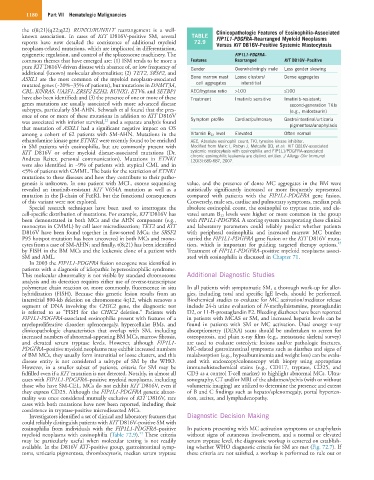
        genesis is unknown. In one patient with MCL, exome sequencing   value,  and  the  presence  of  dense  MC  aggregates  in  the  BM  were
        revealed  an  imatinib-resistant  KIT  V654A  mutation  as  well  as  a   statistically  significantly  increased  or  more  frequently  represented
        mutation in the β-chain of FcεRI, but the functional consequences   compared  with  patients  with  the  FIP1L1-PDGFRA  gene  fusion.
        of this variant were not explored.                    Conversely, male sex, cardiac and pulmonary symptoms, median peak
           Special  research  techniques  have  been  used  to  interrogate  the   absolute eosinophil count, the eosinophil to tryptase ratio, and ele-
        cell-specific distribution of mutations. For example, KIT D816V has   vated serum B 12  levels were higher or more common in the group
        been  demonstrated  in  both  MCs  and  the  AHN  component  (e.g.,   with FIP1L1-PDGFRA. A scoring system incorporating these clinical
        monocytes in CMML) by cell laser microdissection; TET2 and KIT   and  laboratory  parameters  could  reliably  predict  whether  patients
        D816V have been found together in flow-sorted MCs; the SRSF2   with  peripheral  eosinophilia  and  increased  marrow  MC  burden
        P95 hotspot mutation has been uncovered in both MCs and mono-  carried the FIP1L1-PDGFRA gene fusion or the KIT D816V muta-
                                                                                                               23
        cytes from a case of SM-AHN; and finally, t(8;21) has been identified   tion,  which  is  important  for  guiding  targeted  therapy  options.
        by FISH in the BM MCs and the leukemic clone of a patient with   Treatment of FIP1L1-PDGFRA–positive myeloid neoplasms associ-
        SM and AML.                                           ated with eosinophilia is discussed in Chapter 71.
           In 2003 the FIP1L1-PDGFRA fusion oncogene was identified in
        patients with a diagnosis of idiopathic hypereosinophilic syndrome.
        This molecular abnormality is not visible by standard chromosome   Additional Diagnostic Studies
        analysis and its detection requires either use of reverse-transcriptase
        polymerase chain reaction or, more commonly, fluorescence in situ   In all patients with symptomatic SM, a thorough work-up for aller-
        hybridization  (FISH).  Because  this  genetic  lesion  results  from  an   gies,  including  total  and  specific  IgE  levels,  should  be  performed.
        interstitial 800-kb deletion on chromosome 4q12, which removes a   Biochemical studies to evaluate for MC activation/mediator release
        segment  of  DNA  involving  the  CHIC2  gene,  the  diagnostic  test   include 24-h urine evaluation of N-methylhistamine, prostaglandin
        is  referred  to  as  “FISH  for  the  CHIC2  deletion.”  Patients  with   D2, or 11-B-prostaglandin F2. Bleeding diatheses have been reported
        FIP1L1-PDGFRA-associated eosinophilia present with features of a   in patients with MCAS or SM, and increased heparin levels can be
        myeloproliferative  disorder:  splenomegaly,  hypercellular  BMs,  and   found  in  patients  with  SM  or  MC  activation.  Dual  energy  x-ray
        clinicopathologic  characteristics  that  overlap  with  SM,  including   absorptiometry  (DEXA)  scans  should  be  undertaken  to  screen  for
        increased numbers of abnormal-appearing BM MCs, marrow fibrosis,   osteoporosis, and plain x-ray films (e.g., metastastic skeletal survey)
        and  elevated  serum  tryptase  levels.  However,  although  FIP1L1-  are  used  to  evaluate  osteolytic  lesions  and/or  pathologic  fractures.
        PDGFRA–positive myeloid neoplasms may exhibit increased numbers   MC-related gastrointestinal symptoms such as diarrhea and signs of
        of BM MCs, they usually form interstitial or loose clusters, and this   malabsorption (e.g., hypoalbuminemia and weight loss) can be evalu-
        disease  entity  is  not  considered  a  subtype  of  SM  by  the  WHO.   ated  with  endoscopy/colonoscopy  with  biopsy  using  appropriate
        However,  in  a  smaller  subset  of  patients,  criteria  for  SM  may  be   immunohistochemical  stains  (e.g.,  CD117,  tryptase,  CD25,  and
        fulfilled even if a KIT mutation is not detected. Notably, in almost all   CD3 as a control T-cell marker) to highlight abnormal MCs. Ultra-
        cases with FIP1L1-PDGFRA–positive myeloid neoplasms, including   sonography, CT and/or MRI of the abdomen/pelvis (with or without
        those who have SM-CEL, MCs do not exhibit KIT D816V, even if   volumetric imaging) are utilized to determine the presence and extent
        they express CD25. Although the FIP1L1-PDGFRA genetic abnor-  of B and C findings such as hepato/splenomegaly, portal hyperten-
        mality was once considered mutually exclusive of KIT D816V, rare   sion, ascites, and lymphadenopathy.
        cases with both mutations have now been reported, including their
        coexistence in tryptase-positive microdissected MCs.
           Investigators identified a set of clinical and laboratory features that   Diagnostic Decision Making
        could reliably distinguish patients with KIT D816V-positive SM with
        eosinophilia  from  individuals  with  the  FIP1L1-PDGFRA–positive   In patients presenting with MC activation symptoms or anaphylaxis
                                               23
        myeloid neoplasms with eosinophilia (Table 72.9).  These criteria   without signs of cutaneous involvement, and a normal or elevated
        may  be  particularly  useful  when  molecular  testing  is  not  readily   serum tryptase level, the diagnostic workup is centered on establish-
        available. In the D816V KIT-positive group, gastrointestinal symp-  ing whether WHO diagnostic criteria for SM are met (Fig. 72.7). If
        toms, urticaria pigmentosa, thrombocytosis, median serum tryptase   these criteria are not satisfied, a workup is performed to rule out or

