


Page 1336 - Hematology_ Basic Principles and Practice ( PDFDrive )
P. 1336
1182   Part VII  Hematologic Malignancies

                                                                     25
        multilineage involvement of the KIT D816V mutation in more than   measures.   These  medications  include  H1-histamine  blockers  for
        just  MCs  (e.g.,  other  myeloid  lineages,  and  sometimes  lymphoid   flushing  and  pruritis,  and  H2-histamine  blockers  for  SM-related
        cells) is a poor prognostic factor and leads to an increased risk of   gastrointestinal  (GI)  symptomatology  such  as  diarrhea,  abdominal
                              24
        progression  to  advanced  SM.   Many  of  these  patients  may  suffer   discomfort/cramping, and peptic ulcer disease. Leukotriene antago-
        from overt SSM. In patients with SM, eosinophilia was also associ-  nists  such  as  Montelukast  are  commonly  added  to  H1-histamine
        ated  with  inferior  outcomes  in  one  study,  and  was  prognostically   blockers for persistent flushing and pruritis. In rare cases, aspirin can
        neutral in another series. SM patients with eosinophilia tend to suffer   be a alternative therapy for refractory flushing, but needs to be used
        from SSM, ASM, or MCL, but even in ISM, eosinophilia may be   with  caution  because  of  its  ability  to  precipitate  MC  activation,
        detected.                                             bleeding tendency, and GI tract ulcerative disease. In general, however,
                                                              aspirin is not recommended for use in SM. Although the MC stabi-
                                                              lizer sodium cromoglycate (Gastrocrom) is geared to persistent GI
        TREATMENT                                             symptoms such as diarrhea, proton pump inhibitors may be specifi-
                                                              cally useful for patients with refractory GERD/peptic ulcer disease.
        Therapy of mastocytosis centers on addressing symptoms related to   Alternative treatments that have been used for refractory mediator
        MC activation (in all categories), and using cytoreductive agents to   symptoms include the off-label antihistamine/MC stabilizer ketoti-
        reverse organ damage caused by neoplastic MC infiltrates in advanced   fen, and the anti-IgE antibody omalizumab, which has also been used
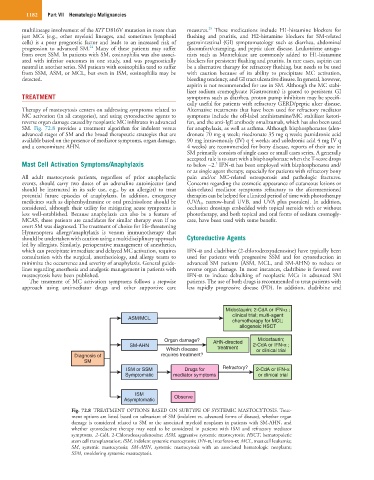
        SM.  Fig.  72.8  provides  a  treatment  algorithm  for  indolent  versus   for anaphylaxis, as well as asthma. Although bisphosphonates (alen-
        advanced stages of SM and the broad therapeutic strategies that are   dronate 70 mg q week; risedronate 35 mg q week; pamidronic acid
        available based on the presence of mediator symptoms, organ damage,   90 mg intravenously (IV) q 4 weeks; and zoledronic acid 4 mg IV q
        and a concomitant AHN.                                4 weeks) are recommended for bony disease, reports of their use in
                                                              SM primarily consists of single cases or small cases series. A generally
                                                              accepted rule is to start with a bisphosphonate when the T-score drops
        Mast Cell Activation Symptoms/Anaphylaxis             to below −2.  IFN-α has been employed with bisphosphonates and/
                                                                        5
                                                              or as single agent therapy, especially for patients with refractory bony
        All  adult  mastocytosis  patients,  regardless  of  prior  anaphylactic   pain  and/or  MC-related  osteoporosis  and  pathologic  fractures.
        events,  should  carry  two  doses  of  an  adrenaline  autoinjector  (and   Concerns regarding the cosmetic appearance of cutaneous lesions or
        should  be  instructed  in  its  safe  use,  e.g.,  by  an  allergist)  to  treat   skin-related  mediator  symptoms  refractory  to  the  aforementioned
        potential  future  episodes  of  anaphylaxis.  In  addition,  emergency   therapies can be helped for a limited period of time with phototherapy
        medicines such as diphenhydramine or oral prednisolone should be   (UVA 1 ,  narrow-band  UVB,  and  UVA  plus  psoralen).  In  addition,
        considered, although their utility for mitigating acute symptoms is   occlusion dressings embedded with topical steroids with or without
        less  well-established.  Because  anaphylaxis  can  also  be  a  feature  of   phototherapy, and both topical and oral forms of sodium cromogly-
        MCAS, these patients are candidates for similar therapy even if no   cate, have been used with some benefit.
        overt SM was diagnosed. The treatment of choice for life-threatening
        Hymenoptera  allergy/anaphylaxis  is  venom  immunotherapy  that
        should be undertaken with caution using a multidisciplinary approach   Cytoreductive Agents
        led by allergists. Similarly, perioperative management of anesthetics,
        which can precipitate immediate and delayed MC activation, requires   IFN-α and cladribine (2-chlorodeoxyadenosine) have typically been
        consultation with the surgical, anesthesiology, and allergy teams to   used  for  patients  with  progressive  SSM  and  for  cytoreduction  in
        minimize the occurrence and severity of anaphylaxis. General guide-  advanced  SM  patients  (ASM,  MCL,  and  SM-AHN)  to  reduce  or
        lines regarding anesthesia and analgesic management in patients with   reverse organ damage. In most instances, cladribine is favored over
        mastocytosis have been published.                     IFN-α  to  induce  debulking  of  neoplastic  MCs  in  advanced  SM
           The  treatment  of  MC  activation  symptoms  follows  a  stepwise   patients. The use of both drugs is recommended to treat patients with
        approach  using  antimediator  drugs  and  other  supportive  care    less  rapidly  progressive  disease  (PD).  In  addition,  cladribine  and


                                                                           Midostaurin; 2-CdA or IFN-α ;
                                                                             clinical trial; multi-agent
                                           ASM/MCL                           chemotherapy for MCL;
                                                                               allogeneic HSCT

                                                       Organ damage?   AHN-directed  Midostaurin;
                                           SM-AHN                       treatment   2-CdA or IFN-α ;
                                                       Which disease                 or clinical trial
                         Diagnosis of                 requires treatment?
                             SM
                                          ISM or SSM         Drugs for    Refractory?  2-CdA or IFN-α
                                          Symptomatic     mediator symptoms          or clinical trial


                                             ISM
                                          Asymptomatic    Observe
                        Fig. 72.8  TREATMENT OPTIONS BASED ON SUBTYPE OF SYSTEMIC MASTOCYTOSIS. Treat-
                        ment options are listed based on subvariant of SM (indolent vs. advanced forms of disease), whether organ
                        damage  is  considered  related  to  SM  or  the  associated  myeloid  neoplasm  in  patients  with  SM-AHN,  and
                        whether  cytoreductive  therapy  may  need  to  be  considered  in  patients  with  ISM  and  refractory  mediator
                        symptoms. 2-CdA, 2-Chlorodeoxyadenosine; ASM, aggressive systemic mastocytosis; HSCT, hematopoietic
                        stem cell transplantation; ISM, indolent systemic mastocytosis; IFN-α, interferon-α; MCL, mast cell leukemia;
                        SM,  systemic  mastocytosis;  SM-AHN,  systemic  mastocytosis  with  an  associated  hematologic  neoplasm;
                        SSM, smoldering systemic mastocytosis.

