


Page 1355 - Hematology_ Basic Principles and Practice ( PDFDrive )
P. 1355
Chapter 73  The Pathologic Basis for the Classification of Non-Hodgkin and Hodgkin Lymphomas  1201


                                                               CD21                               CD20


                          A                     B                     C C                  D D
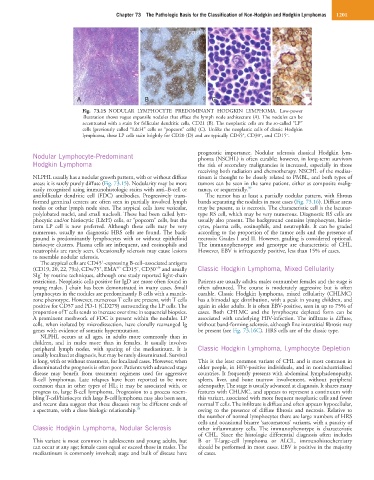
                            Fig.  73.15  NODULAR  LYMPHOCYTE  PREDOMINANT  HODGKIN  LYMPHOMA.  Low-power
                            illustration shows vague expansile nodules that efface the lymph node architecture (A). The nodules can be
                            accentuated with a stain for follicular dendritic cells, CD21 (B). The neoplastic cells are the so-called “LP”
                            cells (previously called “L&H” cells or “popcorn” cells) (C). Unlike the neoplastic cells of classic Hodgkin
                                                                                               −
                                                                                      −
                                                                                +
                            lymphoma, these LP cells stain brightly for CD20 (D) and are typically CD45 , CD30 , and CD15 .
            Nodular Lymphocyte-Predominant                        prognostic  importance.  Nodular  sclerosis  classical  Hodgkin  lym-
                                                                  phoma (NSCHL) is often curable; however, in long-term survivors
            Hodgkin Lymphoma                                      the risk of secondary malignancies is increased, especially in those
                                                                  receiving both radiation and chemotherapy. NSCHL of the medias-
            NLPHL usually has a nodular growth pattern, with or without diffuse   tinum is thought to be closely related to PMBL, and both types of
            areas; it is rarely purely diffuse (Fig. 73.15). Nodularity may be more   tumors can be seen in the same patient, either as composite malig-
            easily recognized using immunohistologic stains with anti–B-cell or   nancy, or sequentially. 39
            antifollicular  dendritic  cell  (FDC)  antibodies.  Progressively  trans-  The tumor has at least a partially nodular pattern, with fibrous
            formed germinal centers are often seen in partially involved lymph   bands separating the nodules in most cases (Fig. 73.16). Diffuse areas
            nodes or other lymph node sites. The atypical cells have vesicular,   may be present, as is necrosis. The characteristic cell is the lacunar-
            polylobated nuclei, and small nucleoli. These had been called lym-  type RS cell, which may be very numerous. Diagnostic RS cells are
            phocytic and/or histiocytic (L&H) cells, or “popcorn” cells, but the   usually also present. The background contains lymphocytes, histio-
            term  LP  cell  is  now  preferred.  Although  these  cells  may  be  very   cytes,  plasma  cells,  eosinophils,  and  neutrophils.  It  can  be  graded
            numerous,  usually  no  diagnostic  HRS  cells  are  found. The  back-  according to the proportion of the tumor cells and the presence of
            ground  is  predominantly  lymphocytes  with  or  without  epithelioid   necrosis: Grades I and II. However, grading is considered optional.
            histiocyte clusters. Plasma cells are infrequent, and eosinophils and   The  immunophenotype  and  genotype  are  characteristic  of  CHL.
            neutrophils are rarely seen. Occasionally sclerosis may cause lesions   However, EBV is infrequently positive, less than 15% of cases.
            to resemble nodular sclerosis.
                                  +
              The atypical cells are CD45 -expressing B-cell–associated antigens
                                       +/−
                                                    −/+
                                              −
                                  +
            (CD19, 20, 22, 79a), CDw75 , EMA  CD15 , CD30  and usually   Classic Hodgkin Lymphoma, Mixed Cellularity
              −
            SIg  by routine techniques, although one study reported light-chain
            restriction. Neoplastic cells positive for IgD are more often found in   Patients are usually adults; males outnumber females and the stage is
            young males. J chain has been demonstrated in many cases. Small   often  advanced.  The  course  is  moderately  aggressive  but  is  often
            lymphocytes in the nodules are predominantly B cells with a mantle-  curable.  Classic  Hodgkin  lymphoma,  mixed  cellularity  (CHLMC)
            zone phenotype. However, numerous T cells are present, with T cells   has a bimodal age distribution, with a peak in young children, and
            positive for CD57 and PD-1 (CD279) surrounding the LP cells. The   again in older adults. It is often EBV-positive, seen in up to 75% of
            proportion of T cells tends to increase over time in sequential biopsies.   cases.  Both  CHLMC  and  the  lymphocyte  depleted  form  can  be
            A prominent meshwork of FDC is present within the nodules. LP   associated with underlying HIV-infection. The infiltrate is diffuse,
            cells, when isolated by microdissection, have clonally rearranged Ig   without band-forming sclerosis, although fine interstitial fibrosis may
            genes with evidence of somatic hypermutation.         be present (see Fig. 73.16C). HRS cells are of the classic type.
              NLPHL  occurs  at  all  ages,  in  adults  more  commonly  than  in
            children,  and  in  males  more  than  in  females.  It  usually  involves
            peripheral  lymph  nodes,  with  sparing  of  the  mediastinum.  It  is   Classic Hodgkin Lymphoma, Lymphocyte Depletion
            usually localized at diagnosis, but may be rarely disseminated. Survival
            is long, with or without treatment, for localized cases. However, when   This is the least common variant of CHL and is most common in
            disseminated the prognosis is often poor. Patients with advanced stage   older people, in HIV-positive individuals, and in nonindustrialized
            disease  may  benefit  from  treatment  regimens  used  for  aggressive   countries. It frequently presents with abdominal lymphadenopathy,
            B-cell  lymphomas.  Late  relapses  have  been  reported  to  be  more   spleen,  liver,  and  bone  marrow  involvement,  without  peripheral
            common than in other types of HL; it may be associated with, or   adenopathy. The stage is usually advanced at diagnosis. It shares many
            progress to, large B-cell lymphoma. Progression to a process resem-  features with CHLMC, and appears to represent a continuum with
            bling T-cell/histiocyte rich large B-cell lymphoma may also been seen,   this variant, associated with more frequent neoplastic cells and fewer
            and recent data suggest that these diseases may be different ends of   normal T cells. The infiltrate is diffuse and often appears hypocellular,
            a spectrum, with a close biologic relationship. 38    owing  to  the  presence  of  diffuse  fibrosis  and  necrosis.  Relative  to
                                                                  the number of normal lymphocytes there are large numbers of HRS
                                                                  cells and occasional bizarre ‘sarcomatous’ variants, with a paucity of
            Classic Hodgkin Lymphoma, Nodular Sclerosis           other  inflammatory  cells.  The  immunophenotype  is  characteristic
                                                                  of  CHL.  Since  the  histologic  differential  diagnosis  often  includes
            This variant is most common in adolescents and young adults, but   B  or  T-large-cell  lymphoma  or  ALCL,  immunohistochemistry
            can occur at any age; female cases equal or exceed those in males. The   should be performed in most cases. EBV is positive in the majority
            mediastinum is commonly involved; stage and bulk of disease have   of cases.

