


Page 1422 - Hematology_ Basic Principles and Practice ( PDFDrive )
P. 1422
1268   Part VII  Hematologic Malignancies

               1,7
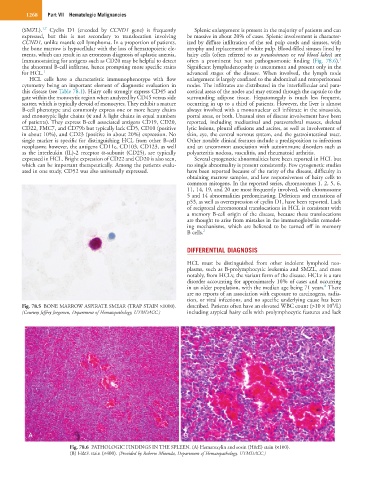
        (SMZL).   Cyclin  D1  (encoded  by  CCND1  gene)  is  frequently   Splenic enlargement is present in the majority of patients and can
        expressed,  but  this  is  not  secondary  to  translocation  involving   be massive in about 20% of cases. Splenic involvement is character-
        CCND1, unlike mantle cell lymphoma. In a proportion of patients,   ized by diffuse infiltration of the red pulp cords and sinuses, with
        the bone marrow is hypocellular with the loss of hematopoietic ele-  atrophy and replacement of white pulp. Blood-filled sinuses lined by
        ments, which can result in an erroneous diagnosis of aplastic anemia.   hairy cells (often referred to as pseudosinuses or red blood lakes) are
                                                                                                                1
        Immunostaining for antigens such as CD20 may be helpful to detect   often  a  prominent  but  not  pathognomonic  finding  (Fig.  78.6).
        the abnormal B-cell infiltrate, hence prompting more specific stains   Significant lymphadenopathy is uncommon and present only in the
        for HCL. 1                                            advanced  stages  of  the  disease.  When  involved,  the  lymph  node
           HCL  cells  have  a  characteristic  immunophenotype  with  flow   enlargement is largely confined to the abdominal and retroperitoneal
        cytometry being an important element of diagnostic evaluation in   nodes. The infiltrates are distributed in the interfollicular and para-
        this disease (see Table 78.1). Hairy cells strongly express CD45 and   cortical areas of the nodes and may extend through the capsule to the
        gate within the monocytic region when analyzed by CD45 versus side   surrounding  adipose  tissue.  Hepatomegaly  is  much  less  frequent,
        scatter, which is typically devoid of monocytes. They exhibit a mature   occurring in up to a third of patients. However, the liver is almost
        B-cell phenotype and commonly express one or more heavy chains   always involved with a mononuclear cell infiltrate in the sinusoids,
        and monotypic light chains (κ and λ light chains in equal numbers   portal areas, or both. Unusual sites of disease involvement have been
        of patients). They express B-cell associated antigens CD19, CD20,   reported,  including  mediastinal  and  paravertebral  masses,  skeletal
        CD22, FMC7, and CD79b but typically lack CD5, CD10 (positive   lytic lesions, pleural effusions and ascites, as well as involvement of
        in about 10%), and CD23 (positive in about 20%) expression. No   skin, eye, the central nervous system, and the gastrointestinal tract.
        single marker is specific for distinguishing HCL from other B-cell   Other notable clinical features include a predisposition to infections
        neoplasms; however, the antigens CD11c, CD103, CD123, as well   and an uncommon association with autoimmune disorders such as
        as  the  interleukin  (IL)-2  receptor  α-subunit  (CD25),  are  typically   polyarteritis nodosa, vasculitis, and rheumatoid arthritis.
        expressed in HCL. Bright expression of CD22 and CD20 is also seen,   Several cytogenetic abnormalities have been reported in HCL but
        which can be important therapeutically. Among the patients evalu-  no single abnormality is present consistently. Few cytogenetic studies
        ated in one study, CD52 was also universally expressed.  have been reported because of the rarity of the disease, difficulty in
                                                              obtaining marrow samples, and low responsiveness of hairy cells to
                                                              common mitogens. In the reported series, chromosomes 1, 2, 5, 6,
                                                              11, 14, 19, and 20 are most frequently involved, with chromosome
                                                              5 and 14 abnormalities predominating. Deletions and mutations of
                                                              p53, as well as overexpression of cyclin D1, have been reported. Lack
                                                              of reciprocal chromosomal translocations in HCL is consistent with
                                                              a memory B-cell origin of the disease, because these translocations
                                                              are thought to arise from mistakes in the immunoglobulin remodel-
                                                              ing  mechanisms,  which  are  believed  to  be  turned  off  in  memory
                                                              B cells. 2

                                                              DIFFERENTIAL DIAGNOSIS

                                                              HCL  must  be  distinguished  from  other  indolent  lymphoid  neo-
                                                              plasms, such as B-prolymphocytic leukemia and SMZL, and most
                                                              notably, from HCLv, the variant form of the disease. HCLv is a rare
                                                              disorder accounting for approximately 10% of cases and occurring
                                                                                                           8
                                                              in an older population, with the median age being 71 years.  There
                                                              are no reports of an association with exposure to carcinogens, radia-
                                                              tion, or viral infections, and no specific underlying cause has been
                                                                                                              9
        Fig. 78.5  BONE MARROW ASPIRATE SMEAR (TRAP STAIN ×1000).   described. Patients often have an elevated WBC count (>10 × 10 /L)
        (Courtesy Jeffrey Jorgensen, Department of Hematopathology, UTMDACC.)  including atypical hairy cells with prolymphocytic features and lack


          A                                                  B

                        Fig. 78.6  PATHOLOGIC FINDINGS IN THE SPLEEN. (A) Hematoxylin and eosin (H&E) stain (×100).
                        (B) H&E stain (×400). (Provided by Roberto Miranda, Department of Hematopathology, UTMDACC.)

