


Page 1424 - Hematology_ Basic Principles and Practice ( PDFDrive )
P. 1424
1270   Part VII  Hematologic Malignancies


          TABLE   Selected Published Reports of Cladribine Therapy for   TABLE   Alternative Dose and Schedules of Cladribine Therapy
          78.3    Hairy Cell Leukemia                           78.4    Reported in the Literature
                      Evaluable                                                         Route of
         Reference    Patients (n)  CR (%)  PR (%)   OR (%)    Study     Dosing         Administration  Responses
         Intravenous Daily Administration (Continuous or Pulsed)  Saven 15  0.1 mg/kg/day ×   Continuous IV   CR: 91%; PR:
         Saven 15       349        91         7        98                  7 days         infusion    7%
                                                                                2
         Goodman 16     207        95         5       100      Juliusson 14  3.4 mg/m /day ×   Subcutaneous   CR: 75% after
                                                                           7 days         injection   1 cycle, 85%
         Tallman         50        80        18        98
                                                                                                      after 2 cycles
         Chadha 17       85        79        21       100
                                                               Robak 13  0.12 mg/kg/day ×   2-hour IV   CR: 76%; PR:
         Hoffman         49        76        24       100                  5 days         bolus       19%
         Seymore 18      46        78        11        89      Robak 13  0.12 mg/kg/week ×   2 hour IV   CR: 72%; PR:
         Dearden         45        84        16       100                  6 weeks        bolus       19%
         Juliusson       16        75         0        75      Chacko    0.15 mg/kg/week ×   3 hour IV   CR: 100%
         Zinzani a       21        81        19       100                  6 weeks        infusion
         Jehn            44        98         2       100      Lauria 12  0.15 mg/kg/week ×   2 hour IV   CR: 76%; PR:
                                                                           6 weeks        bolus       24%
         Robakb, 13     132        76        19        95
         Intravenous Weekly Administration                     Von Rohr  0.14 mg/kg/day ×   Subcutaneous   CR: 76%; PR:
         Lauria          30        73        27       100                  5 days         injection   21%
                                                               CR, Complete response; IV, intravenous; PR, partial response.
         Zinzani a       16        81        19       100
         Robak b,13      57        72        19        91
         Subcutaneous Administration                              1.0
         Juliusson 14    73        81        13        94         0.9
         Forconi 19      58        72        19        91                                    CR + Hb and/or
         a Reports from the same publication.                     0.8                        Plt higher (n = 88)
         b Numbers reported for the two arms of a randomized study.  0.7
         CR, Complete response; OR, overall response; PR, partial response.  0.6             CR + Hb and/or
                                                                                             Plt lower (n = 90)

        analogs in treating lymphoid neoplasms can be traced back to the  Proportion of patients remaining relapse free  0.5
                                                                  0.4
        observation that children with the deficiency of the enzyme adenine             PR + Hb and
        deaminase  (ADA)  developed  severe  combined  immunodeficiency.   0.3          Plt higher (n =15)
        The accumulation of the triphosphorylated form of deoxyadenosine   0.2
        (dependent on the action of the enzyme deoxycitidine kinase [DCK])           PR + Hb and/or
        is thought to be responsible for the lack of lymphocyte development.   0.1   Plt lower (n =19)  P < 0.0001
        Similarly, after treatment with purine nucleoside analogs, the accu-  0.0
        mulation  of  deoxyadenosine  triphosphate  results  in  DNA  strand   0  2  4  6  8  10  12  14  16  18  20
        breaks,  inhibition  of  DNA  repair,  and  apoptosis  preferentially  in
        lymphoid cells, rich in DCK and low in 5′ nucleotidase (the enzyme   Years from first purine analogue treatment
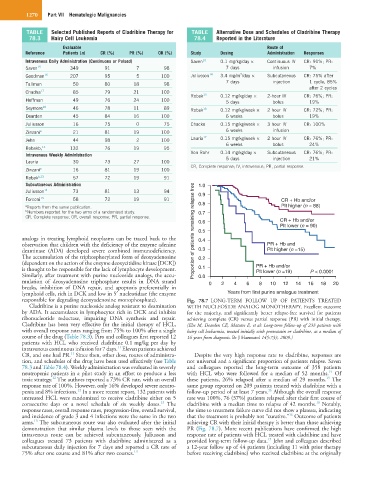
        responsible for degrading deoxyadenosine monophosphate).  Fig.  78.7  LONG-TERM  FOLLOW  UP  OF  PATIENTS  TREATED
           Cladribine is a purine nucleoside analog resistant to deamination   WITH NUCLEOSIDE ANALOG MONOTHERAPY. Excellent outcome
        by ADA. It accumulates in lymphocytes rich in DCK and inhibits   for  the  majority,  and  significantly  better  relapse-free  survival  for  patients
        ribonucleotide  reductase,  impairing  DNA  synthesis  and  repair.   achieving complete (CR) versus partial response (PR) with initial therapy.
        Cladribine  has  been  very  effective  for  the  initial  therapy  of  HCL,   (Else M, Dearden CE, Matutes E, et al: Long-term follow-up of 233 patients with
        with overall response rates ranging from 75% to 100% after a single   hairy cell leukaemia, treated initially with pentostatin or cladribine, at a median of
        course of the drug (Table 78.3). Piro and colleagues first reported 12   16 years from diagnosis. Br J Haematol 145:733, 2009.)
        patients with HCL who received cladribine 0.1 mg/kg per day by
                                       11
        intravenous continuous infusion for 7 days.  Eleven patients achieved
                        11
        CR, and one had PR.  Since then, other dose, routes of administra-  Despite the very high response rate to cladribine, responses are
        tion, and schedules of the drug have been used effectively (see Table   not universal and a significant proportion of patients relapse. Saven
        78.3 and Table 78.4). Weekly administration was evaluated in severely   and  colleagues  reported  the  long-term  outcome  of  358  patients
                                                                                                             15
        neutropenic patients in a pilot study in an effort to produce a less   with  HCL  who  were  followed  for  a  median  of  52  months.   Of
                  12
                                                                                                            15
        toxic strategy.  The authors reported a 73% CR rate, with an overall   these  patients,  26%  relapsed  after  a  median  of  29  months.  The
        response rate of 100%. However, only 16% developed severe neutro-  same group reported on 209 patients treated with cladribine with a
                          12
                                                                                         16
        penia and 8% infections.  In a more recent report, 132 patients with   follow-up period of at least 7 years.  Although the overall response
        untreated HCL were randomized to receive cladribine either on 5   rate was 100%, 76 (37%) patients relapsed after their first course of
                                                                                                        16
                                                      13
        consecutive  days  or  a  novel  schedule  of  six  weekly  doses.   The   cladribine with a median time to relapse of 42 months.  Notably,
        response rates, overall response rates, progression-free, overall survival,   the time to treatment failure curve did not show a plateau, indicating
                                                                                                16
        and incidence of grade 3 and 4 infections were the same in the two   that the treatment is probably not “curative.”  Outcome of patients
            13
        arms.  The subcutaneous route was also evaluated after the initial   achieving CR with their initial therapy is better than those achieving
        demonstration  that  similar  plasma  levels  to  those  seen  with  the   PR (Fig. 78.7). More recent publications have confirmed the high
        intravenous  route  can  be  achieved  subcutaneously.  Juliusson  and   response rate of patients with HCL treated with cladribine and have
                                                                                         17
        colleagues  treated  73  patients  with  cladribine  administered  as  a   provided long-term follow-up data.  Jehn and colleagues described
        subcutaneous daily injection for 7 days and reported a CR rate of   a 12-year follow up of 44 patients (including 11 with prior therapy
        75% after one course and 81% after two courses. 14    before receiving cladribine) who received cladribine at the originally

