


Page 1425 - Hematology_ Basic Principles and Practice ( PDFDrive )
P. 1425
Chapter 78  Hairy Cell Leukemia  1271


            reported dose and schedule. The CR rate was 98%, and with a median   79%, with an overall response rate of 96%. With a median follow up
            follow up of 8.5 years (range 0.1−12.2), 17 patients had relapsed.   of 63.5 months, 34 (15%) of 220 responding patients had relapsed.
            Eight  of  nine  patients  retreated  with  cladribine  responded  again.   The  estimated  5-  and  10-year  disease-free  survival  was  88%  and
            The  overall  survival  at  12  years  was  79%.  Zinzani  and  colleagues   69%, respectively, and the estimated 5-year overall survival was 89%.
            reported the long-term outcome of 37 patients treated with one of   There are no prospective trials comparing the efficacy and durabil-
            two regimens of cladribine. Twenty-one patients received cladribine   ity  of  response  between  cladribine  and  pentostatin.  Dearden  and
            by a 2-hour infusion for 5 days, whereas 16 patients were treated with   colleagues examined the outcome of the patients with the two agents
            a once-weekly schedule for 5 weeks. A CR rate of 81% with an overall   at their institution and reported that 82% of 165 patients treated
            response  rate  of  100%  was  reported,  with  no  difference  between   with pentostatin achieved a CR compared with 84% of 45 patients
            the two schedules. After a median follow up of 122 months (range   treated with cladribine. Relapse rates were 24% with pentostatin and
            54−156), the overall relapse rate was about 30% for both groups. The   29% with cladribine after median follow up of 71 and 45 months,
            projected 13-year overall and relapse-free survival rates were 96% and   respectively. These relapse rates suggest a longer remission duration
            52%, respectively. Investigators at Northwestern University treated   with pentostatin. However, with further follow up, there appears to
            86 consecutive patients with cladribine and reported a CR rate of   be no difference between the two agents with regard to disease-free
                                       17
            79%, as well as a PR rate of 21%.  The progression-free survival   survival  (Fig.  78.9A).  Further  follow-up  data  of  these  cohorts  of
                                                                                       10
            after 12 years was 54%. After a median follow up of 9.7 years (range   patients have been reported.  With a median follow up of 16 years,
                                         17
            0.3−13.8), 31 patients (36%) relapsed.  Of these, 23 were treated   there  was  no  significant  difference  in  the  outcome  of  the  patients
            with a second course of cladribine; 12 (52%) achieved CR, and 7   treated  with  the  two  drugs.  After  relapse  or  nonresponse,  patients
                                                             17
            (30%) achieved PR. The overall survival after 12 years was 87%.    could  be  successfully  retreated  with  pentostatin  or  cladribine  but
            The  authors  suggested  that  the  lower  CR  rate  in  this  study  was
            caused by their more stringent criteria for response, which included
            a requirement for resolution of splenomegaly and lymphadenopathy   100%
            by computed tomography scan as criteria for CR. 17
              Similar excellent responses have been achieved using pentostatin
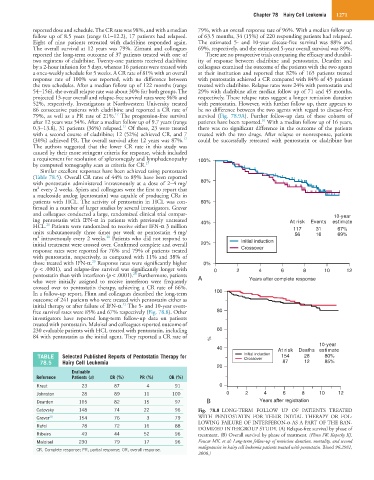
            (Table 78.5). Overall CR rates of 44% to 89% have been reported
            with  pentostatin  administered  intravenously  at  a  dose  of  2−4 mg/  80%
             2
            m  every 2 weeks. Spiers and colleagues were the first to report that
            a nucleoside analog (pentostatin) was capable of producing CRs in
            patients  with  HCL. The  activity  of  pentostatin  in  HCL  was  con-  60%
            firmed in a number of larger studies by several investigators. Grever
            and colleagues conducted a large, randomized clinical trial compar-                               10-year
            ing  pentostatin  with  IFN-α  in  patients  with  previously  untreated   40%      At risk  Events  estimate
                20
            HCL.  Patients were randomized to receive either IFN-α 3 million                     117    31     67%
            units  subcutaneously  three  times  per  week  or  pentostatin  4 mg/               56     16     69%
                                    20
             2
            m  intravenously every 2 weeks.  Patients who did not respond to    Initial induction
            initial treatment were crossed over. Confirmed complete and overall   20%  Crossover
            response rates were reported for 76% and 79% of patients treated
            with pentostatin, respectively, as compared with 11% and 38% of
                               20
            those treated with IFN-α.  Response rates were significantly higher   0%
            (p < .0001), and relapse-free survival was significantly longer with   0  2  4   6      8      10     12
                                             20
            pentostatin than with interferon (p < .0001).  Furthermore, patients   A
            who  were  initially  assigned  to  receive  interferon  were  frequently   Years after complete response
            crossed  over  to  pentostatin  therapy,  achieving  a  CR  rate  of  66%.
            In a follow-up report, Flinn and colleagues described the long-term   100
            outcome of 241 patients who were treated with pentostatin either as
                                         21
            initial therapy or after failure of IFN-α.  The 5- and 10-year event-
            free survival rates were 85% and 67% respectively (Fig. 78.8). Other   80
            investigators  have  reported  long-term  follow-up  data  on  patients
            treated with pentostatin. Maloisel and colleagues reported outcome of
            230 evaluable patients with HCL treated with pentostatin, including   60
            84 with pentostatin as the initial agent. They reported a CR rate of
                                                                      %
                                                                                                         10-year
                                                                        40                  At risk    Deaths estimate
             TABLE   Selected Published Reports of Pentostatin Therapy for       Initial induction    154   28   80%
                                                                                 Crossover
              78.5   Hairy Cell Leukemia                                                      87     12    85%
                                                                        20
                         Evaluable
             Reference   Patients (n)  CR (%)  PR (%)   OR (%)
             Kraut          23        87         4        91             0
             Johnston       28        89        11       100               0     2     4      6     8    10     12
             Dearden       165        82        15        97         B                Years after registration
             Catovsky      148        74        22        96      Fig.  78.8  LONG-TERM  FOLLOW  UP  OF  PATIENTS  TREATED
             Grever 20     154        76         3        79      WITH  PENTOSTATIN  FOR  THEIR  INITIAL  THERAPY  OR  FOL-
                                                                  LOWING FAILURE OF INTERFERON-α AS A PART OF THE RAN-
             Rafel          78        72        16        88
                                                                  DOMIZED INTERGROUP STUDY. (A) Relapse-free survival by phase of
             Ribeiro        49        44        52        96      treatment. (B) Overall survival by phase of treatment. (Flinn IW, Kopecky KJ,
             Maloisel      230        79        17        96      Foucar MK, et al: Long-term follow-up of remission duration, mortality, and second
                                                                  malignancies in hairy cell leukemia patients treated with pentostatin. Blood 96:2981,
             CR, Complete response; PR, partial response; OR, overall response.
                                                                  2000.)

