


Page 1423 - Hematology_ Basic Principles and Practice ( PDFDrive )
P. 1423
Chapter 78  Hairy Cell Leukemia  1269


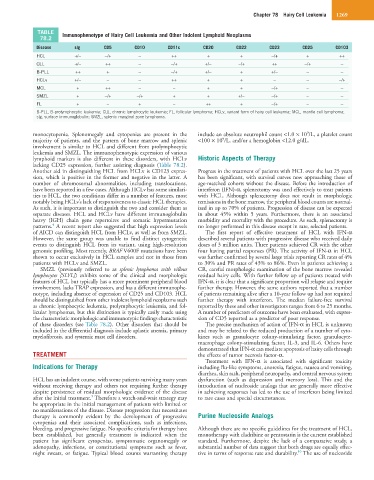
             TABLE   Immunophenotype of Hairy Cell Leukemia and Other Indolent Lymphoid Neoplasms
              78.2
             Disease     sIg       CD5       CD10       CD11c       CD20      CD22       CD23       CD25       CD103
             HCL         +/−       −/+        −          ++          +          +         −/+        +          ++
             CLL         +/−        ++        −          −/+        +/−        −/+        ++         −/+        −
             B-PLL        ++        +         −          −/+        +/−         +         +/−        −          −
             HCLv        +/−        −         −          ++          +          +         −          −          −/+
             MCL          +         ++        −           −          +          +         −/+        −          −
             SMZL         +        −/+        −/+         +          +         +/−        −/+        −          −
             FL           +         −         +           −         ++          +         −/+        −          −
             B-PLL, B-prolymphocytic leukemia; CLL, chronic lymphocytic leukemia; FL, follicular lymphoma; HCLv, variant form of hairy cell leukemia; MCL, mantle cell lymphoma;
             sIg, surface immunoglobulin; SMZL, splenic marginal zone lymphoma.


                                                                                                     9
            monocytopenia.  Splenomegaly  and  cytopenias  are  present  in  the   include an absolute neutrophil count <1.0 × 10 /L, a platelet count
                                                                          9
            majority  of  patients,  and  the  pattern  of  bone  marrow  and  splenic   <100 × 10 /L, and/or a hemoglobin <12.0 g/dL.
            involvement is similar to HCL and different from prolymphocytic
            leukemia and SMZL. The immunophenotypic expression of various
            lymphoid  markers  is  also  different  in  these  disorders,  with  HCLv   Historic Aspects of Therapy
            lacking  CD25  expression,  further  assisting  diagnosis  (Table  78.2).
            Another aid in distinguishing HCL from HCLv is CD123 expres-  Progress in the treatment of patients with HCL over the last 25 years
            sion, which is positive in the former and negative in the latter. A   has been significant, with survival curves now approaching those of
            number  of  chromosomal  abnormalities,  including  translocations,   age-matched cohorts without the disease. Before the introduction of
            have been reported in a few cases. Although HCLv has some similari-  interferon (IFN)-α, splenectomy was used effectively to treat patients
            ties to HCL, the two conditions differ in a number of features, most   with  HCL.  Although  splenectomy  does  not  result  in  morphologic
            notably being HCLv’s lack of responsiveness to classic HCL therapies.   remissions in the bone marrow, the peripheral blood counts are normal-
            As such, it is important to distinguish the two and consider them as   ized in up to 70% of patients. Progression of disease can be expected
            separate diseases. HCL and HCLv have different immunoglobulin   in  about  45%  within  5  years.  Furthermore,  there  is  an  associated
            heavy  (IGH)  chain  gene  repertoires  and  somatic  hypermutation   morbidity and mortality with the procedure. As such, splenectomy is
                  4
            patterns.  A recent report also suggested that high expression levels   no longer performed in this disease except in rare, selected patients.
            of AICD can distinguish HCL from HCLv, as well as from SMZL.   The  first  report  of  effective  treatment  of  HCL  with  IFN-α
            However,  the  same  group  was  unable  to  find  distinct  cytogenetic   described several patients with progressive disease who received daily
            events  to  distinguish  HCL  from  its  variant,  using  high-resolution   doses of 3 million units. Three patients achieved CR with the other
            genomic profiling. Most recently, BRAF V600F mutations have been   four having partial responses (PR). The activity of IFN-α in HCL
            shown to occur exclusively in HCL samples and not in those from   was further confirmed by several large trials reporting CR rates of 4%
            patients with HCLv and SMZL.                          to 30% and PR rates of 43% to 86%. Even in patients achieving a
              SMZL  (previously  referred  to  as  splenic  lymphoma  with  villous   CR, careful morphologic examination of the bone marrow revealed
            lymphocytes  [SLVL])  exhibits  some  of  the  clinical  and  morphologic   residual hairy cells. With further follow up of patients treated with
            features of HCL but typically has a more prominent peripheral blood   IFN-α, it is clear that a significant proportion will relapse and require
            involvement, lacks TRAP expression, and has a different immunophe-  further therapy. However, the same authors reported that a number
            notype, including absence of expression of CD25 and CD103. HCL   of patients remaining alive after a 10-year follow up had not required
            should be distinguished from other indolent lymphoid neoplasms such   further  therapy  with  interferon.  The  median  failure-free  survival
            as chronic lymphocytic leukemia, prolymphocytic leukemia, and fol-  reported by these and other investigators ranges from 6 to 25 months.
            licular lymphomas, but this distinction is typically easily made using   A number of predictors of outcome have been evaluated, with expres-
            the characteristic morphologic and immunotypic findings characteristic   sion of CD5 reported as a predictor of poor response.
            of  these  disorders  (see Table  78.2).  Other  disorders  that  should  be   The precise mechanism of action of IFN-α in HCL is unknown
            included in the differential diagnosis include aplastic anemia, primary   and may be related to the reduced production of a number of cyto-
            myelofibrosis, and systemic mast cell disorders.      kines  such  as  granulocyte  colony-stimulating  factor,  granulocyte-
                                                                  macrophage colony-stimulating factor, IL-3, and IL-6. Others have
                                                                  demonstrated that IFN-α can mediate apoptosis of hairy cells through
            TREATMENT                                             the effects of tumor necrosis factor-α.
                                                                    Treatment  with  IFN-α  is  associated  with  significant  toxicity
            Indications for Therapy                               including flu-like symptoms, anorexia, fatigue, nausea and vomiting,
                                                                  diarrhea, skin rash, peripheral neuropathy, and central nervous system
            HCL has an indolent course, with some patients surviving many years   dysfunction  (such  as  depression  and  memory  loss).  This  and  the
            without receiving therapy and others not requiring further therapy   introduction of nucleoside analogs that are generally more effective
            despite persistence of residual morphologic evidence of the disease   in achieving responses has led to the use of interferon being limited
                               9
            after the initial treatment.  Therefore a watch-and-wait strategy may   to rare cases and special circumstances.
            be appropriate in the initial management of patients with limited or
            no manifestations of the disease. Disease progression that necessitates
            therapy  is  commonly  evident  by  the  development  of  progressive   Purine Nucleoside Analogs
            cytopenias  and  their  associated  complications,  such  as  infections,
            bleeding, and progressive fatigue. No specific criteria for therapy have   Although there are no specific guidelines for the treatment of HCL,
            been  established,  but  generally  treatment  is  indicated  when  the   monotherapy with cladribine or pentostatin is the current established
            patient  has  significant  cytopenias,  symptomatic  organomegaly  or   standard.  Furthermore,  despite  the  lack  of  a  comparative  study,  a
            adenopathy,  infections,  or  constitutional  symptoms  such  as  fever,   substantial number of data suggest that both drugs are equally effec-
                                                                                                  10
            night  sweats,  or  fatigue. Typical  blood  counts  warranting  therapy   tive in terms of response rate and durability.  The use of nucleoside

