


Page 1463 - Hematology_ Basic Principles and Practice ( PDFDrive )
P. 1463
1300   Part VII  Hematologic Malignancies


                                                                  BCR
                                         BCR/BTK        LYN  P            CD19
                                                       SYK  P
                                                                       P                 BCL-2 family
                   NF-κB               PKCβ                         PI3Kδ            (BCL-2, BCL-XL, MCL-1)
                                                        BTK
                     IKKγ
              IKKα                    AKT                                                          Apoptosis
                      IKKβ          P                                                     BAD
                                                        NFAT
            P      P
              IκBα                           NF-κB
                                                                                 P  AKT
                                                                                         mTOR
              IκBα             Cell cycle
                                                        CyclinD1                              PI3K/ALT/mTOR
                                            E2F       CDK4/6
                                                             E2F
                                                                           B-Catenin
                   Defective                  RB1               RB1
                  DNA damage                P    P                                                     P
                                       CyclinD1              CDK2                G5K3β            G5K3β
                    BMI-1            CDK4    P27       P27  CyclinE
                        p14/ARF        MDM2        P21             P  CyclinD1                            FZD
                                                                       CRM1
                                                                                                       WNT
                             CHK2                                                   P
                                                   P53                             CyclinD1          LRP
                             CHK1
                  ATM                                                              E3 ligase SCF
                                                 P53
                                                 CyclinD1  AKT                Ub-Ub-Ub      Protein degradation

                                                 HSP90              Proteasome  Ub-Ub-Ub
                        Protein homeostasis

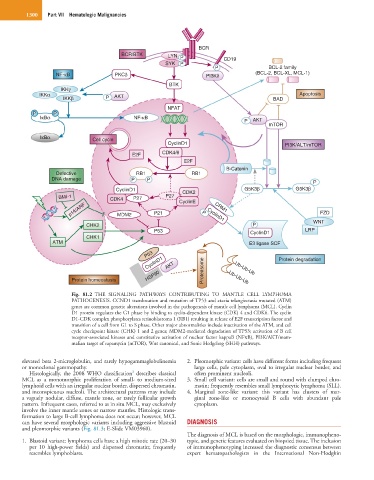
                        Fig.  81.2  THE  SIGNALING  PATHWAYS  CONTRIBUTING  TO  MANTLE  CELL  LYMPHOMA
                        PATHOGENESIS. CCND1 translocation and mutation of TP53 and ataxia telangiectasia mutated (ATM)
                        genes are common genetic alterations involved in the pathogenesis of mantle cell lymphoma (MCL). Cyclin
                        D1 protein regulates the G1 phase by binding to cyclin-dependent kinase (CDK) 4 and CDK6. The cyclin
                        D1-CDK complex phosphorylates retinoblastoma 1 (RB1) resulting in release of E2F transcription factor and
                        transition of a cell from G1 to S phase. Other major abnormalities include inactivation of the ATM, and cell
                        cycle checkpoint kinase (CHK) 1 and 2 genes; MDM2-mediated degradation of TP53; activation of B cell
                        receptor-associated kinases and constitutive activation of nuclear factor kappaB (NFκB), PI3K/AKT/mam-
                        malian target of rapamycin (mTOR), Wnt canonical, and Sonic Hedgehog (SHH) pathways.


        elevated beta 2-microglobulin, and rarely hypogammaglobulinemia   2.  Pleomorphic variant: cells have different forms including frequent
        or monoclonal gammopathy.                                large cells, pale cytoplasm, oval to irregular nuclear border, and
                                            3
           Histologically,  the  2008 WHO  classification   describes  classical   often prominent nucleoli.
        MCL  as  a  monomorphic  proliferation  of  small-  to  medium-sized   3.  Small cell variant: cells are small and round with clumped chro-
        lymphoid cells with an irregular nuclear border, dispersed chromatin,   matin; frequently resembles small lymphocytic lymphoma (SLL).
        and inconspicuous nucleoli. The architectural patterns may include   4.  Marginal  zone-like  variant:  this  variant  has  clusters  of  mar-
        a vaguely nodular, diffuse, mantle zone, or rarely follicular growth   ginal  zone-like  or  monocytoid  B  cells  with  abundant  pale
        pattern. Infrequent cases, referred to as in situ MCL, may exclusively   cytoplasm.
        involve the inner mantle zones or narrow mantles. Histologic trans-
        formation to large B-cell lymphoma does not occur; however, MCL
        can have several morphologic variants including aggressive blastoid   DIAGNOSIS
        and pleomorphic variants (Fig. 81.3; E-Slide VM03960).
                                                              The diagnosis of MCL is based on the morphologic, immunopheno-
        1.  Blastoid variant: lymphoma cells have a high mitotic rate (20–30   typic, and genetic features evaluated on biopsied tissue. The inclusion
           per  10  high-power  fields)  and  dispersed  chromatin;  frequently   of immunophenotyping increased the diagnostic consensus between
           resembles lymphoblasts.                            expert  hematopathologists  in  the  International  Non-Hodgkin

