


Page 1484 - Hematology_ Basic Principles and Practice ( PDFDrive )
P. 1484
Chapter 83  Virus-Associated Lymphoma  1319


             TABLE   Viruses and Lymphomagenesis                  situ hybridization or related techniques, although greatly improved
              83.1                                                in recent years, remain the purview of research laboratories and are
                                                                  generally not readily applicable to clinical specimens. This reflects the
             Virus        Viral Genome in Tumor Cell  Lymphoma Type  relatively low copy number of the viral genome in tumor cells, typi-
             EBV          Episomal                 B, T, NK       cally 1–200 copies per cell. In contrast, in situ hybridization for the
                                                                  EBV-encoded  ribonucleic  acids  (RNAs)  has  emerged  as  a  clinical
             KSHV         Episomal                 B                             12
                                                                  laboratory standard.  These RNAs are polymerase 3 transcripts that
             HTLV-1       Integrated               T              are expressed at very high copy number (perhaps millions of copies
             HIV-1        Absent                   B              per cell) in latently infected cells. The functions of these RNAs are
                                                                  disputed, but their use for the detection of virus in a variety of tissue
             HCV          Uncertain                B
                                                                  specimens is generally accepted.
             EBV, Epstein-Barr virus; HCV, hepatitis C virus; HIV-1, human   Viral antigens are detected by immunohistochemistry. In clinical
             immunodeficiency virus type 1; HTLV-1, human T-lymphotropic virus-1; KSHV,   laboratories,  immunohistochemistry  for  LMP1  is  commonly
             Kaposi sarcoma–associated herpesvirus; NK, natural killer.
                                                                  employed  and  is  sensitive  for  the  detection  of  EBV  in  Hodgkin
                                                                  lymphoma (HL). In a variety of other EBV-associated B- and T-cell
                                                                  malignancies, expression of LMP1 is more variable. Thus failure to
             TABLE   Patterns of Epstein-Barr Virus Gene Expression in   detect LMP1 expression does not exclude the presence of EBV, except
              83.2   Latency                                      perhaps in HL. In principle, detection of EBNA1 should be univer-
                                EBNA2, EBNA3A,                    sally applicable, although the low level of antigen expression and the
             Latency   EBNA1    EBNA3B, EBNA3C  LMP1     LMP2A    cross-reactivity  of  available  monoclonal  antibodies  have  prevented
                                                                  immunohistochemistry for this antigen from emerging as a standard
             I          +                                         tool.
             II         +                        +        +
             III        +            +           +        +
             EBNA1, Epstein-Barr virus nuclear antigen 1; EBV, Epstein-Barr virus; LMP1,   Association With Particular Types of Lymphoma
             latent membrane protein 1.
                                                                  Some lymphoma types are nearly 100% EBV associated, including
                                                                  endemic BL, extranodal natural killer (NK)/T-cell lymphoma of the
                                                                  nasal type, early PTLD, lymphomatoid granulomatosis, diffuse large
                                LMP2
                                                                  B-cell lymphoma (DLBCL) associated with chronic inflammation,
                                                                  EBV-positive  DLBCL  of  older  adults,  and  AIDS  primary  central
             LMP1                                                 nervous system (CNS) lymphoma (PCNSL). 13–16  Other lymphoma
                                                    B-cell receptor  types are variably EBV associated. These include classic HL, PTLDs
                                                                  occurring many months or years after transplantation, and systemic
                                                                  AIDS-related lymphoma.
                                                                    Some lymphoma types appear never or almost never to be EBV
                      NF-κB                                       associated,  including  most  indolent  B-cell  lymphomas,  although
                                                                  there is growing evidence that exceptions do exist, particularly in the
                                              Cell                setting  of  immunocompromise.  Nodular  lymphocyte  predominant
                                              survival            HL was historically thought to always be EBV negative, but a recent
                                                                  pathologic review of over 300 cases suggests that 3%–5% are EBV
                                     EBNA1
                                                                        17
                                                                  positive.   Low-grade  lymphomas  such  as  EBV-positive  mucosa-
                                                                  associated lymphoid tissue (MALT) lymphomas have been reported
                                                                                                     18
                                                                  in patients with congenital immunodeficiencies.  Whereas low-grade
                                                                  lymphomas that arise posttransplant are not considered to be PTLD
                                                                  in  the  current  classification,  it  is  interesting  to  note  that  cases  of
                            Transcription                         EBV-positive, indolent B-cell lymphomas, particularly MALT lym-
                              factors:
                              EBNA-LP                             phomas  with  a  predilection  to  involve  the  subcutaneous  or  soft
                                                                                                         19,20
                                                                  tissues,  have  been  reported  in  transplant  patients.
                                                                                                              Thus  the
                               EBNA2
                           EBNA3A, EBNA3B,                        spectrum of EBV-associated lymphomas continues to expand, and
                               EBNA3C
                                                                  the presence of EBV might be an indication to consider an underlying
                                                                  immune defect in the patient.
                                                                    Other lymphomas are typically not EBV associated but have the
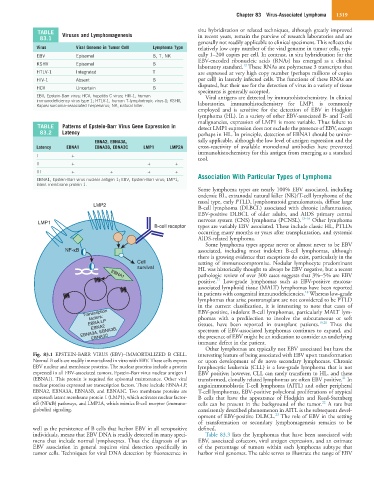
            Fig.  83.1  EPSTEIN-BARR  VIRUS  (EBV)–IMMORTALIZED  B  CELL.   interesting feature of being associated with EBV upon transformation
            Normal B cells are readily immortalized in vitro with EBV. These cells express   or  upon  development  of  de  novo  secondary  lymphomas.  Chronic
            EBV nuclear and membrane proteins. The nuclear proteins include a protein   lymphocytic leukemia (CLL) is a low-grade lymphoma that is not
            expressed in all EBV-associated tumors, Epstein-Barr virus nuclear antigen 1   EBV positive; however, CLL can rarely transform to HL, and these
                                                                                                                 21
            (EBNA1). This  protein  is  required  for  episomal  maintenance.  Other  viral   transformed, clonally related lymphomas are often EBV positive.  In
            nuclear proteins expressed are transcription factors. These include EBNA-LP,   angioimmunoblastic T-cell lymphoma (AITL) and other peripheral
            EBNA2, EBNA3A, EBNA3B, and EBNA3C. Two membrane proteins are   T-cell lymphomas, EBV-positive polyclonal proliferations of atypical
            expressed: latent membrane protein 1 (LMP1), which activates nuclear factor-  B  cells  that  have  the  appearance  of  Hodgkin  and  Reed-Sternberg
                                                                                                          22
            κB (NFκB) pathways, and LMP2A, which mimics B-cell receptor (immuno-  cells can be present in the background of the tumor.  A rare but
            globulin) signaling.                                  consistently described phenomenon in AITL is the subsequent devel-
                                                                                           23
                                                                  opment of EBV-positive DLBCL.  The role of EBV in the setting
                                                                  of  transformation  or  secondary  lymphomagenesis  remains  to  be
            well as the persistence of B cells that harbor EBV in all seropositive   defined.
            individuals, means that EBV DNA is readily detected in many speci-  Table  83.3  lists  the  lymphomas  that  have  been  associated  with
            mens  that  include  normal  lymphocytes. Thus  the  diagnosis  of  an   EBV, associated cofactors, viral antigen expression, and an estimate
            EBV  association  in  general  requires  viral  detection  specifically  in   of  the  percentage  of  tumors  within  each  lymphoma  subtype  that
            tumor cells. Techniques for viral DNA detection by fluorescence in   harbor viral genomes. The table serves to illustrate the range of EBV

