


Page 1490 - Hematology_ Basic Principles and Practice ( PDFDrive )
P. 1490
Chapter 83  Virus-Associated Lymphoma  1325


                                                               D                                 F


             A


             B                        C C                      E                                 G

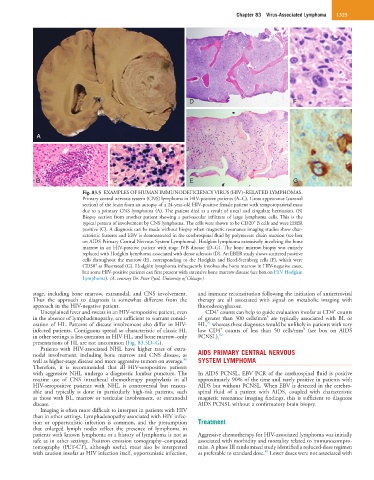
                            Fig. 83.5  EXAMPLES OF HUMAN IMMUNODEFICIENCY VIRUS (HIV)–RELATED LYMPHOMAS.
                            Primary central nervous system (CNS) lymphoma in HIV-positive patients (A–C). Gross appearance (coronal
                            section) of the brain from an autopsy of a 24-year-old HIV-positive female patient with temporoparietal mass
                            due to a primary CNS lymphoma (A). The patient died as a result of uncal and cingulate herniation. (B)
                            Biopsy section from another patient showing a perivascular infiltrate of large lymphoma cells. This is the
                                                                                    +
                            typical pattern of involvement by CNS lymphoma. The cells were shown to be CD20  B cells and were EBER
                            positive (C). A diagnosis can be made without biopsy when magnetic resonance imaging studies show char-
                            acteristic features and EBV is demonstrated in the cerebrospinal fluid by polymerase chain reaction (see box
                            on AIDS Primary Central Nervous System Lymphoma). Hodgkin lymphoma extensively involving the bone
                            marrow in an HIV-positive patient with stage IVB disease (D–G). The bone marrow biopsy was entirely
                            replaced with Hodgkin lymphoma associated with dense sclerosis (D). An EBER study shows scattered positive
                            cells throughout the marrow (E), corresponding to the Hodgkin and Reed-Sternberg cells (F), which were
                                +
                            CD30  as illustrated (G). Hodgkin lymphoma infrequently involves the bone marrow in HIV-negative cases,
                            but some HIV-positive patients can first present with extensive bone marrow disease (see box on HIV Hodgkin
                            Lymphoma). (A, courtesy Dr. Peter Pytel, University of Chicago.)
            stage,  including  bone  marrow,  extranodal,  and  CNS  involvement.   and immune reconstitution following the initiation of antiretroviral
            Thus  the  approach  to  diagnosis  is  somewhat  different  from  the   therapy  are  all  associated  with  signal  on  metabolic  imaging  with
            approach in the HIV-negative patient.                 fluorodeoxyglucose.
                                                                                                              +
                                                                        +
              Unexplained fever and sweats in an HIV-seropositive patient, even   CD4  counts can help to guide evaluation insofar as CD4  counts
                                                                                        3
            in the absence of lymphadenopathy, are sufficient to warrant consid-  of  greater  than  300  cells/mm   are  typically  associated  with  BL  or
                                                                     81
            eration of HL. Patterns of disease involvement also differ in HIV-  HL,  whereas these diagnoses would be unlikely in patients with very
                                                                         +
                                                                                                    3
            infected patients. Contiguous spread so characteristic of classic HL   low  CD4   counts  of  less  than  50  cells/mm   (see  box  on  AIDS
            in other settings is less common in HIV HL, and bone marrow–only   PCNSL). 82
            presentations of HL are not uncommon (Fig. 83.5D–G).
              Patients  with  HIV-associated  NHL  have  higher  rates  of  extra-
            nodal  involvement,  including  bone  marrow  and  CNS  disease,  as   AIDS PRIMARY CENTRAL NERVOUS
                                                             80
            well as higher-stage disease and more aggressive tumors on average.    SYSTEM LYMPHOMA
            Therefore,  it  is  recommended  that  all  HIV-seropositive  patients
            with  aggressive  NHL  undergo  a  diagnostic  lumbar  puncture. The   In AIDS PCNSL, EBV PCR of the cerebrospinal fluid is positive
            routine  use  of  CNS  intrathecal  chemotherapy  prophylaxis  in  all   approximately 90% of the time and rarely positive in patients with
            HIV-seropositive  patients  with  NHL  is  controversial  but  reason-  AIDS but without PCNSL. When EBV is detected in the cerebro-
            able  and  typically  is  done  in  particularly  high-risk  patients,  such   spinal  fluid  of  a  patient  with  AIDS,  coupled  with  characteristic
            as those with BL, marrow or testicular involvement, or extranodal    magnetic resonance imaging findings, this is sufficient to diagnose
            disease.                                              AIDS PCNSL without a confirmatory brain biopsy.
              Imaging is often more difficult to interpret in patients with HIV
            than in other settings. Lymphadenopathy associated with HIV infec-
            tion  or  opportunistic  infection  is  common,  and  the  presumption   Treatment
            that  enlarged  lymph  nodes  reflect  the  presence  of  lymphoma  in
            patients with known lymphoma or a history of lymphoma is not as   Aggressive chemotherapy for HIV-associated lymphoma was initially
            safe as in other settings. Positron emission tomography–computed   associated with morbidity and mortality related to immunocompro-
            tomography  (PET-CT),  although  useful,  must  also  be  interpreted   mise. A phase III randomized study identified a reduced-dose regimen
                                                                                        83
            with caution insofar as HIV infection itself, opportunistic infection,   as preferable to standard dose.  Lower doses were not associated with

