


Page 1485 - Hematology_ Basic Principles and Practice ( PDFDrive )
P. 1485
1320   Part VII  Hematologic Malignancies


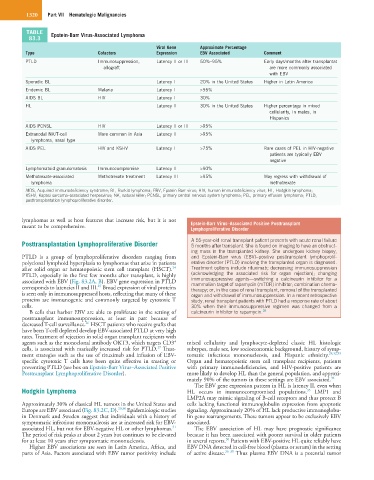
          TABLE   Epstein-Barr Virus-Associated Lymphoma
          83.3
                                                    Viral Gene     Approximate Percentage
         Type                    Cofactors          Expression     EBV Associated      Comment
         PTLD                    Immunosuppression,   Latency II or III  50%–95%       Early days/months after transplantat
                                   allograft                                             are more commonly associated
                                                                                         with EBV
         Sporadic BL                                Latency I     20% in the United States  Higher in Latin America
         Endemic BL              Malaria            Latency I     >95%
         AIDS BL                 HIV                Latency I     30%
         HL                                         Latency II    30% in the United States  Higher percentage in mixed
                                                                                         cellularity, in males, in
                                                                                         Hispanics
         AIDS PCNSL              HIV                Latency II or III  >95%
         Extranodal NK/T-cell    More common in Asia  Latency II  >95%
           lymphoma, nasal type
         AIDS PEL                HIV and KSHV       Latency I     >75%                 Rare cases of PEL in HIV-negative
                                                                                         patients are typically EBV
                                                                                         negative
         Lymphomatoid granulomatosis  Immunocompromise  Latency II  >90%
         Methotrexate-associated   Methotrexate treatment  Latency III  >95%           May regress with withdrawal of
           lymphoma                                                                      methotrexate
         AIDS, Acquired immunodeficiency syndrome; BL, Burkitt lymphoma; EBV, Epstein-Barr virus; HIV, human immunodeficiency virus; HL, Hodgkin lymphoma;
         KSHV, Kaposi sarcoma–associated herpesvirus; NK, natural killer; PCNSL, primary central nervous system lymphoma; PEL, primary effusion lymphoma; PTLD,
         posttransplantation lymphoproliferative disorder.


        lymphomas as well as host features that increase risk, but it is not
        meant to be comprehensive.                             Epstein-Barr Virus–Associated Positive Posttransplant
                                                               Lymphoproliferative Disorder
        Posttransplantation Lymphoproliferative Disorder        A 55-year-old renal transplant patient presents with acute renal failure
                                                                5 months after transplant. She is found on imaging to have an obstruct-
                                                                ing  mass  in  the  transplanted  kidney.  She  undergoes  kidney  biopsy,
        PTLD  is  a  group  of  lymphoproliferative  disorders  ranging  from   and  Epstein-Barr  virus  (EBV)–positive  posttransplant  lymphoprolif-
        polyclonal lymphoid hyperplasia to lymphomas that arise in patients   erative disorder (PTLD) involving the transplanted organ is diagnosed.
                                                         24
        after  solid  organ  or  hematopoietic  stem  cell  transplant  (HSCT).    Treatment options include rituximab; decreasing immunosuppression
        PTLD, especially in the first few months after transplant, is highly   (acknowledging  the  associated  risk  for  organ  rejection);  changing
        associated with EBV (Fig. 83.2A, B). EBV gene expression in PTLD   immunosuppressive  agents—switching  a  calcineurin  inhibitor  for  a
                                                                mammalian target of rapamycin (mTOR) inhibitor; combination chemo-
                                 25
        corresponds to latencies II and III.  Broad expression of viral proteins   therapy; or, in the case of renal transplant, removal of the transplanted
        is seen only in immunosuppressed hosts, reflecting that many of these   organ and withdrawal of immunosuppression. In a recent retrospective
        proteins are immunogenic and commonly targeted by cytotoxic T   study, renal transplant patients with PTLD had a response rate of about
        cells.                                                  30%  when  their  immunosuppressive  regimen  was  changed  from  a
           B cells that harbor EBV are able to proliferate in the setting of   calcineurin inhibitor to rapamycin. 28
        posttransplant  immunosuppression,  at  least  in  part  because  of
                             26
        decreased T-cell surveillance.  HSCT patients who receive grafts that
        have been T-cell depleted develop EBV-associated PTLD at very high
        rates. Treatment of rejection in solid organ transplant recipients with
                                                          +
        agents such as the monoclonal antibody OKT3, which targets CD3    mixed  cellularity  and  lymphocyte-depleted  classic  HL  histologic
                                                     27
        cells, is associated with markedly increased risk for PTLD.  Treat-  subtypes, male sex, low socioeconomic background, history of symp-
        ment strategies such as the use of rituximab and infusion of EBV-  tomatic  infectious  mononucleosis,  and  Hispanic  ethnicity. 29,32,33
        specific  cytotoxic  T  cells  have  been  quite  effective  in  treating  or   Organ  and  hematopoietic  stem  cell  transplant  recipients,  patients
        preventing PTLD (see box on Epstein-Barr Virus–Associated Positive   with  primary  immunodeficiencies,  and  HIV-positive  patients  are
        Posttransplant Lymphoproliferative Disorder).         more likely to develop HL than the general population, and approxi-
                                                              mately 90% of the tumors in these settings are EBV associated. 34
                                                                 The EBV gene expression pattern in HL is latency II, even when
        Hodgkin Lymphoma                                      HL  occurs  in  immunocompromised  populations.   LMP1  and
                                                                                                     35
                                                              LMP2A may mimic signaling of B-cell receptors and thus protect B
        Approximately 30% of classical HL tumors in the United States and   cells lacking functional immunoglobulin expression from apoptotic
        Europe are EBV associated (Fig. 83.2C, D). 29,30  Epidemiologic studies   signaling. Approximately 20% of HL lack productive immunoglobu-
        in Denmark and Sweden suggest that individuals with a history of   lin gene rearrangements. These tumors appear to be exclusively EBV
        symptomatic infectious mononucleosis are at increased risk for EBV-  associated.
                                                         31
        associated HL, but not for EBV-negative HL or other lymphomas.    The  EBV  association  of  HL  may  have  prognostic  significance
        The period of risk peaks at about 2 years but continues to be elevated   because it has been associated with poorer survival in older patients
                                                                           30
        for at least 10 years after symptomatic mononucleosis.  in several reports.  Patients with EBV-positive HL quite reliably have
           Higher EBV associations are seen in Latin America, Africa, and   EBV DNA detected in cell-free blood (plasma or serum) in the setting
        parts of Asia. Factors associated with EBV tumor positivity include   of active disease. 36–38  Thus plasma EBV DNA is a potential tumor

