


Page 1488 - Hematology_ Basic Principles and Practice ( PDFDrive )
P. 1488
Chapter 83  Virus-Associated Lymphoma  1323


                                                                      HTLV-1 infection


                                                Apoptosis


                                                                 Tax


                          Viral control                        Tax activates AKT and NF-κB,
                          by cytotoxic   CTL                   inactivates p53
                          T lymphocytes


                                                          Tax                 Tax induces
                                                                        Tax    aneuploidy
                                                                            and DNA damage
                                             Proliferation                                   Cellular
                                                                                           transformation
                                                                Tax                           to ATL
                                                                    30-40 years

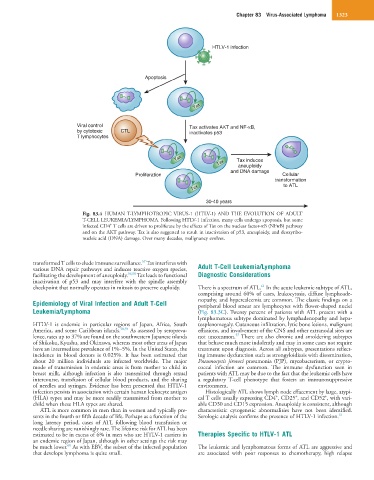
                            Fig.  83.4  HUMAN T-LYMPHOTROPIC VIRUS-1  (HTLV-1)  AND THE  EVOLUTION  OF  ADULT
                            T-CELL LEUKEMIA/LYMPHOMA. Following HTLV-1 infection, many cells undergo apoptosis, but some
                                     +
                            infected CD4  T cells are driven to proliferate by the effects of Tax on the nuclear factor-κB (NFκB) pathway
                            and on the AKT pathway. Tax is also suggested to result in inactivation of p53, aneuploidy, and deoxyribo-
                            nucleic acid (DNA) damage. Over many decades, malignancy evolves.


                                               57
            transformed T cells to elude immune surveillance.  Tax interferes with
            various DNA repair pathways and induces reactive oxygen species,   Adult T-Cell Leukemia/Lymphoma
            facilitating the development of aneuploidy. 56,58  Tax leads to functional   Diagnostic Considerations
            inactivation  of  p53  and  may  interfere  with  the  spindle  assembly
                                                                                      61
            checkpoint that normally operates in mitosis to preserve euploidy.  There is a spectrum of ATL.  In the acute leukemic subtype of ATL,
                                                                  comprising around 60% of cases, leukocytosis, diffuse lymphoade-
            Epidemiology of Viral Infection and Adult T-Cell      nopathy, and hypercalcemia are common. The classic findings on a
                                                                  peripheral blood smear are lymphocytes with flower-shaped nuclei
            Leukemia/Lymphoma                                     (Fig. 83.3C). Twenty percent of patients with ATL present with a
                                                                  lymphomatous subtype dominated by lymphadenopathy and hepa-
            HTLV-1  is  endemic  in  particular  regions  of  Japan,  Africa,  South   tosplenomegaly. Cutaneous infiltration, lytic bone lesions, malignant
            America, and some Caribbean islands. 58,59  As assessed by seropreva-  effusions, and involvement of the CNS and other extranodal sites are
                                                                              57
            lence, rates up to 37% are found on the southwestern Japanese islands   not uncommon.  There are also chronic and smoldering subtypes
            of Shikoku, Kyushu, and Okinawa, whereas most other areas of Japan   that behave much more indolently and may in some cases not require
            have an intermediate prevalence of 1%–5%. In the United States, the   treatment upon diagnosis. Across all subtypes, presentations reflect-
            incidence  in  blood  donors  is  0.025%.  It  has  been  estimated  that   ing immune dysfunction such as strongyloidiasis with dissemination,
            about  20  million  individuals  are  infected  worldwide.  The  major   Pneumocystis  jiroveci  pneumonia  (PJP),  mycobacterium,  or  crypto-
            mode of transmission in endemic areas is from mother to child in   coccal  infection  are  common.  The  immune  dysfunction  seen  in
            breast  milk,  although  infection  is  also  transmitted  through  sexual   patients with ATL may be due to the fact that the leukemic cells have
            intercourse, transfusion of cellular blood products, and the sharing   a  regulatory  T-cell  phenotype  that  fosters  an  immunosuppressive
            of needles and syringes. Evidence has been presented that HTLV-1   environment.
            infection persists in association with certain human leukocyte antigen   Histologically ATL shows lymph node effacement by large, atypi-
                                                                                                  +
                                                                                                           +
                                                                                           +
            (HLA) types and may be more readily transmitted from mother to   cal T cells usually expressing CD4 , CD25 , and CD52 , with vari-
            child when these HLA types are shared.                able CD30 and CD15 expression. Aneuploidy is consistent, although
              ATL is more common in men than in women and typically pre-  characteristic  cytogenetic  abnormalities  have  not  been  identified.
            sents in the fourth or fifth decade of life. Perhaps as a function of the   Serologic analysis confirms the presence of HTLV-1 infection. 61
            long  latency  period,  cases  of  ATL  following  blood  transfusion  or
            needle sharing are vanishingly rare. The lifetime risk for ATL has been
            estimated to be in excess of 6% in men who are HTLV-1 carriers in   Therapies Specific to HTLV-1 ATL
            an endemic region of Japan, although in other settings the risk may
                       60
            be much lower.  As with EBV, the subset of the infected population   The leukemic and lymphomatous forms of ATL are aggressive and
            that develops lymphoma is quite small.                are  associated  with  poor  responses  to  chemotherapy,  high  relapse

