


Page 1486 - Hematology_ Basic Principles and Practice ( PDFDrive )
P. 1486
Chapter 83  Virus-Associated Lymphoma  1321


                          A A                        C                         E E


                          B                         D                          FF
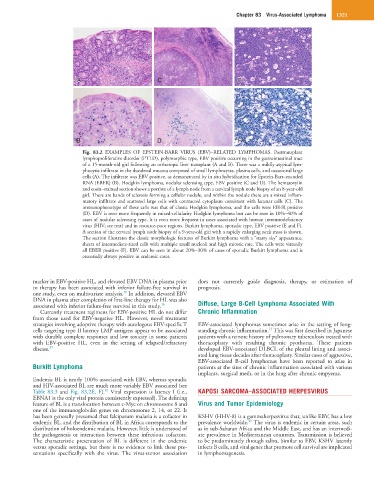
                            Fig.  83.2  EXAMPLES  OF  EPSTEIN-BARR  VIRUS  (EBV)–RELATED  LYMPHOMAS.  Posttransplant
                            lymphoproliferative disorder (PTLD), polymorphic type, EBV positive occurring in the gastrointestinal tract
                            of a 15-month-old girl following an orthotopic liver transplant (A and B). There was a mildly atypical lym-
                            phocytic infiltrate in the duodenal mucosa composed of small lymphocytes, plasma cells, and occasional large
                            cells (A). The infiltrate was EBV positive, as demonstrated by in situ hybridization for Epstein-Barr–encoded
                            RNA (EBER) (B). Hodgkin lymphoma, nodular sclerosing type, EBV positive (C and D). The hematoxylin
                            and eosin–stained section shows a portion of a lymph node from a cervical lymph node biopsy of an 8-year-old
                            girl. There are bands of sclerosis forming a cellular nodule, and within the nodule there are a mixed inflam-
                            matory infiltrate and scattered large cells with contracted cytoplasm consistent with lacunar cells (C). The
                            immunophenotype of these cells was that of classic Hodgkin lymphoma, and the cells were EBER positive
                            (D). EBV is seen more frequently in mixed-cellularity Hodgkin lymphoma but can be seen in 10%–40% of
                            cases of nodular sclerosing type. It is even more frequent in cases associated with human immunodeficiency
                            virus (HIV; see text) and in resource-poor regions. Burkitt lymphoma, sporadic type, EBV positive (E and F).
                            A section of the cervical lymph node biopsy of a 9-year-old girl with a rapidly enlarging neck mass is shown.
                            The section illustrates the classic morphologic features of Burkitt lymphoma with a “starry sky” appearance,
                            sheets of intermediate-sized cells with multiple small nucleoli and high mitotic rate. The cells were virtually
                            all EBER positive (F). EBV can be seen in about 20%–30% of cases of sporadic Burkitt lymphoma and is
                            essentially always positive in endemic cases.


            marker in EBV-positive HL, and elevated EBV DNA in plasma prior   does  not  currently  guide  diagnosis,  therapy,  or  estimation  of
            to therapy has been associated with inferior failure-free survival in   prognosis.
                                         36
            one study, even on multivariate analysis.  In addition, elevated EBV
            DNA in plasma after completion of first-line therapy for HL was also
            associated with inferior failure-free survival in this study. 36  Diffuse, Large B-Cell Lymphoma Associated With
              Currently treatment regimens for EBV-positive HL do not differ   Chronic Inflammation
            from  those  used  for  EBV-negative  HL.  However,  novel  treatment
            strategies involving adoptive therapy with autologous EBV-specific T   EBV-associated lymphomas sometimes arise in the setting of long-
                                                                                         15
            cells targeting type II latency LMP antigens appear to be associated   standing chronic inflammation.  This was first described in Japanese
            with durable complete responses and low toxicity in some patients   patients with a remote history of pulmonary tuberculosis treated with
            with  EBV-positive  HL,  even  in  the  setting  of  relapsed/refractory   thoracoplasty  with  resulting  chronic  pyothorax.  These  patients
            disease. 39                                           developed EBV-associated DLBCL of the pleural lining and associ-
                                                                  ated lung tissue decades after thoracoplasty. Similar cases of aggressive,
                                                                  EBV-associated  B-cell  lymphomas  have  been  reported  to  arise  in
            Burkitt Lymphoma                                      patients at the sites of chronic inflammation associated with various
                                                                  implants, surgical mesh, or in the lung after chronic empyema.
            Endemic BL is nearly 100% associated with EBV, whereas sporadic
            and HIV-associated BL are much more variably EBV associated (see
                                   40
            Table 83.3 and Fig. 83.2E, F).  Viral expression is latency I (i.e.,   KAPOSI SARCOMA–ASSOCIATED HERPESVIRUS
            EBNA1 is the only viral protein consistently expressed). The defining
            feature of BL is a translocation between c-Myc on chromosome 8 and   Virus and Tumor Epidemiology
            one of the immunoglobulin genes on chromosome 2, 14, or 22. It
            has been generally presumed that falciparum malaria is a cofactor in   KSHV (HHV-8) is a gammaherpesvirus that, unlike EBV, has a low
                                                                                  41
            endemic BL, and the distribution of BL in Africa corresponds to the   prevalence worldwide.  The virus is endemic in certain areas, such
            distribution of holoendemic malaria. However, little is understood of   as in sub-Saharan Africa and the Middle East, and has an intermedi-
            the  pathogenesis  or  interaction  between  these  infectious  cofactors.   ate prevalence in Mediterranean countries. Transmission is believed
            The  characteristic  presentation  of  BL  is  different  in  the  endemic   to be predominately through saliva. Similar to EBV, KSHV latently
            versus sporadic settings, but there is no evidence to link these pre-  infects B cells, and viral genes that promote cell survival are implicated
            sentations  specifically  with  the  virus.  The  virus-tumor  association   in lymphomagenesis.

