


Page 1489 - Hematology_ Basic Principles and Practice ( PDFDrive )
P. 1489
1324   Part VII  Hematologic Malignancies


        rates,  and  low  overall  survival.  In  a  phase  III  randomized  trial  in   TABLE
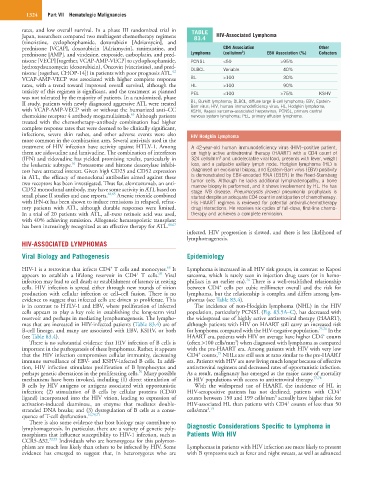
        Japan, researchers compared two multiagent chemotherapy regimens   83.4  HIV-Associated Lymphoma
        (vincristine,  cyclophosphamide,  doxorubicin  [Adriamycin],  and
        prednisone  [VCAP],  doxorubicin  [Adriamycin],  ranimustine,  and   CD4 Association             Other
                                                                                3
        prednisone [AMP], and vindesine, etoposide, carboplatin, and pred-  Lymphoma  (cells/mm )  EBV Association (%)  Cofactors
        nisone [VECP] [together, VCAP-AMP-VECP] to cyclophosphamide,   PCNSL  <50            >95%
        hydroxydaunomycin (doxorubicin), Oncovin (vincristine), and pred-  DLBCL  Variable    40%
                                                         62
        nisone [together, CHOP-14]) in patients with poor prognosis ATL.
        VCAP-AMP-VECP  was  associated  with  higher  complete  response   BL  >100           30%
        rates, with a trend toward improved overall survival, although the   HL  >100         90%
        toxicity of this regimen is significant, and the treatment as planned   PEL  <100    >75%        KSHV
        was not tolerated by the majority of patients. In a randomized, phase
        II study, patients with newly diagnosed aggressive ATL were treated   BL, Burkitt lymphoma; DLBCL, diffuse large B-cell lymphoma; EBV, Epstein-
                                                               Barr virus; HIV, human immunodeficiency virus; HL, Hodgkin lymphoma;
        with VCAP-AMP-VECP with or without the humanized anti–CC   KSHV, Kaposi sarcoma–associated herpesvirus; PCNSL, primary central
                                            63
        chemokine receptor 4 antibody mogamulizimab.  Although patients   nervous system lymphoma; PEL, primary effusion lymphoma.
        treated  with  the  chemotherapy–antibody  combination  had  higher
        complete response rates that were deemed to be clinically significant,
        infections,  severe  skin  rashes,  and  other  adverse  events  were  also   HIV Hodgkin Lymphoma
        more common in the combination arm. Several antivirals used in the
        treatment of HIV infection have activity against HTLV-1. Among   A 42-year-old human immunodeficiency virus (HIV)–positive patient,
        them are zidovudine and lamivudine. The combination of interferon   on  highly  active  antiretroviral  therapy  (HAART)  with  a  CD4  count  of
        (IFN) and zidovudine has yielded promising results, particularly in   324 cells/mm  and undetectable viral load, presents with fever, weight
                                                                         3
                         61
        the leukemic subtype.  Proteasome and histone deacetylase inhibi-  loss, and a palpable axillary lymph node. Hodgkin lymphoma (HL) is
        tors have attracted interest. Given high CD25 and CD52 expression   diagnosed on excisional biopsy, and Epstein-Barr virus (EBV) positivity
        in ATL, the efficacy of monoclonal antibodies aimed against these   is demonstrated by EBV-encoded RNA (EBER) in the Reed-Sternberg
        two receptors has been investigated. Thus far, alemtuzumab, an anti-  tumor  cells.  Although  he  lacks  additional  lymphadenopathy,  a  bone
                                                                marrow biopsy is performed, and it shows involvement by HL. He has
        CD52 monoclonal antibody, may have some activity in ATL based on   stage  IVB  disease.  Pneumocystis  jiroveci  pneumonia  prophylaxis  is
        small phase II studies and case reports. 64,65  Arsenic trioxide combined   started despite an adequate CD4 count in anticipation of chemotherapy.
        with IFN-α has been shown to induce remissions in relapsed, refrac-  His HAART regimen is reviewed for potential antiviral-chemotherapy
        tory  patients  with  ATL,  although  durable  responses  were  limited.   drug interactions. He receives six cycles of full-dose, first-line chemo-
        In a trial of 20 patients with ATL, all-trans retinoic acid was used,   therapy and achieves a complete remission.
        with 40% achieving remission. Allogeneic hematopoietic transplant
        has been increasingly recognized as an effective therapy for ATL. 66,67
                                                              infected, HIV progression is slowed, and there is less likelihood of
                                                              lymphomagenesis.
        HIV-ASSOCIATED LYMPHOMAS
        Viral Biology and Pathogenesis                        Epidemiology

                                     +
                                                        68
        HIV-1 is a retrovirus that infects CD4  T cells and monocytes.  It   Lymphoma is increased in all HIV risk groups, in contrast to Kaposi
                                              +
                                                     69
        appears  to  establish  a  lifelong  reservoir  in  CD4   T  cells.   Viral   sarcoma, which is rarely seen in injection drug users (or in hemo-
                                                                                  74
        infection may lead to cell death or establishment of latency in resting   philiacs in an earlier era).  There is a well-established relationship
                                                                         +
        cells. HIV infection is spread either through new rounds of virion   between  CD4   cells  per  cubic  millimeter  overall  and  the  risk  for
        production  with  cellular  infection  or  cell–cell  fusion. There  is  no   lymphoma, but the relationship is complex and differs among lym-
        evidence to suggest that infected cells are driven to proliferate. This   phomas (see Table 83.4).
        is in contrast to HTLV-1 and EBV, where proliferation of infected   The  incidence  of  non-Hodgkin  lymphoma  (NHL)  in  the  HIV
        cells  appears  to  play  a  key  role  in  establishing  the  long-term  viral   population, particularly PCNSL (Fig. 83.5A–C), has decreased with
        reservoir and perhaps in mediating lymphomagenesis. The lympho-  the widespread use of highly active antiretroviral therapy (HAART),
        mas that are increased in HIV-infected patients (Table 83.4) are of   although patients with HIV on HAART still carry an increased risk
        B-cell lineage, and many are associated with EBV, KSHV, or both   for lymphoma compared with the HIV-negative population. 75,76  In the
                                                                                                           +
        (see Table 83.4).                                     HAART era, patients with HIV on average have higher CD4  counts
                                                                              3
           There is no substantial evidence that HIV infection of B cells is   (often >100 cells/mm ) when diagnosed with lymphoma as compared
        important in the pathogenesis of these lymphomas. Rather, it appears   with the pre-HAART era. Among patients with HIV with very low
                                                                  +
                                                                        75
        that the HIV infection compromises cellular immunity, decreasing   CD4  counts,  NHLs are still seen at rates similar to the pre-HAART
        immune surveillance of EBV- and KSHV-infected B cells. In addi-  era. Patients with HIV are now living much longer because of effective
        tion, HIV infection stimulates proliferation of B lymphocytes and   antiretroviral regimens and decreased rates of opportunistic infection.
                                              70
        perhaps genetic aberrations in the proliferating cells.  Many possible   As a result, malignancy has emerged as the major cause of mortality
        mechanisms have been invoked, including (1) direct stimulation of   in HIV populations with access to antiretroviral therapy. 77,78
        B  cells  by  HIV  antigens  or  antigens  associated  with  opportunistic   With  the  widespread  use  of  HAART,  the  incidence  of  HL  in
                                                                                                                +
        infection;  (2)  stimulation  of  B  cells  by  cellular  proteins  (CD40   HIV-seropositive  patients  has  not  declined;  patients  with  CD4
                                                                                           3
        ligand) incorporated into the HIV virion, leading to expression of   counts between 150 and 199 cells/mm  actually have higher risk for
                                                                                               +
        activation-induced  deaminase,  an  enzyme  that  mediates  double-  HIV-associated HL than patients with CD4  counts of less than 50
                                                                     3 79
        stranded DNA breaks; and (3) dysregulation of B cells as a conse-  cells/mm .
        quence of T-cell dysfunction. 16,70,71
           There is also some evidence that host biology may contribute to
        lymphomagenesis. In particular, there are a variety of genetic poly-  Diagnostic Considerations Specific to Lymphoma in
        morphisms that influence susceptibility to HIV-1 infection, such as   Patients With HIV
        CCR5-Δ32. 72,73  Individuals who are homozygous for this polymor-
        phism are much less likely than others to be infected by HIV. Some   Lymphomas in patients with HIV infection are more likely to present
        evidence  has  emerged  to  suggest  that,  in  heterozygotes  who  are   with B symptoms such as fever and night sweats, as well as advanced

