


Page 1487 - Hematology_ Basic Principles and Practice ( PDFDrive )
P. 1487
1322   Part VII  Hematologic Malignancies


                       A                                 B                 C

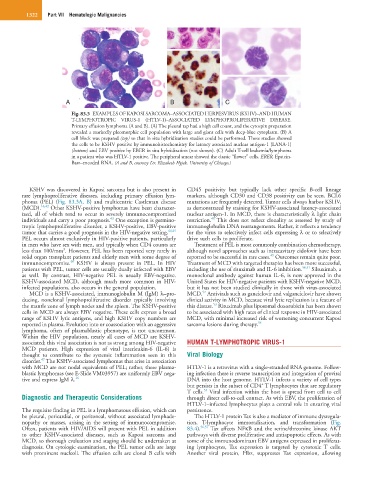
                        Fig. 83.3  EXAMPLES OF KAPOSI SARCOMA–ASSOCIATED HERPESVIRUS (KSHV)–AND HUMAN
                        T-LYMPHOTROPIC  VIRUS-1  (HTLV-1)–ASSOCIATED  LYMPHOPROLIFERATIVE  DISEASE.
                        Primary effusion lymphoma (A and B). (A) The pleural tap had a high cell count, and the cytospin preparation
                        revealed a markedly pleomorphic cell population with large and giant cells with deep-blue cytoplasm. (B) A
                        cell block was prepared (top) so that in situ hybridization studies could be performed. These studies showed
                        the cells to be KSHV positive by immunohistochemistry for latency associated nuclear antigen-1 (LANA-1)
                        (bottom) and EBV positive by EBER in situ hybridization (not shown). (C) Adult T-cell leukemia/lymphoma
                        in a patient who was HTLV-1 positive. The peripheral smear showed the classic “flower” cells. EBER, Epstein-
                        Barr–encoded RNA. (A and B, courtesy Dr. Elizabeth Hyjek, University of Chicago.)


           KSHV was discovered in Kaposi sarcoma but is also present in   CD45  positivity  but  typically  lack  other  specific  B-cell  lineage
        rare  lymphoproliferative  diseases,  including  primary  effusion  lym-  markers, although CD30 and CD38 positivity can be seen. BCL6
        phoma  (PEL)  (Fig.  83.3A,  B)  and  multicentric  Castleman  disease   mutations are frequently detected. Tumor cells always harbor KSHV,
        (MCD). 16,42  Other KSHV-positive lymphomas have been character-  as demonstrated by staining for KSHV-associated latency-associated
        ized,  all  of  which  tend  to  occur  in  severely  immunocompromised   nuclear antigen-1. In MCD, there is characteristically λ light chain
                                     43
                                                                      48
        individuals and carry a poor prognosis.  One exception is germino-  restriction.  This does not reflect clonality as assessed by study of
        tropic lymphoproliferative disorder, a KSHV-positive, EBV-positive   immunoglobulin DNA rearrangements. Rather, it reflects a tendency
        tumor that carries a good prognosis in the HIV-negative setting. 44,45    for the virus to selectively infect cells expressing λ or to selectively
        PEL occurs almost exclusively in HIV-positive patients, particularly   drive such cells to proliferate.
        in men who have sex with men, and typically when CD4 counts are   Treatment of PEL is most commonly combination chemotherapy,
                      3
        less than 100/mm . However, PEL has been reported very rarely in   although novel approaches such as intracavitary cidofovir have been
                                                                                         49
        solid organ transplant patients and elderly men with some degree of   reported to be successful in rare cases.  Outcomes remain quite poor.
                        46
        immunocompromise.   KSHV  is  always  present  in  PEL.  In  HIV   Treatment of MCD with targeted therapies has been more successful,
        patients with PEL, tumor cells are usually dually infected with EBV   including the use of rituximab and IL-6 inhibition. 50,51  Siltuximab, a
        as  well.  By  contrast,  HIV-negative  PEL  is  usually  EBV-negative.   monoclonal antibody against human IL-6, is now approved in the
        KSHV-associated  MCD,  although  much  more  common  in  HIV-  United States for HIV-negative patients with KSHV-negative MCD,
        infected populations, also occurs in the general population.  but it has not been studied clinically in those with virus-associated
                                                                   52
           MCD is a KSHV-associated, immunoglobulin M (IgM) λ–pro-  MCD.  Antivirals such as ganciclovir and valganciclovir have shown
        ducing,  nonclonal  lymphoproliferative  disorder  typically  involving   clinical activity in MCD, because viral lytic replication is a feature of
                                                                       53
        the mantle zone of lymph nodes and the spleen. The KSHV-positive   this disease.  Rituximab plus liposomal doxorubicin has been shown
        cells in MCD are always EBV negative. These cells express a broad   to be associated with high rates of clinical response in HIV-associated
        range of KSHV lytic antigens, and high KSHV copy numbers are   MCD, with minimal increased risk of worsening concurrent Kaposi
        reported in plasma. Evolution into or coassociation with an aggressive   sarcoma lesions during therapy. 54
        lymphoma,  often  of  plasmablastic  phenotype,  is  not  uncommon.
        Within the HIV population, nearly all cases of MCD are KSHV-
        associated; this viral association is not as strong among HIV-negative   HUMAN T-LYMPHOTROPIC VIRUS-1
        MCD  patients.  High  expression  of  viral  interleukin-6  (IL-6)  is
        thought  to  contribute  to  the  systemic  inflammation  seen  in  this   Viral Biology
               47
        disorder.  The KSHV-associated lymphomas that arise in association
        with MCD are not nodal equivalents of PEL; rather, these plasma-  HTLV-1 is a retrovirus with a single-stranded RNA genome. Follow-
        blastic lymphomas (see E-Slide VM03957) are uniformly EBV nega-  ing infection there is reverse transcription and integration of proviral
        tive and express IgM λ. 16                            DNA into the host genome. HTLV-1 infects a variety of cell types
                                                                                       +
                                                              but persists in the subset of CD4  T lymphocytes that are regulatory
                                                                    55
                                                              T cells.  Viral infection within the host is spread from cell to cell
        Diagnostic and Therapeutic Considerations             through direct cell-to-cell contact. As with EBV, the proliferation of
                                                              HTLV-1–infected lymphocytes plays a central role in ensuring viral
        The requisite finding in PEL is a lymphomatous effusion, which can   persistence.
        be pleural, pericardial, or peritoneal, without associated lymphade-  The HTLV-1 protein Tax is also a mediator of immune dysregula-
        nopathy  or  masses,  arising  in  the  setting  of  immunocompromise.   tion,  T-lymphocyte  immortalization,  and  transformation  (Fig.
        Often, patients with HIV/AIDS will present with PEL in addition   83.4). 56,57  Tax  affects  NFκB  and  the  serine/threonine  kinase  AKT
        to  other  KSHV-associated  diseases,  such  as  Kaposi  sarcoma  and   pathways with diverse proliferative and antiapoptotic effects. As with
        MCD, so thorough evaluation and staging should be undertaken at   some of the immunodominant EBV antigens expressed in proliferat-
        diagnosis. On cytologic examination, the PEL tumor cells are large   ing  lymphocytes,  Tax  expression  is  targeted  by  cytotoxic  T  cells.
        with prominent nucleoli. The effusion cells are clonal B cells with   Another  viral  protein,  Hbz,  suppresses  Tax  expression,  allowing

