


Page 1585 - Hematology_ Basic Principles and Practice ( PDFDrive )
P. 1585
1412   Part VII  Hematologic Malignancies


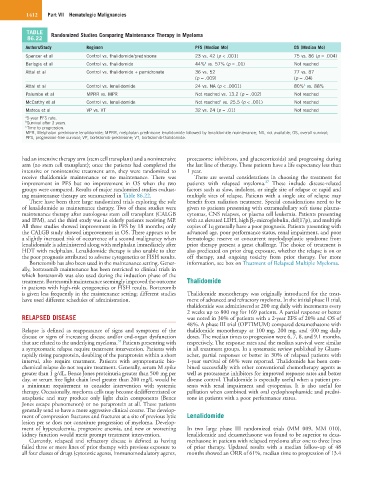
          TABLE   Randomized Studies Comparing Maintenance Therapy in Myeloma
          86.22
         Authors/Study       Regimen                             PFS (Median Mo)                 OS (Median Mo)
         Spencer et al       Control vs. thalidomide/prednisone  23 vs. 42 (p < .001)            75 vs. 86 (p = .004)
         Barlogie et al      Control vs. thalidomide             44%  vs. 57% (p = .01)          Not reached
                                                                    a
         Attal et al         Control vs. thalidomide + pamidronate  36 vs. 52                    77 vs. 87
                                                                 (p = .009)                      (p = .04)
         Attal et al         Control vs. lenalidomide            24 vs. NA (p < .0001)           80%  vs. 88%
                                                                                                    b
         Palumbo et al       MPRR vs. MPR                        Not reached vs. 13.2 (p = .002)  Not reached
                                                                         c
         McCarthy et al      Control vs. lenalidomide            Not reached  vs. 25.5 (p < .001)  Not reached
         Mateos et al        VP vs. VT                           32 vs. 24 (p = .01)             Not reached
         a 5-year PFS rate.
         b Survival after 3 years.
         c Time to progression.
         MPR, Melphalan-prednisone-lenalidomide; MPRR, melphalan-prednisone-lenalidomide followed by lenalidomide maintenance; NA, not available; OS, overall survival;
         PFS, progression-free survival; VP, bortezomib-prednisone; VT, bortezomib-thalidomide.


        had an intensive therapy arm (stem cell transplant) and a nonintensive   proteasome inhibitors, and glucocorticoids) and progressing during
        arm (no stem cell transplant); once the patients had completed the   the last line of therapy. These patients have a life expectancy less than
        intensive or nonintensive treatment arm, they were randomized to   1 year.
        receive  thalidomide  maintenance  or  no  maintenance.  There  was   There  are  several  considerations  in  choosing  the  treatment  for
                                                                                        37
        improvement  in  PFS  but  no  improvement  in  OS  when  the  two   patients  with  relapsed  myeloma.   These  include  disease-related
        groups were compared. Results of major randomized studies evaluat-  factors such as slow, indolent, or single site of relapse or rapid and
        ing maintenance therapy are summarized in Table 86.22.  multiple sites of relapse. Patients with a single site of relapse may
           There have been three large randomized trials exploring the role   benefit from radiation treatment. Special considerations need to be
        of lenalidomide as maintenance therapy. Two of these studies were   given to patients presenting with extramedullary soft tissue plasma-
        maintenance therapy after autologous stem cell transplant (CALGB   cytomas, CNS relapses, or plasma cell leukemia. Patients presenting
        and IFM), and the third study was in elderly patients receiving MP.   with an elevated LDH, high β 2 -microglobulin, del(17p), and multiple
        All three studies showed improvement in PFS by 18 months; only   copies of 1q generally have a poor prognosis. Patients presenting with
        the CALGB study showed improvement in OS. There appears to be   advanced age, poor performance status, renal impairment, and poor
        a slightly increased risk of occurrence of a second malignancy when   hematologic  reserve  or  concurrent  myelodysplastic  syndrome  from
        lenalidomide is administered along with melphalan immediately after   prior therapy present a great challenge. The choice of treatment is
        HDT with melphalan. Lenalidomide therapy is also unable to alter   also predicated on prior drug exposure, whether the relapse is on or
        the poor prognosis attributed to adverse cytogenetics or FISH results.  off  therapy,  and  ongoing  toxicity  from  prior  therapy.  For  more
           Bortezomib has also been used in the maintenance setting. Gener-  information, see box on Treatment of Relapsed Multiple Myeloma.
        ally, bortezomib maintenance has been restricted to clinical trials in
        which bortezomib was also used during the induction phase of the
        treatment. Bortezomib maintenance seemingly improved the outcome   Thalidomide
        in patients with high-risk cytogenetics or FISH results. Bortezomib
        is given less frequently in the maintenance setting; different studies   Thalidomide monotherapy was originally introduced for the treat-
        have used different schedules of administration.      ment of advanced and refractory myeloma. In the initial phase II trial,
                                                              thalidomide was administered at 200 mg daily with increments every
                                                              2 weeks up to 800 mg for 169 patients. A partial response or better
        RELAPSED DISEASE                                      was noted in 30% of patients with a 2-year EFS of 20% and OS of
                                                              48%. A phase III trial (OPTIMUM) compared dexamethasone with
        Relapse  is  defined  as  reappearance  of  signs  and  symptoms  of  the   thalidomide  monotherapy  at  100 mg,  200 mg,  and  400 mg  daily
        disease or signs of increasing disease and/or end-organ dysfunction   doses. The median times to progression were 6, 7, 8, and 9.1 months,
                                        37
        that are related to the underlying myeloma.  Patients presenting with   respectively. The response rates and the median survival were similar
        a symptomatic relapse require treatment intervention. Patients with   in all treatment groups. In a systematic review published by Glasm-
        rapidly rising paraprotein, doubling of the paraprotein within a short   acher, partial responses or better in 30% of relapsed patients with
        interval,  also  require  treatment.  Patients  with  asymptomatic  bio-  1-year survival of 60% were reported. Thalidomide has been com-
        chemical relapse do not require treatment. Generally, serum M spike   bined successfully with other conventional chemotherapy agents as
        greater than 1 g/dL, Bence Jones proteinuria greater than 500 mg per   well as proteasome inhibitors for improved response rates and better
        day, or serum free light chain level greater than 200 mg/L would be   disease control. Thalidomide is especially useful when a patient pre-
        a  minimum  requirement  to  consider  intervention  with  systemic   sents  with  renal  impairment  and  cytopenias.  It  is  also  useful  for
        therapy. Occasionally, myeloma cells may become dedifferentiated or   palliation when combined with oral cyclophosphamide and predni-
        anaplastic  and  may  produce  only  light  chain  components  (Bence   sone in patients with a poor performance status.
        Jones escape phenomenon) or no paraprotein at all. These patients
        generally tend to have a more aggressive clinical course. The develop-
        ment of compression fractures and fractures at a site of previous lytic   Lenalidomide
        lesion per se does not constitute progression of myeloma. Develop-
        ment of hypercalcemia, progressive anemia, and new or worsening   In  two  large  phase  III  randomized  trials  (MM  009,  MM  010),
        kidney function would merit prompt treatment intervention.  lenalidomide and dexamethasone was found to be superior to dexa-
           Currently,  relapsed  and  refractory  disease  is  defined  as  having   methasone in patients with relapsed myeloma after one to three lines
        failed three or more lines of prior therapy with previous exposure to   of  prior  therapy.  Updated  results  with  a  median  follow-up  of  48
        all four classes of drugs (cytotoxic agents, immunomodulatory agents,   months showed an ORR of 61%, median time to progression of 13.4

