


Page 1586 - Hematology_ Basic Principles and Practice ( PDFDrive )
P. 1586
Chapter 86  Plasma Cell Neoplasms  1413


                                                                  Among patients with relapsed myeloma following one to three lines
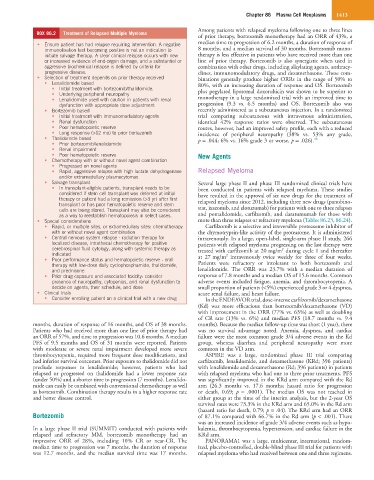
             BOX 86.2  Treatment of Relapsed Multiple Myeloma
                                                                  of prior therapy, bortezomib monotherapy had an ORR of 43%, a
             •  Ensure patient has had relapse requiring intervention. A negative   median time to progression of 6.2 months, a duration of response of
                immunofixation test becoming positive is not an indication to   8 months, and a median survival of 30 months. Bortezomib mono-
                initiate salvage therapy. A clear clinical relapse occurs with new   therapy is less effective in patients who have received more than one
                or increased evidence of end-organ damage, and a substantial or   line  of  prior  therapy.  Bortezomib  is  also  synergistic  when  used  in
                aggressive biochemical relapse is defined by criteria for   combination with other drugs, including alkylating agents, anthracy-
                progressive disease.                              clines, immunomodulatory drugs, and dexamethasone. These com-
             •  Selection of treatment depends on prior therapy received  binations generally produce higher ORRs in the range of 50% to
                •  Lenalidomide based                             80%, with an increasing duration of response and OS. Bortezomib
                  •  Initial treatment with bortezomib/thalidomide.  plus pegylated liposomal doxorubicin was shown to be superior to
                  •  Underlying peripheral neuropathy
                  •  Lenalidomide used with caution in patients with renal   monotherapy in a large randomized trial with an improved time to
                    dysfunction with appropriate dose adjustment  progression  (9.3  vs.  6.5  months)  and  OS.  Bortezomib  also  was
                •  Bortezomib based                               recently administered as a subcutaneous injection. In a randomized
                  •  Initial treatment with immunomodulatory agents  trial  comparing  subcutaneous  with  intravenous  administration,
                  •  Renal dysfunction                            identical  42%  response  ratios  were  observed.  The  subcutaneous
                  •  Poor hematopoietic reserve                   routes, however, had an improved safety profile, each with a reduced
                  •  Long response (>12 mo) to prior bortezomib   incidence  of  peripheral  neuropathy  (38%  vs.  53%  any  grade,
                •  Thalidomide based                              p = .044; 6% vs. 16% grade 3 or worse, p = .026). 38
                  •  Prior bortezomib/lenalidomide
                  •  Renal impairment
                  •  Poor hematopoietic reserve                   New Agents
                •  Chemotherapy with or without novel agent combination
                  •  Progressed on novel agents
                  •  Rapid, aggressive relapse with high lactate dehydrogenase   Relapsed Myeloma
                    and/or extramedullary plasmacytomas
                •  Salvage transplant                             Several large phase II and phase III randomized clinical trials have
                  •  In transplant-eligible patients, transplant needs to be   been  conducted  in  patients  with  relapsed  myeloma. These  studies
                    considered if stem cell transplant was deferred at initial   have resulted in the approval of six new drugs for the treatment of
                    therapy or patient had a long remission (>3 yr) after first   relapsed myeloma since 2012, including three new drugs (panobino-
                    transplant or has poor hematopoietic reserve and stem
                    cells are being stored. Transplant may also be considered   stat, ixazomib, and elotuzumab) for patients with one to three relapses
                    as a way to reestablish hematopoiesis in select cases.  and  pomalidomide,  carfilzomib,  and  daratumumab  for  those  with
             •  Special considerations                            more than three relapses or refractory myeloma (Tables 86.23, 86.24).
                •  Rapid, or multiple sites, or extramedullary sites: chemotherapy   Carfilzomib is a selective and irreversible proteasome inhibitor of
                  with or without novel agent combination         the chymotrypsin-like activity of the proteasome. It is administered
                •  Central nervous system relapse - radiation therapy for   intravenously. In a large, open-label, single-arm phase II study, 266
                  localized disease, intrathecal chemotherapy for positive   patients with relapsed myeloma progressing on the last therapy were
                  cerebrospinal fluid cytology, along with systemic therapy as   treated with carfilzomib at 20 mg/m  during cycle 1 and thereafter
                                                                                             2
                  indicated                                       at  27 mg/m   intravenously  twice  weekly  for  three  of  four  weeks.
                                                                           2
                •  Poor performance status and hematopoietic reserve - oral
                  therapy with low-dose daily cyclophosphamide, thalidomide,   Patients  were  refractory  or  intolerant  to  both  bortezomib  and
                  and prednisone                                  lenalidomide.  The  ORR  was  23.7%  with  a  median  duration  of
                •  Prior drug exposure and associated toxicity: consider   response of 7.8 months and a median OS of 15.6 months. Common
                  presence of neuropathy, cytopenias, and renal dysfunction to   adverse events included fatigue, anemia, and thrombocytopenia. A
                  decide on agents, their schedule, and dose      small proportion of patients (<5%) experienced grade 3 or 4 dyspnea,
             •  Clinical trials                                   acute renal failure, and heart failure.
                •  Consider enrolling patient on a clinical trial with a new drug  In the ENDEAVOR trial, dose-intense carfilzomib/dexamethasone
                                                                  (Kd)  was  more  efficacious  than  bortezomib/dexamethasone  (VD)
                                                                  with improvement in the ORR (77% vs. 63%) as well as doubling
                                                                  of  CR  rate  (13%  vs.  6%)  and  median  PFS  (18.7  months  vs.  9.4
            months, duration of response of 16 months, and OS of 38 months.   months). Because the median follow-up time was short (1 year), there
            Patients who had received more than one line of prior therapy had   was  no  survival  advantage  noted.  Anemia,  dyspnea,  and  cardiac
            an ORR of 57%, and time to progression was 10.6 months. A median   failure were the most common grade 3/4 adverse events in the Kd
            PFS of 9.5 months and OS of 31 months were reported. Patients   group,  whereas  diarrhea  and  peripheral  neuropathy  were  more
            with  moderate  or  severe  renal  impairment  developed  more  severe   common in the VD arm.
            thrombocytopenia, required more frequent dose modifications, and   ASPIRE  was  a  large,  randomized  phase  III  trial  comparing
            had inferior survival outcomes. Prior exposure to thalidomide did not   carfilzomib, lenalidomide, and dexamethasone (KRd; 396 patients)
            preclude  responses  to  lenalidomide;  however,  patients  who  had   with lenalidomide and dexamethasone (Rd; 396 patients) in patients
            relapsed  or  progressed  on  thalidomide  had  a  lower  response  rate   with relapsed myeloma who had one to three prior treatments. PFS
            (under 50%) and a shorter time to progression (7 months). Lenalido-  was significantly improved in the KRd arm compared with the Rd
            mide can easily be combined with conventional chemotherapy as well   arm  (26.3  months  vs.  17.6  months;  hazard  ratio  for  progression
            as bortezomib. Combination therapy results in a higher response rate   or  death,  0.69;  p  =  .0001).  The  median  OS  was  not  reached  in
            and better disease control.                           either group at the time of the interim analysis, but the 2-year OS
                                                                  survival rates were 73.3% in the KRd arm and 65.0% in the Rd arm
                                                                  (hazard ratio for death, 0.79; p = .04). The KRd arm had an ORR
            Bortezomib                                            of 87.1% compared with 66.7% in the Rd arm (p < .001). There
                                                                  was an increased incidence of grade 3/4 adverse events such as hypo-
            In a large phase II trial (SUMMIT) conducted with patients with   kalemia, thrombocytopenia, hypertension, and cardiac failure in the
            relapsed  and  refractory  MM,  bortezomib  monotherapy  had  an   KRd arm.
            impressive  ORR  of  28%,  including  10%  CR  or  near-CR.  The   PANORAMA1 was a large, multicenter, international, random-
            median time to progression was 7 months, the duration of response   ized, placebo-controlled, double-blind phase III trial for patients with
            was  12.7  months,  and  the  median  survival  time  was  17  months.   relapsed myeloma who had received between one and three regimens.

