


Page 1587 - Hematology_ Basic Principles and Practice ( PDFDrive )
P. 1587
1414   Part VII  Hematologic Malignancies


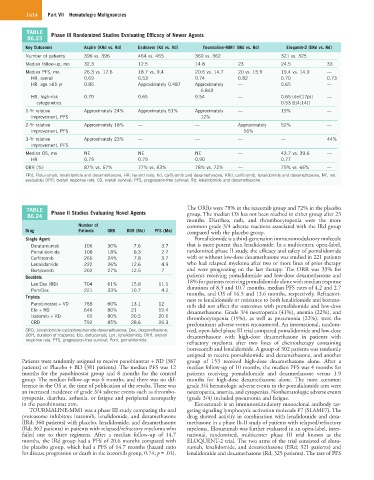
          TABLE   Phase III Randomized Studies Evaluating Efficacy of Newer Agents
          86.23
         Key Outcomes        Aspire (KRd vs. Rd)  Endeavor (Kd vs. Vd)  Tourmaline-MM1 (IRd vs. Rd)  Eloquent-2 (ERd vs. Rd)
         Number of patients  396 vs. 396      464 vs. 465        360 vs. 362                 321 vs. 325
         Median follow-up, mo  32.3           12.5               14.8          23            24.5           33
         Median PFS, mo      26.3 vs. 17.6    18.7 vs. 9.4       20.6 vs. 14.7  20 vs. 15.9  19.4 vs. 14.9  —
            HR, overall      0.69             0.53               0.74          0.82          0.70           0.73
            HR, age ≥65 yr   0.85             Approximately 0.487  Approximately   —         0.65           —
                                                                   0.843
            HR, high-risk    0.70             0.65               0.54          —             0.65 [del(17p)]  —
             cytogenetics                                                                    0.53 [t(4;14)]
         1-Yr relative       Approximately 24%  Approximately 51%  Approximately   —         19%            —
           improvement, PFS                                        12%
         2-Yr relative       Approximately 18%  —                —             Approximately   52%          —
           improvement, PFS                                                      16%
         3-Yr relative       Approximately 23%  —                —             —             —              44%
           improvement, PFS
         Median OS, mo       NE               NE                 NE            —             43.7 vs. 39.6  —
            HR               0.79             0.79               0.90          —             0.77           —
         ORR (%)             87% vs. 67%      77% vs. 63%        78% vs. 72%   —             79% vs. 66%    —
         ERd, Elotuzumab, lenalidomide and dexamethasone; HR, hazard ratio; Kd, carfilzomib and dexamethasone; KRd, carfilzomib, lenalidomide and dexamethasone; NE, not
         evaluable; ORR, overall response rate; OS, overall survival; PFS, progression-free survival; Rd, lenalidomide and dexamethasone.


          TABLE   Phase II Studies Evaluating Novel Agents    The ORRs were 78% in the ixazomib group and 72% in the placebo
          86.24                                               group. The median OS has not been reached in either group after 23
                                                              months.  Diarrhea,  rash,  and  thrombocytopenia  were  the  more
                           Number of                          common grade 3/4 adverse reactions associated with the IRd group
         Drug              Patients  ORR   DOR (Mo)  PFS (Mo)  compared with the placebo group.
         Single Agent                                            Pomalidomide is a third-generation immunomodulatory molecule
            Daratumumab      106    30%      7.6      3.7     that is more potent than lenalidomide. In a multicenter, open-label,
            Pomalidomide     108    18%      8.3      2.7     randomized phase II study, the efficacy and safety of pomalidomide
            Carfilzomib      266    24%      7.8      3.7     with or without low-dose dexamethasone was studied in 221 patients
            Lenalidomide     222    26%     12.6      4.9     who had relapsed myeloma after two or more lines of prior therapy
            Bortezomib       202    27%     12.5      7       and  were  progressing  on  the  last  therapy. The  ORR  was  33%  for
         Doublets                                             patients receiving pomalidomide and low-dose dexamethasone and
            Len/Dex (RD)     704    61%     15.8     11.1     18% for patients receiving pomalidomide alone with median response
                                                              durations of 8.3 and 10.7 months, median PFS rates of 4.2 and 2.7
            Pom/Dex          221    33%     10.7      4.2     months, and OS of 16.5 and 13.6 months, respectively. Refractori-
         Triplets                                             ness to lenalidomide or resistance to both lenalidomide and bortezo-
            Panobinostat + VD  768  60%     13.1     12       mib did not affect the outcomes with pomalidomide and low-dose
            Elo + RD         646    80%     21       19.4     dexamethasone. Grade 3/4 neutropenia (41%), anemia (22%), and
            Ixazomib + RD    65     80%     20.5     20.6     thrombocytopenia  (19%),  as  well  as  pneumonia  (22%),  were  the
            CRD              792    85%     28.6     26.3     predominant adverse events encountered. An international, random-
         CRD, Lenalidomide-cyclophosphamide-dexamethasone; Dex, dexamethasone;   ized, open-label phase III trial compared pomalidomide and low-dose
         DOR, duration of response; Elo, elotuzumab; Len, lenalidomide; ORR, overall   dexamethasone  with  high-dose  dexamethasone  in  patients  with
         response rate; PFS, progression-free survival; Pom, pomalidomide.
                                                              refractory  myeloma  after  two  lines  of  chemotherapy  containing
                                                              bortezomib and lenalidomide. A group of 302 patients was randomly
                                                              assigned to receive pomalidomide and dexamethasone, and another
        Patients were randomly assigned to receive panobinostat + BD (387   group  of  153  received  high-dose  dexamethasone  alone.  After  a
        patients) or Placebo + BD (381 patients). The median PFS was 12   median follow-up of 10 months, the median PFS was 4 months for
        months for the panobinostat group and 8 months for the control   patients  receiving  pomalidomide  and  dexamethasone  versus  1.9
        group. The median follow-up was 6 months, and there was no dif-  months  for  high-dose  dexamethasone  alone.  The  most  common
        ference in the OS at the time of publication of the results. There was   grade 3/4 hematologic adverse events in the pomalidomide arm were
        an increased incidence of grade 3/4 adverse events such as thrombo-  neutropenia, anemia, and cytopenias. Nonhematologic adverse events
        cytopenia, diarrhea, asthenia, or fatigue and peripheral neuropathy   (grade 3/4) included pneumonia and fatigue.
        in the panobinostat arm.                                 Elotuzumab is an immunostimulatory monoclonal antibody tar-
           TOURMALINE-MM1 was a phase III study comparing the oral   geting signaling lymphocytic activation molecule F7 (SLAMF7). The
        proteasome  inhibitors  ixazomib,  lenalidomide,  and  dexamethasone   drug showed activity in combination with lenalidomide and dexa-
        (IRd; 360 patients) with placebo, lenalidomide, and dexamethasone   methasone in a phase Ib-II study of patients with relapsed/refractory
        (Rd; 362 patients) in patients with relapsed/refractory myeloma who   myeloma. Elotuzumab was further evaluated in an open-label, inter-
        failed  one  to  three  regimens.  After  a  median  follow-up  of  14.7   national,  randomized,  multicenter  phase  III  trial  known  as  the
        months, the IRd group had a PFS of 20.6 months compared with   ELOQUENT-2 trial. The two arms of the trial consisted of elotu-
        the placebo group, which had a PFS of 14.7 months (hazard ratio   zumab, lenalidomide, and dexamethasone (ERd; 321 patients) and
        for disease progression or death in the ixazomib group, 0.74; p = .01).   lenalidomide and dexamethasone (Rd; 325 patients). The rate of PFS

