


Page 1613 - Hematology_ Basic Principles and Practice ( PDFDrive )
P. 1613
1434   Part VII  Hematologic Malignancies


        fraction. The patient was placed on lisinopril and did not improve.
        He returned and underwent catheterization with coronary angiogra-
        phy. His coronary arteries were normal, and he was diagnosed with
        deconditioning.  His  dyspnea  continued,  and  he  was  referred  to  a
        pulmonologist, who recognized the long-standing monoclonal gam-
        mopathy and obtained light chain studies that showed a λ light chain
        of 41 mg/dL and κ of 10 mg/dL. The patient underwent a subcuta-
        neous fat aspiration that demonstrated amyloid deposits, which, by
        mass spectroscopy, were found to be of λ origin. At this point, the
        patient had New York Heart Association class IV heart failure; he
        died within 3 months thereafter.

        Comment on Patient 2

        This case is an example of a classic failure to recognize that patients
        with monoclonal gammopathies should have amyloidosis included in
        the differential diagnosis. The fact that the monoclonal protein was
        stable  would  certainly  argue  against  the  development  of  multiple
        myeloma, but light-chain amyloidosis regularly occurs without any
        change in the M component over time. The failure to recognize the
        patient’s progressive fatigue and shortness of breath as cardiac amyloid
        is not unusual. The echocardiographic findings of thickening were
        interpreted as being caused by hypertension, but, in fact, they were
        caused by infiltrative cardiomyopathy, and the cardiac catheterization
        and angiogram without an endomyocardial biopsy led to a missed
        diagnosis. Only an increased index of suspicion in patients with a
        known monoclonal protein allowed this diagnosis to be confirmed.
           One of the major difficulties in the diagnosis of amyloidosis is
        that there is virtually no blood test or imaging study that is diagnostic
        of the disease. The most common symptoms associated with amyloi-
        dosis are fatigue, lower extremity edema (may be cardiac or renal),
        unexplained  weight  loss  (often  leading  to  search  for  occult  malig-
        nancy), exertional dyspnea, orthostatic hypotension, and paresthesias.
        These symptoms are quite vague, and in a general medical practice,
        there are hundreds of disorders that are far more common and are
        responsible for light-chain amyloidosis. As noticed in Patient 2, the
        fatigue,  which is often caused  by  early  cardiac  amyloid but  is  not
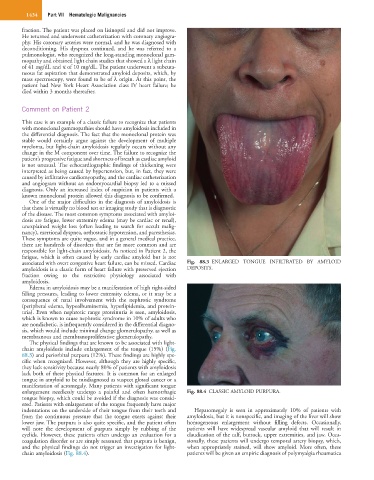
        associated with overt congestive heart failure, can be missed. Cardiac   Fig.  88.3  ENLARGED  TONGUE  INFILTRATED  BY  AMYLOID
        amyloidosis is a classic form of heart failure with preserved ejection   DEPOSITS.
        fraction  owing  to  the  restrictive  physiology  associated  with
        amyloidosis.
           Edema in amyloidosis may be a manifestation of high right-sided
        filling pressures, leading to lower extremity edema, or it may be a
        consequence  of  renal  involvement  with  the  nephrotic  syndrome
        (peripheral edema, hypoalbuminemia, hyperlipidemia, and protein-
        uria). Even when nephrotic range proteinuria is seen, amyloidosis,
        which is known to cause nephrotic syndrome in 10% of adults who
        are nondiabetic, is infrequently considered in the differential diagno-
        sis, which would include minimal change glomerulopathy, as well as
        membranous and membranoproliferative glomerulopathy.
           The physical findings that are known to be associated with light-
        chain  amyloidosis  include  enlargement  of  the  tongue  (15%)  (Fig.
        88.3) and periorbital purpura (12%). These findings are highly spe-
        cific when recognized. However, although they are highly specific,
        they lack sensitivity because nearly 80% of patients with amyloidosis
        lack both of these physical features. It is common for an enlarged
        tongue in amyloid to be misdiagnosed as suspect glossal cancer or a
        manifestation of acromegaly. Many patients with significant tongue
        enlargement  needlessly  undergo  a  painful  and  often  hemorrhagic   Fig. 88.4  CLASSIC AMYLOID PURPURA.
        tongue biopsy, which could be avoided if the diagnosis was consid-
        ered. Patients with enlargement of the tongue frequently have major
        indentations on the underside of their tongue from their teeth and   Hepatomegaly  is  seen  in  approximately  10%  of  patients  with
        from  the  continuous  pressure  that  the  tongue  exerts  against  their   amyloidosis, but it is nonspecific, and imaging of the liver will show
        lower jaw. The purpura is also quite specific, and the patient often   homogeneous  enlargement  without  filling  defects.  Occasionally,
        will  note  the  development  of  purpura  simply  by  rubbing  of  the   patients  will  have  widespread  vascular  amyloid  that  will  result  in
        eyelids. However, these patients often undergo an evaluation for a   claudication of the calf, buttock, upper extremities, and jaw. Occa-
        coagulation disorder or are simply reassured that purpura is benign,   sionally, these patients will undergo temporal artery biopsy, which,
        and the physical findings do not trigger an investigation for light-  when  appropriately  stained,  will  show  amyloid.  More  often,  these
        chain amyloidosis (Fig. 88.4).                        patients will be given an empiric diagnosis of polymyalgia rheumatica

