


Page 1735 - Hematology_ Basic Principles and Practice ( PDFDrive )
P. 1735
1540   Part IX  Cell-Based Therapies


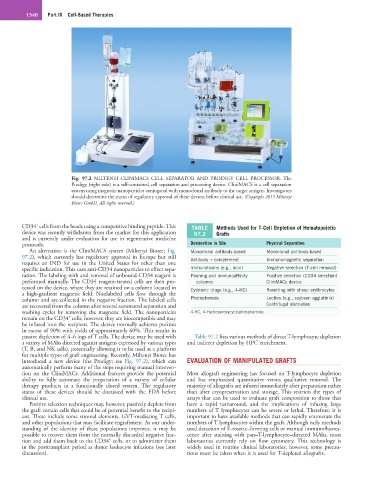
                        Fig.  97.2  MILTENYI  CLINIMACS  CELL  SEPARATOR  AND  PRODIGY  CELL  PROCESSOR.  The
                        Prodigy (right side) is a self-contained cell separation and processing device. CliniMACS is a cell separation
                        system using magnetic nanoparticles conjugated with monoclonal antibody to the target antigen. Investigators
                        should determine the status of regulatory approval of these devices before clinical use. (Copyright 2015 Miltenyi
                        Biotec GmbH. All rights reserved.)


             +
        CD34  cells from the beads using a competitive binding peptide. This   TABLE   Methods Used for T-Cell Depletion of Hematopoietic
        device was recently withdrawn from the market for this application   97.2  Grafts
        and is currently under evaluation for use in regenerative medicine
        protocols.                                             Destruction in Situ      Physical Separation
           An  alternative  is  the  CliniMACS  system  (Miltenyi  Biotec;  Fig.   Monoclonal antibody-based  Monoclonal antibody-based
        97.2),  which  currently  has  regulatory  approval  in  Europe  but  still   Antibody + complement  Immunomagnetic separation
        requires  an  IND  for  use  in  the  United  States  for  other  than  one
        specific indication. This uses anti-CD34 nanoparticles to effect sepa-  Immunotoxins (e.g., ricin)  Negative selection (T-cell removal)
        ration. The labeling with and removal of unbound CD34 reagent is   Panning and immunoaffinity   Positive selection (CD34 selection)
        performed manually. The CD34 reagent-treated cells are then pro-  columns       CliniMACs device
        cessed on the device, where they are retained on a column located in   Cytotoxic drugs (e.g., 4-HC)  Rosetting with sheep erythrocytes
        a  high-gradient  magnetic  field.  Nonlabeled  cells  flow  through  the
        column and are collected in the negative fraction. The labeled cells   Photopheresis  Lectins (e.g., soybean agglutinin)
        are recovered from the column after several automated separation and            Centrifugal elutriation
        washing  cycles  by  removing  the  magnetic  field. The  nanoparticles   4-HC, 4-Hydroperoxycyclophosphamide.
                       +
        remain on the CD34  cells; however, they are biocompatible and may
        be infused into the recipient. The device normally achieves purities
        in excess of 90% with yields of approximately 60%. This results in
        passive depletion of 4–6 logs of T cells. The device may be used with   Table 97.2 lists various methods of direct T-lymphocyte depletion
        a variety of MAbs directed against antigens expressed by various types   and indirect depletion by HPC enrichment.
        (T, B, and NK cells), potentially allowing it to be used as a platform
        for multiple types of graft engineering. Recently, Miltenyi Biotec has
        introduced  a  new  device  (the  Prodigy;  see  Fig.  97.2),  which  can   EVALUATION OF MANIPULATED GRAFTS
        automatically perform many of the steps requiring manual interven-
        tion  on  the  CliniMACs.  Additional  features  provide  the  potential   Most allograft engineering has focused on T-lymphocyte depletion
        ability  to  fully  automate  the  preparation  of  a  variety  of  cellular   and  has  emphasized  quantitative  versus  qualitative  removal.  The
        therapy  products  in  a  functionally  closed  system.  The  regulatory   majority of allografts are infused immediately after preparation rather
        status  of  these  devices  should  be  discussed  with  the  FDA  before   than  after  cryopreservation  and  storage. This  restricts  the  types  of
        clinical use.                                         assays that can be used to evaluate graft composition to those that
           Positive selection techniques may, however, passively deplete from   have  a  rapid  turnaround,  and  the  implications  of  infusing  large
        the graft certain cells that could be of potential benefit to the recipi-  numbers of T lymphocytes can be severe or lethal. Therefore, it is
        ent. These include some stromal elements, GVT-mediating T cells,   important to have available methods that can rapidly enumerate the
        and other populations that may facilitate engraftment. As our under-  numbers of T lymphocytes within the graft. Although early methods
        standing  of  the  identity  of  these  populations  improves,  it  may  be   used detection of E-rosette–forming cells or manual immunofluores-
        possible to recover them from the normally discarded negative frac-  cence  after  staining  with  pan–T-lymphocyte–directed  MAbs,  most
                                     +
        tion and add them back to the CD34  cells, or to administer them   laboratories  currently  rely  on  flow  cytometry.  This  technology  is
        in the posttransplant period as donor leukocyte infusions (see later   widely used in routine clinical laboratories; however, some precau-
        discussion).                                          tions must be taken when it is used for T-depleted allografts.

