


Page 1733 - Hematology_ Basic Principles and Practice ( PDFDrive )
P. 1733
1538   Part IX  Cell-Based Therapies


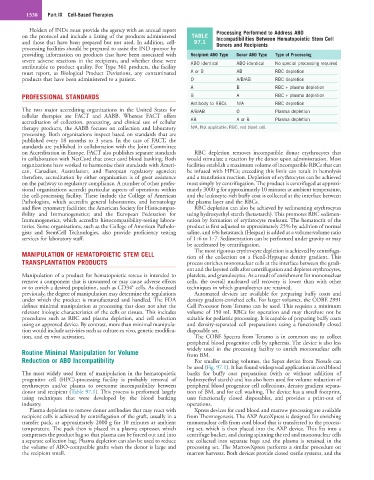
           Holders of INDs must provide the agency with an annual report   Processing Performed to Address ABO
        on the protocol and include a listing of the products administered   TABLE   Incompatibilities Between Hematopoietic Stem Cell
        and those that have been prepared but not used. In addition, cell-  97.1  Donors and Recipients
        processing facilities should be prepared to assist the IND sponsor by
        providing information on products that have been associated with   Recipient ABO Type  Donor ABO Type  Type of Processing
        severe  adverse  reactions  in  the  recipients,  and  whether  these  were   ABO identical  ABO identical  No special processing required
        attributable to product quality. For Type 361 products, the facility
        must  report,  as  Biological  Product  Deviations,  any  contaminated   A or B  AB  RBC depletion
        products that have been administered to a patient.     O              A/B/AB       RBC depletion
                                                               A              B            RBC + plasma depletion
        PROFESSIONAL STANDARDS                                 B              A            RBC + plasma depletion
                                                               Antibody to RBCs  N/A       RBC depletion
        The  two  major  accrediting  organizations  in  the  United  States  for   A/B/AB  O  Plasma depletion
        cellular  therapies  are  FACT  and  AABB.  Whereas  FACT  offers
        accreditation  of  collection,  processing,  and  clinical  use  of  cellular   AB  A or B  Plasma depletion
        therapy  products,  the  AABB  focuses  on  collection  and  laboratory   N/A, Not applicable; RBC, red blood cell.
        processing. Both organizations inspect based on standards that are
        published  every  18  months  to  3  years.  In  the  case  of  FACT,  the
        standards are published in collaboration with the Joint Committee
        on Accreditation in Europe. FACT also publishes separate standards   RBC  depletion  removes  incompatible  donor  erythrocytes  that
        in collaboration with NetCord that cover cord blood banking. Both   would stimulate a reaction by the donor upon administration. Most
        organizations have worked to harmonize their standards with Ameri-  facilities establish a maximum volume of incompatible RBCs that can
        can,  Canadian,  Australasian,  and  European  regulatory  agencies;   be infused with HPCs; exceeding this limit can result in hemolysis
        therefore, accreditation by either organization is of great assistance   and a transfusion reaction. Depletion of erythrocytes can be achieved
        on the pathway to regulatory compliance. A number of other profes-  most simply by centrifugation. The product is centrifuged at approxi-
        sional organizations accredit particular aspects of operations within   mately 3000 g for approximately 10 minutes at ambient temperature,
        the  cell-processing  facility. These  include  the  College  of  American   and the leukocyte-rich buffy coat is collected at the interface between
        Pathologists,  which  accredits  general  laboratories,  and  hematology   the plasma layer and the RBCs.
        and flow cytometry facilities; the American Society for Histocompat-  RBC depletion can also be achieved by sedimenting erythrocytes
        ibility  and  Immunogenetics;  and  the  European  Federation  for   using hydroxyethyl starch (hetastarch). This promotes RBC sedimen-
        Immunogenetics, which accredits histocompatibility-testing labora-  tation by formation of erythrocyte rouleaux. The hematocrit of the
        tories. Some organizations, such as the College of American Patholo-  product is first adjusted to approximately 25% by addition of normal
        gists  and  StemCell  Technologies,  also  provide  proficiency  testing   saline, and 6% hetastarch (Hespan) is added at a volume:volume ratio
        services for laboratory staff.                        of 1 : 6 to 1 : 7. Sedimentation can be performed under gravity or may
                                                              be accelerated by centrifugation.
                                                                 The most rigorous erythrocyte depletion is achieved by centrifuga-
        MANIPULATION OF HEMATOPOIETIC STEM CELL               tion  of  the  collection  on  a  Ficoll-Hypaque  density  gradient. This
        TRANSPLANTATION PRODUCTS                              process enriches mononuclear cells at the interface between the gradi-
                                                              ent and the layered cells after centrifugation and depletes erythrocytes,
        Manipulation of a product for hematopoietic rescue is intended to   platelets, and granulocytes. As a result of enrichment for mononuclear
        remove a component that is unwanted or may cause adverse effects   cells,  the  overall  nucleated  cell  recovery  is  lower  than  with  other
                                            +
        or to enrich a desired population, such as CD34  cells. As discussed   techniques in which granulocytes are retained.
        previously, the degree of manipulation may determine the regulations   Automated  devices  are  available  for  preparing  buffy  coats  and
        under which the product is manufactured and handled. The FDA   density gradient-enriched cells. For larger volumes, the COBE 2991
        defines minimal manipulation as processing that does not alter the   Cell Processor from Terumo can be used. This requires a minimum
        relevant biologic characteristics of the cells or tissues. This includes   volume of 150 mL RBCs for operation and may therefore not be
        procedures  such  as  RBC  and  plasma  depletion,  and  cell  selection   suitable for pediatric processing. It is capable of preparing buffy coats
        using an approved device. By contrast, more than minimal manipula-  and  density-separated  cell  preparations  using  a  functionally  closed
        tion would include activities such as culture ex vivo, genetic modifica-  disposable set.
        tion, and ex vivo activation.                            The COBE Spectra from Terumo is in common use to collect
                                                              peripheral blood progenitor cells by apheresis. The device is also less
        Routine Minimal Manipulation for Volume               widely  used  in  the  processing  facility  to  enrich  mononuclear  cells
                                                              from BM.
        Reduction or ABO Incompatibility                         For smaller starting volumes, the Sepax device from Biosafe can
                                                              be used (Fig. 97.1). It has found widespread application in cord blood
        The most widely used form of manipulation in the hematopoietic   banks  for  buffy  coat  preparation  (with  or  without  addition  of
        progenitor  cell  (HPC)-processing  facility  is  probably  removal  of   hydroxyethyl starch) and has also been used for volume reduction of
        erythrocytes  and/or  plasma  to  overcome  incompatibility  between   peripheral blood progenitor cell collections, density gradient separa-
        donor and recipient (Table 97.1). This process is performed largely   tion of BM, and for cell washing. The device has a small footprint,
        using  techniques  that  were  developed  by  the  blood  banking   uses  functionally  closed  disposables,  and  provides  a  print-out  of
        industry.                                             operations.
           Plasma depletion to remove donor antibodies that may react with   Xpress devices for cord blood and marrow processing are available
        recipient cells is achieved by centrifugation of the graft, usually in a   from Thermogenesis. The AXP AutoXpress is designed for enriching
        transfer pack, at approximately 2000 g for 10 minutes at ambient   mononuclear cells from cord blood that is transferred to the process-
        temperature. The pack then is placed in a plasma expresser, which   ing set, which is then placed into the AXP device. This fits into a
        compresses the product bag so that plasma can be forced out and into   centrifuge bucket, and during spinning the red and mononuclear cells
        a separate collection bag. Plasma depletion can also be used to reduce   are  collected  into  separate  bags  and  the  plasma  is  retained  in  the
        the volume of ABO-compatible grafts when the donor is large and   processing set. The MarrowXpress performs a similar procedure on
        the recipient small.                                  marrow harvests. Both devices provide closed sterile systems, and the

