


Page 1736 - Hematology_ Basic Principles and Practice ( PDFDrive )
P. 1736
Chapter 97  Graft Engineering and Cell Processing  1541

            Flow Cytometry                                        effects).  Stimulation of  cells  with  interleukin-2  (IL-2) and ex  vivo
                                                                  culture also has been used to detect functional residual T lympho-
            Accurate  enumeration  of  very  small  numbers  of  target  cells  by   cytes. In some cases, this method has shown a correlation between
            cytometry  requires  rare  event  analysis.  In  this  technique,  large   the  numbers  of  T  lymphocytes  in  the  cultured  sample  and  the
            numbers  of  events  must  be  accumulated  and  carefully  analyzed  if   development of clinical GVHD in the graft recipient.
            reliable  data  are  to  be  obtained.  This  approach  has  been  widely
                                  +
            adopted  for  counting  CD34   cells  in  unfractionated  grafts  but  is
            often neglected when enumerating T lymphocytes in depleted grafts.   Tetramer Analysis
            The choice of MAb for detection of the T-lymphocyte population
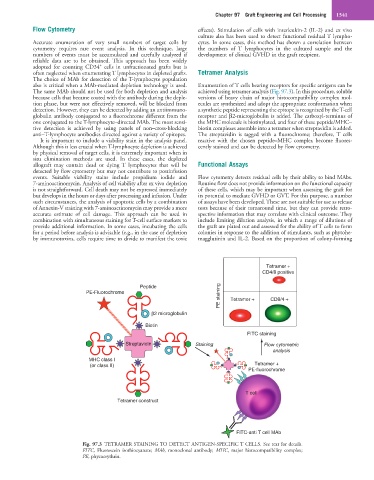
            also is critical when a MAb-mediated depletion technology is used.   Enumeration of T cells bearing receptors for specific antigens can be
            The same MAb should not be used for both depletion and analysis   achieved using tetramer analysis (Fig. 97.3). In this procedure, soluble
            because cells that became coated with the antibody during the deple-  versions  of  heavy  chain  of  major  histocompatibility  complex  mol-
            tion phase, but were not effectively removed, will be blocked from   ecules are synthesized and adopt the appropriate conformation when
            detection. However, they can be detected by adding an antiimmuno-  a synthetic peptide representing the epitope is recognized by the T-cell
            globulin antibody conjugated to a fluorochrome different from the   receptor and β2-microglobulin is added. The carboxyl-terminus of
            one conjugated to the T-lymphocyte–directed MAb. The most sensi-  the MHC molecule is biotinylated, and four of these peptide/MHC–
            tive  detection  is  achieved  by  using  panels  of  non–cross-blocking   biotin complexes assemble into a tetramer when streptavidin is added.
            anti–T-lymphocyte antibodies directed against a variety of epitopes.  The  streptavidin  is  tagged  with  a  fluorochrome;  therefore, T  cells
              It is important to include a viability stain in the analysis panel.   reactive  with  the  chosen  peptide–MHC  complex  become  fluores-
            Although this is less crucial when T-lymphocyte depletion is achieved   cently stained and can be detected by flow cytometry.
            by physical removal of target cells, it is extremely important when in
            situ  elimination  methods  are  used.  In  these  cases,  the  depleted
            allograft  may  contain  dead  or  dying  T  lymphocytes  that  will  be   Functional Assays
            detected by flow cytometry but may not contribute to postinfusion
            events.  Suitable  viability  stains  include  propidium  iodide  and   Flow cytometry detects residual cells by their ability to bind MAbs.
            7-aminoactinomycin. Analysis of cell viability after ex vivo depletion   Routine flow does not provide information on the functional capacity
            is not straightforward. Cell death may not be expressed immediately   of these cells, which may be important when assessing the graft for
            but develops in the hours or days after processing and infusion. Under   its potential to mediate GVHD or GVT. For this purpose, a number
            such circumstances, the analysis of apoptotic cells by a combination   of assays have been developed. These are not suitable for use as release
            of Annexin-V staining with 7-aminoactinomycin may provide a more   tests because of their turnaround time, but they can provide retro-
            accurate  estimate  of  cell  damage.  This  approach  can  be  used  in   spective information that may correlate with clinical outcome. They
            combination with simultaneous staining for T-cell surface markers to   include limiting dilution analysis, in which a range of dilutions of
            provide additional information. In some cases, incubating the cells   the graft are plated out and assessed for the ability of T cells to form
            for a period before analysis is advisable (e.g., in the case of depletion   colonies in response to the addition of stimulants, such as phytohe-
            by immunotoxins, cells require time to divide to manifest the toxic   magglutinin and IL-2. Based on the proportion of colony-forming


                                                                                        Tetramer +
                                                                                       CD4/8 positive

                                                                         PE staining  Tetramer +  CD8/4 +
                                               Peptide
                             PE-Fluorochrome

                                                   β2 microglobulin

                                                 Biotin
                                                                                  FITC staining
                                          Streptavidin           Staining              Flow cytometric
                                                                                          analysis
                              MHC class I
                              (or class II)                                         Tetramer +
                                                                                  PE-fluorochrome


                                                                                 T cell
                                       Tetramer construct


                                                                              FITC-anti T cell MAb
                            Fig. 97.3  TETRAMER STAINING TO DETECT ANTIGEN-SPECIFIC T CELLS. See text for details.
                            FITC,  Fluorescein  isothiocyanate;  MAb,  monoclonal  antibody;  MHC,  major  histocompatibility  complex;
                            PE, phycoerythrin.

