


Page 1737 - Hematology_ Basic Principles and Practice ( PDFDrive )
P. 1737
1542   Part IX  Cell-Based Therapies


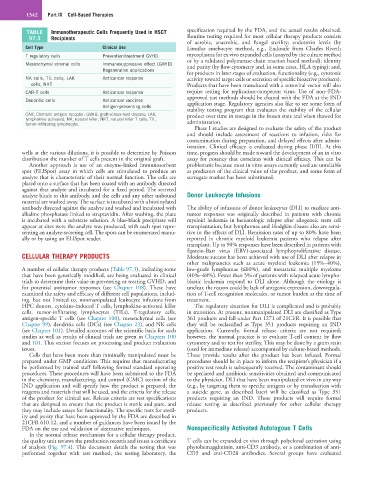
          TABLE   Immunotherapeutic Cells Frequently Used in HSCT   specification required by the FDA, and the actual results obtained.
          97.3    Recipients                                  Routine testing required for most cellular therapy products consists
                                                              of  aerobic,  anaerobic,  and  fungal  sterility;  endotoxin  levels  (by
         Cell Type                 Clinical Use               Limulus  amebocyte  method,  e.g.,  Endosafe  from  Charles  River);
         T regulatory cells        Prevention/treatment GVHD  mycoplasma for ex vivo expanded cells (assayed by the culture method
                                                              or by a validated polymerase chain reaction based method); identity
         Mesenchymal stromal cells  Immunosuppressive effect (GVHD)  and purity (by flow cytometry and, in some cases, HLA typing); and,
                                   Regenerative applications
                                                              for products in later stages of evaluation, functionality (e.g., cytotoxic
         NK cells, TIL cells, LAK   Anticancer response       activity toward target cells or secretion of specific bioactive products).
           cells, NKT                                         Products that have been transduced with a retroviral vector will also
         CAR-T cells               Anticancer response        require  testing  for  replication-competent  virus.  Use  of  non–FDA-
                                                              approved test methods should be cleared with the FDA at the IND
         Dendritic cells           Anticancer vaccines        application stage. Regulatory agencies also like to see some form of
                                   Antigen-presenting cells
                                                              stability  testing  program  that  evaluates  the  stability  of  the  cellular
         CAR, Chimeric antigen receptor; GVHD, graft-versus-host disease; LAK,   product over time in storage in the frozen state and when thawed for
         lymphokine activated; NK, natural killer; NKT, natural killer T cells; TIL,   administration.
         tumor-infiltrating lymphocyte.
                                                                 Phase I studies are designed to evaluate the safety of the product
                                                              and  should  include  assessment  of  reactions  to  infusion,  risks  for
                                                              contamination during preparation, and delayed effects after admin-
                                                              istration.  Clinical  efficacy  is  evaluated  during  phase  II/III.  At  this
        wells at the various dilutions, it is possible to determine by Poisson   time, progress should be made toward the development of an in vitro
        distribution the number of T cells present in the original graft.  assay for potency that correlates with clinical efficacy. This can be
           Another  approach  is  use  of  an  enzyme-linked  immunosorbent   problematic because most in vitro assays currently used are unreliable
        spot  (ELISpot)  assay  in  which  cells  are  stimulated  to  produce  an   as predictors of the clinical value of the product, and some form of
        analyte that is characteristic of their normal function. The cells are   surrogate marker has been substituted.
        plated onto a surface that has been coated with an antibody directed
        against that analyte and incubated for a fixed period. The secreted
        analyte binds to this antibody, and the cells and any other unbound   Donor Leukocyte Infusions
        material are washed away. The surface is incubated with a biotinylated
        antibody directed against the analyte and washed and incubated with   The ability of infusions of donor leukocytes (DLI) to mediate anti-
        alkaline phosphatase linked to streptavidin. After washing, the plate   tumor  responses  was  originally  described  in  patients  with  chronic
        is incubated with a substrate solution. A blue-black precipitate will   myeloid leukemia in hematologic relapse after allogeneic stem cell
        appear at sites were the analyte was produced, with each spot repre-  transplantation, but lymphomas and Hodgkin disease also are sensi-
        senting an analyte-secreting cell. The spots can be enumerated manu-  tive to the effects of DLI. Remission rates of up to 80% have been
        ally or by using an ELISpot reader.                   reported  in  chronic  myeloid  leukemia  patients  who  relapse  after
                                                              transplant. Up to 90% responses have been described in patients with
                                                              Epstein-Barr  virus  (EBV)-associated  lymphoproliferative  disease.
        CELLULAR THERAPY PRODUCTS                             Moderate success has been achieved with use of DLI after relapse in
                                                              other  malignancies  such  as  acute  myeloid  leukemia  (15%–40%),
        A number of cellular therapy products (Table 97.3), including some   low-grade  lymphomas  (≤60%),  and  metastatic  multiple  myeloma
        that have been genetically modified, are being evaluated in clinical   (40%–60%). Fewer than 5% of patients with relapsed acute lympho-
        trials to determine their value in preventing or treating GVHD, and   blastic  leukemia  respond  to  DLI  alone.  Although  the  etiology  is
        for  potential  antitumor  responses  (see  Chapter  108).  These  have   unclear, the reason could be lack of antigenic expression, downregula-
        examined the safety and efficacy of different cell populations, includ-  tion of T-cell recognition molecules, or tumor burden at the time of
        ing, but not limited to, nonmanipulated leukocyte infusions from   treatment.
        HPC donors, cytokine-induced T cells, lymphokine-activated killer   The regulatory situation for DLI is complicated and is probably
        cells,  tumor-infiltrating  lymphocytes  (TILs),  T-regulatory  cells,   in transition. At present, nonmanipulated DLI are classified as Type
        antigen-specific T  cells  (see  Chapter  100),  mesenchymal  cells  (see   361 products and fall under Part 1271 of 21CFR. It is possible that
        Chapter 99), dendritic cells (DCs) (see Chapter 23), and NK cells   they  will  be  reclassified  as  Type  351  products  requiring  an  IND
        (see Chapter 101). Detailed accounts of the scientific basis for such   application.  Currently,  formal  release  criteria  are  not  required;
        studies as well as results of clinical trials are given in Chapters 100   however,  the  normal  practice  is  to  evaluate T-cell  content  by  flow
        and 101. This section focuses on processing and product evaluation   cytometry and to test for sterility. This may be done by a gram stain
        issues.                                               (used for immediate release) accompanied by culture-based methods.
           Cells that have been more than minimally manipulated must be   These  provide  results  after  the  product  has  been  infused.  Formal
        prepared under GMP conditions. This requires that manufacturing   procedures should be in place to inform the recipient’s physician if a
        be performed by trained staff following formal standard operating   positive test result is subsequently received. The contaminant should
        procedures. These procedures will have been submitted to the FDA   be speciated and antibiotic sensitivities obtained and communicated
        in the chemistry, manufacturing, and control (CMC) section of the   to the physician. DLI that have been manipulated ex vivo in any way
        IND application and will specify how the product is prepared, the   (e.g., by targeting them to specific antigens or by transduction with
        reagents and materials that will be used, and the criteria for the release   a  suicide  gene,  as  described  later)  will  be  classified  as  Type  351
        of the product for clinical use. Release criteria are test specifications   products  requiring  an  IND.  These  products  will  require  formal
        that are designed to ensure that the product is sterile and pure, and   release  testing  as  described  previously  for  other  cellular  therapy
        they may include assays for functionality. The specific tests for steril-  products.
        ity and purity that have been approved by the FDA are described in
        21CFR 610.12, and a number of guidances have been issued by the
        FDA on the use and validation of alternative techniques.  Nonspecifically Activated Autologous T Cells
           In the normal release mechanism for a cellular therapy product,
        the quality unit reviews the production records and issues a certificate   T cells can be expanded ex vivo through polyclonal activation using
        of analysis (Fig. 97.4). This document details the testing that was   phytohemagglutinin, anti-CD3 antibody, or a combination of anti-
        performed  together  with  test  method,  the  testing  laboratory,  the   CD3  and  anti-CD28  antibodies.  Several  groups  have  evaluated

