


Page 1734 - Hematology_ Basic Principles and Practice ( PDFDrive )
P. 1734
Chapter 97  Graft Engineering and Cell Processing  1539


                                                                  Chapter  108).  Considerable  work  has  been  done  to  determine
                                                                  whether these opposing effects are produced by distinct subpopula-
                                                                  tions of T lymphocytes. This would allow ex vivo manipulation of
                                                                  allogeneic  grafts  to  remove  differentially  the  GVHD-producing T
                                                                  cells while sparing those that mediate GVT responses. Various sub-
                                                                  populations  of  T  cells  have  been  identified  as  candidate  effector
                                                                  subpopulations;  however,  there  is  no  widespread  consensus  as  to
                                                                  which subsets should be targeted.
                                                                    Methods  are  available  for  eliminating T  cells  from  grafts  using
                                                                  approaches  similar  to  those  used  for  purging  tumor  cells.  Early
                                                                  techniques included use of soybean agglutinin to aggregate the major-
                                                                  ity of nonprogenitor cells and rosetting of sheep erythrocytes with T
                                                                  cells to facilitate their removal. Although successful, these techniques
                                                                  are not “FDA friendly” and do not offer the specificity that likely is
                                                                  required to engineer T-cell subpopulations in allogeneic grafts. This
                                                                  is made possible by the use of MAbs directed toward the antigens
                                                                  that are currently used to identify T-lymphocyte subpopulations. The
                                                                  target  population  then  can  be  removed  with  high  efficiency  using
                                                                  immunomagnetic  separation,  as  described  previously  for  purging
                                                                  autologous grafts. The challenge remains to identify the appropriate
                                                                  target T-cell populations and to source clinical grade MAbs for these
                                                                  procedures. A number of potential target antigens have been identi-
                                                                  fied  and  separation  techniques  implemented.  They  range  from
                                                                  pan–T-cell depletions using antibodies to CD3 and CD2, to deple-
                                                                  tions of helper and cytotoxic T cells using MAbs against CD4 and
                                                                  CD8,  to  stimulation  and  removal  of  alloreactive  populations  by
                                                                  targeting activation antigens.
                                                                    Efforts have recently focused on depletion of αβ-positive T cells
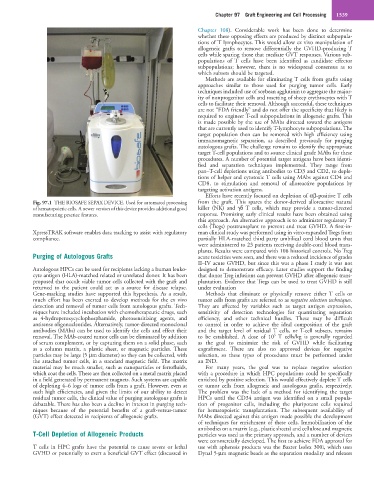
            Fig. 97.1  THE BIOSAFE SEPAX DEVICE. Used for automated processing   from  the  graft.  This  spares  the  donor-derived  alloreactive  natural
            of hematopoietic cells. A newer version of this device provides additional good   killer  (NK)  and  γδ  T  cells,  which  may  provide  a  tumor-directed
            manufacturing practice features.                      response. Promising early clinical results have been obtained using
                                                                  this approach. An alternative approach is to administer regulatory T
                                                                  cells (Tregs) posttransplant to prevent and treat GVHD. A first-in-
            XpressTRAK software enables data tracking to assist with regulatory   man clinical study was performed using in vitro-expanded Tregs from
            compliance.                                           partially HLA-matched third party umbilical cord blood units that
                                                                  were administered to 23 patients receiving double-cord blood trans-
                                                                  plants. Results were compared with 108 historical controls. No Treg
            Purging of Autologous Grafts                          acute toxicities were seen, and there was a reduced incidence of grades
                                                                  II–IV acute GVHD, but since this was a phase I study it was not
            Autologous HPCs can be used for recipients lacking a human leuko-  designed to demonstrate efficacy. Later studies support the finding
            cyte antigen (HLA)-matched related or unrelated donor. It has been   that donor Treg infusions can prevent GVHD after allogeneic trans-
            proposed that occult viable tumor cells collected with the graft and   plantation. Evidence that Tregs can be used to treat GVHD is still
            returned  to  the  patient  could  act  as  a  source  for  disease  relapse.   under evaluation
            Gene-marking  studies  have  supported  this  hypothesis.  As  a  result,   Methods  that  eliminate  or  physically  remove  either  T  cells  or
            much  effort  has  been  exerted  to  develop  methods  for  the  ex  vivo   tumor cells from grafts are referred to as negative selection techniques.
            detection and removal of tumor cells from autologous grafts. Tech-  They  are  affected  by  variables  such  as  target  antigen  expression,
            niques have included incubation with chemotherapeutic drugs, such   sensitivity  of  detection  technologies  for  quantitating  separation
            as  4-hydroperoxycyclophosphamide,  photosensitizing  agents,  and   efficiency,  and  other  technical  hurdles.  These  may  be  difficult
            antisense oligonucleotides. Alternatively, tumor-directed monoclonal   to  control  in  order  to  achieve  the  ideal  composition  of  the  graft
            antibodies (MAbs) can be used to identify the cells and effect their   and  the  target  level  of  residual T  cells,  or T-cell  subsets,  remains
                                                                                           5
            removal. The MAb-coated tumor cells can be eliminated by addition   to  be  established.  A  dose  of  10   T  cells/kg  is  generally  regarded
            of serum complement, or by capturing them on a solid phase, such   as  the  goal  to  minimize  the  risk  of  GVHD  while  facilitating
            as  a  column  matrix,  a  plastic  sheet,  or  magnetic  particles.  These   engraftment.  There  are  also  no  approved  devices  for  negative
            particles may be large (5 µm diameter) so they can be collected, with   selection,  so  these  types  of  procedures  must  be  performed  under
            the attached tumor cells, in a standard magnetic field. The matrix   an IND.
            material may be much smaller, such as nanoparticles or ferrofluids,   For  many  years,  the  goal  was  to  replace  negative  selection
            which coat the cells. These are then collected on a metal matrix placed   with a  procedure  in  which  HPC  populations  could be specifically
            in a field generated by permanent magnets. Such systems are capable   enriched by positive selection. This would effectively deplete T cells
            of depleting 4–6 logs of tumor cells from a graft. However, even at   or  tumor  cells  from  allogeneic  and  autologous  grafts,  respectively.
            such high efficiencies, and given the limits of our ability to detect   The  problem  was  the  lack  of  a  method  for  identifying  the  target
            residual tumor cells, the clinical value of purging autologous grafts is   HPCs  until  the  CD34  antigen  was  identified  on  a  small  popula-
            debatable. There has also been a decline in interest in purging tech-  tion  of  progenitor  cells,  including  the  pluripotent  cells  required
            niques  because  of  the  potential  benefits  of  a  graft-versus-tumor   for  hematopoietic  transplantation.  The  subsequent  availability  of
            (GVT) effect detected in recipients of allogeneic grafts.  MAbs directed against this antigen made possible the development
                                                                  of techniques for enrichment of these cells. Immobilization of the
                                                                  antibodies on a matrix (e.g., plastic sheets) and cellulose and magnetic
            T-Cell Depletion of Allogeneic Products               particles was used as the primary approach, and a number of devices
                                                                  were commercially developed. The first to achieve FDA approval for
            T  cells  in  HPC  grafts  have  the  potential  to  cause  severe  or  lethal   use with apheresis products was the Baxter Isolex 300i, which uses
            GVHD or potentially to exert a beneficial GVT effect (discussed in   Dynal 5-µm magnetic beads as the separation modality and releases

