


Page 212 - Hematology_ Basic Principles and Practice ( PDFDrive )
P. 212
164    Part II  Cellular Basis of Hematology


            Ligands  IL-3  IL-5   GM-CSF         IL-12    IL-23     IL-35    IL-27              IL-7   TSLP


          Receptor
            chains
                 βc/IL-3Rα  βc/IL-5Rα  βc/GM-CSFRα  IL-12Rβ1/IL-12Rβ2  IL-12Rβ1/IL-23R  IL-12Rβ2/?  gp130/IL-27Rα  Rγ/IL-7Rα  IL-7Rα/TSLPR
            Ligands  IL-2       IL-15      IL-4    IL-7    IL-9     IL-21                   IL4      IL13


          Receptor
            chains
                 Rγ/IL-2Rβ/IL-2Rα   Rγ/IL-2Rβ/IL-15Rα   Rγ/IL-4Rα   Rγ/IL-7Rα   Rγ/IL-9α  Rγ/IL-21Rα  Rγ/IL-4Rα  IL-4Rα/IL-13Rα


            Ligands  IL-6  IL-11  LIF/OSM  OSM     CNTF /CLC /NP   CT-1     IL-27            OSM      IL-31


          Receptor
            chains
             gp130/IL-6Rα  gp130/IL-11Rα  gp130/LIFR  gp130/OSMRβ  gp130/LIFR/CNTFRα  gp130/LIFR/?  gp130/IL-27Rα  gp130/OSMRβ  GPL/OSMRβ
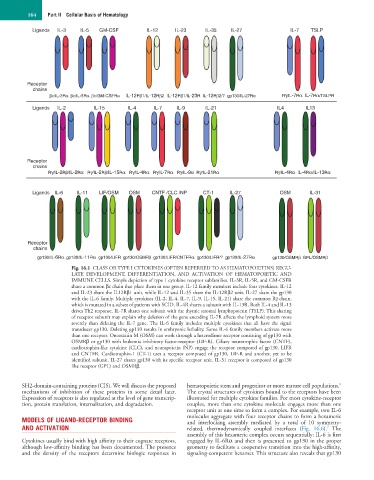
                        Fig. 16.1  CLASS OR TYPE I CYTOKINES (OFTEN REFERRED TO AS HEMATOPOIETINS) REGU-
                        LATE  DEVELOPMENT,  DIFFERENTIATION,  AND  ACTIVATION  OF  HEMATOPOIETIC  AND
                        IMMUNE CELLS. Simple depiction of type 1 cytokine receptor subfamilies. IL-3R, IL-5R, and GM-CSFR
                        share a common βc chain that place them in one group. IL-12 family members include four cytokines. IL-12
                        and IL-23 share the IL12Rβ1 unit, while IL-12 and IL-35 share the IL-12Rβ2 unit. IL-27 share the gp130
                        with the IL-6 family. Multiple cytokines (IL-2, IL-4, IL-7, IL-9, IL-15, IL-21) share the common Rγ chain,
                        which is mutated in a subset of patients with SCID. IL-4R shares a subunit with IL-13R. Both IL-4 and IL-13
                        drives Th2 response. IL-7R shares one subunit with the thymic stromal lymphopoietin (TSLP). This sharing
                        of receptor subunit may explain why deletion of the gene encoding IL-7R affects the lymphoid system more
                        severely than deleting the IL-7 gene. The IL-6 family includes multiple cytokines that all have the signal
                        transducer gp130. Deleting gp130 results in embryonic lethality. Some IL-6 family members activate more
                        than one receptor. Oncostatin M (OSM) can work through a heterodimer receptor consisting of gp130 with
                        OSMRβ or gp130 with leukemia inhibitory factor-receptor (LIF-R). Ciliary neurotrophic factor (CNTF),
                        cardiotrophin-like cytokine (CLC), and neuropoietin (NP) engage the receptor composed of gp130, LIFR
                        and CNTFR. Cardiotrophin-1 (CT-1) uses a receptor composed of gp130, LIF-R and another, yet to be
                        identified subunit. IL-27 shares gp130 with its specific receptor unit. IL-31 receptor is composed of gp130
                        like receptor (GPL) and OSMRβ.


                                                                                                                6
        SH2-domain-containing proteins (CIS). We will discuss the proposed   hematopoietic stem and progenitor or more mature cell populations.
        mechanisms  of  inhibition  of  these  proteins  in  some  detail  later.   The crystal structures of cytokines bound to the receptors have been
        Expression of receptors is also regulated at the level of gene transcrip-  illustrated for multiple cytokine families. For most cytokine-receptor
        tion, protein translation, internalization, and degradation.  couples, more than one cytokine molecule engages more than one
                                                              receptor unit at one time to form a complex. For example, two IL-6
        MODELS OF LIGAND-RECEPTOR BINDING                     molecules aggregate with four receptor chains to form a hexameric
                                                              and  interlocking  assembly  mediated  by  a  total  of  10  symmetry-
        AND ACTIVATION                                        related,  thermodynamically  coupled  interfaces  (Fig.  16.6).   The
                                                                                                            7
                                                              assembly of this hexameric complex occurs sequentially: IL-6 is first
        Cytokines usually bind with high affinity to their cognate receptors,   engaged by IL-6Rα and then is presented to gp130 in the proper
        although low-affinity binding has been documented. The presence   geometry to facilitate a cooperative transition into the high-affinity,
        and  the  density  of  the  receptors  determine  biologic  responses  in   signaling-competent hexamer. This structure also reveals that gp130

