


Page 2096 - Hematology_ Basic Principles and Practice ( PDFDrive )
P. 2096
Chapter 124  Megakaryocyte and Platelet Structure  1859


             A            B                C                D                           E

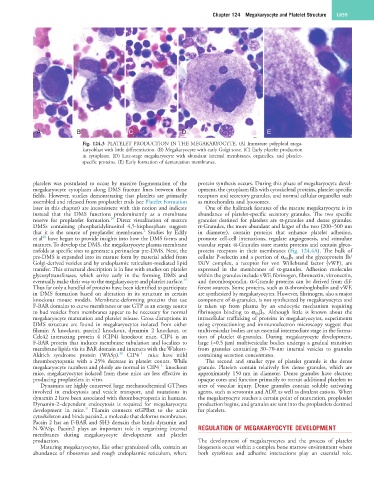
                            Fig. 124.3  PLATELET PRODUCTION IN THE MEGAKARYOCYTE. (A) Immature polyploid mega-
                            karyoblast with little differentiation. (B) Megakaryocyte with early Golgi zone. (C) Early platelet production
                            in  cytoplasm.  (D)  Late-stage  megakaryocyte  with  abundant  internal  membranes,  organelles,  and  platelet-
                            specific proteins. (E) Early formation of demarcation membranes.


            platelets  was  postulated  to  occur  by  massive  fragmentation  of  the   protein synthesis occurs. During this phase of megakaryocyte devel-
            megakaryocyte cytoplasm along DMS fracture lines between these   opment, the cytoplasm fills with cytoskeletal proteins, platelet-specific
            fields.  However,  studies  demonstrating  that  platelets  are  primarily   receptors and secretory granules, and normal cellular organelles such
            assembled and released from proplatelet ends (see Platelet Formation   as mitochondria and lysosomes.
            later in this chapter) are inconsistent with this notion and indicate   One of the hallmark features of the mature megakaryocyte is its
            instead  that  the  DMS  functions  predominantly  as  a  membrane   abundance  of  platelet-specific  secretory  granules. The  two  specific
                                     24
            reserve  for  proplatelet  formation.   Direct  visualization  of  mature   granules  destined  for  platelets  are  α-granules  and  dense  granules.
            DMSs  containing  phosphatidylinositol  4,5-bisphosphate  suggests   α-Granules, the more abundant and larger of the two (200–500 nm
                                                2
            that  it  is  the  source  of  proplatelet  membranes.   Studies  by  Eckly   in  diameter),  contain  proteins  that  enhance  platelet  adhesion,
               28
            et al  have begun to provide insights into how the DMS forms and   promote  cell-cell  interactions,  regulate  angiogenesis,  and  stimulate
            matures. To develop the DMS, the megakaryocyte plasma membrane   vascular repair. α-Granules store matrix proteins and contain glyco-
            enfolds at specific sites to generate a perinuclear pre-DMS. Next, the   protein  receptors  in  their  membranes  (Fig.  124.4A). The  bulk  of
            pre-DMS is expanded into its mature form by material added from   cellular P-selectin and a portion of α IIb β 3  and the glycoprotein Ib/
            Golgi-derived vesicles and by endoplasmic reticulum-mediated lipid   IX/V  complex,  a  receptor  for  von  Willebrand  factor  (vWF),  are
            transfer. This structural description is in line with studies on platelet   expressed  in  the  membranes  of  α-granules.  Adhesion  molecules
            glycosyltransferases,  which  arrive  early  in  the  forming  DMS  and   within the granules include vWF, fibrinogen, fibronectin, vitronectin,
                                                             29
            eventually make their way to the megakaryocyte and platelet surface.    and thrombospondin. α-Granule proteins can be derived from dif-
            Thus far only a handful of proteins have been identified to participate   ferent sources. Some proteins, such as α-thromboglobulin and vWF,
            in  DMS  formation  based  on  alteration  in  its  structure  in  certain   are synthesized by megakaryocytes. However, fibrinogen, also a major
            knockout  mouse  models.  Membrane-deforming  proteins  that  use   component of α-granules, is not synthesized by megakaryocytes and
            F-BAR domains to curve membranes or use GTP as an energy source   is  taken  up  from  plasma  by  an  endocytic  mechanism  requiring
            to bud vesicles from membranes appear to be necessary for normal   fibrinogen  binding  to  α IIb β 3 .  Although  little  is  known  about  the
            megakaryocyte maturation and platelet release. Gross disruptions in   intracellular trafficking of proteins in megakaryocytes, experiments
            DMS  structure  are  found  in  megakaryocytes  isolated  from  either   using cryosectioning and immunoelectron microscopy suggest that
            filamin  A  knockout,  pascin2  knockout,  dynamin  2  knockout,  or   multivesicular bodies are an essential intermediate stage in the forma-
            Cdc42  interacting  protein  4  (CIP4)  knockout  mice.  CIP4  is  an   tion  of  platelet  α-granules.  During  megakaryocyte  development,
            F-BAR protein that induces membrane tubulation and localizes to   large (≈0.5 µm) multivesicular bodies undergo a gradual transition
            membrane lipids via its BAR domain and interacts with the Wiskott-  from  granules  containing  30–70-nm  internal  vesicles  to  granules
                                              −/−
                                        30
            Aldrich  syndrome  protein  (WASp).   CIP4   mice  have  mild   containing secretion concentrates.
            thrombocytopenia  with  a  25%  decrease  in  platelet  counts.  While   The  second  and  smaller  type  of  platelet  granule  is  the  dense
                                                     −/−
            megakaryocyte numbers and ploidy are normal in CIP4  knockout   granule.  Platelets  contain  relatively  few  dense  granules,  which  are
            mice, megakaryocytes isolated from these mice are less effective in   approximately  150 nm  in  diameter.  Dense  granules  have  electron
            producing proplatelets in vitro.                      opaque cores and function primarily to recruit additional platelets to
              Dynamins are highly conserved large mechanochemical GTPases   sites  of  vascular  injury.  Dense  granules  contain  soluble  activating
            involved  in  endocytosis  and  vesicle  transport,  and  mutations  in   agents, such as serotonin and ADP, as well as divalent cations. When
            dynamin 2 have been associated with thrombocytopenia in humans.   the megakaryocyte reaches a certain point of maturation, proplatelet
            Dynamin-2–dependent  endocytosis  is  required  for  megakaryocyte   production begins, and granules are sent into the proplatelets destined
                             31
            development  in  mice.   Filamin  connects  αGPIbα  to  the  actin   for platelets.
            cytoskeleton and binds pacsin2, a molecule that deforms membranes.
            Pacsin 2 has an F-BAR and SH3 domain that binds dynamin and
            N-WASp.  Pacsin2  plays  an  important  role  in  organizing  internal   REGULATION OF MEGAKARYOCYTE DEVELOPMENT
            membranes  during  megakaryocyte  development  and  platelet
            production.                                           The  development  of  megakaryocytes  and  the  process  of  platelet
              Maturing megakaryocytes, like other granulated cells, contain an   biogenesis occur within a complex bone marrow environment where
            abundance  of  ribosomes  and  rough  endoplasmic  reticulum,  where   both  cytokines  and  adhesive  interactions  play  an  essential  role.

