


Page 2098 - Hematology_ Basic Principles and Practice ( PDFDrive )
P. 2098
Chapter 124  Megakaryocyte and Platelet Structure  1861


            the maturation of hematopoietic stem cells into proplatelet-producing   tubulin as a downstream effector of the megakaryocyte transcription
            megakaryocytes in the second half. Human embryonic stem cells can   factor  NF-E2  that  is  absent  in  NF-E2–deficient  megakaryocytes.
                                                    3
            be coaxed to differentiate into mature megakaryocytes,  although the   Second, genetic elimination of the β 1-tubulin gene in mice results in
                                                                                6
            process takes several more days in culture. Recently, platelets have   thrombocytopenia.  Third, megakaryocytes isolated from β 1 -tubulin
            been generated from induced human pluripotent stem cells in culture   knockout mice fail to form proplatelets in vitro and instead extend
            using a doxycycline-controlled c-MYC expression vector. 4  only a small number of blunt protrusions.
                                                                    The first event that signals proplatelet production is the consolida-
                                                                  tion of microtubules into large bundles at the megakaryocyte cortex
            PLATELET FORMATION                                    that subsequently are reorganized into parallel bundles in the shafts
                                                                                         8
                                                                  of the proplatelets (Fig. 124.6).  Microtubule bundles are thick near
            Proplatelets and the Cytoskeletal                     the body of the megakaryocyte as they enter the proplatelet shaft but
                                                                  become progressively thinner along the shaft, such that only 5–10
            Mechanics of Platelet Formation                       microtubules  remain  at  the  end  of  the  proplatelet.  Of  note,  the
                                                                  microtubule  bundles  that  run  down  the  proplatelet  shaft  make
            The discovery of TPO and the development of megakaryocyte cul-  characteristic  U  turns  in  the  tips  and  reenter  the  shaft,  forming
            tures that reconstitute platelet formation in vitro have allowed visu-  teardrop-shaped structures (Fig. 124.7). This creates a bipolar orien-
                                                          5
            alization  of  megakaryocytes  in  the  act  of  forming  platelets.   The   tation  of  bundles  near  the  proplatelet  tip,  a  geometry  required  to
            actual mechanical process of platelet production begins when mature   explain  the  bidirectional  granule  and  organelle  traffic  observed  in
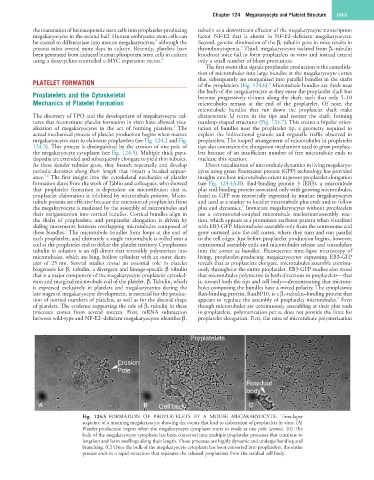
            megakaryocytes start to elaborate proplatelets (see Fig. 124.2 and Fig.   proplatelets. The looped arrangement of microtubules in proplatelet
            124.5). This process is distinguished by the erosion of one pole of   tips also constrains the elongation mechanism used to grow proplate-
            the megakaryocyte cytoplasm (see Fig. 124.5). Multiple thick pseu-  lets because of an insufficient number of free microtubule ends to
            dopodia are extended and subsequently elongate to yield thin tubules.   nucleate this reaction.
            As these slender tubules grow, they branch repeatedly and develop   Direct visualization of microtubule dynamics in living megakaryo-
            periodic  densities  along  their  length  that  impart  a  beaded  appear-  cytes using green fluorescent protein (GFP) technology has provided
                5,6
            ance.  The first insight into the cytoskeletal mechanics of platelet   insights into how microtubules orient to power proplatelet elongation
            formation dates from the work of Tablin and colleagues, who showed   (see  Fig.  124.4A,B).  End-binding  protein  3  (EB3),  a  microtubule
            that  proplatelet  formation  is  dependent  on  microtubules;  that  is,   plus end-binding protein associated only with growing microtubules,
            proplatelet elaboration is inhibited by microtubule poisons. Micro-  fused to GFP was retrovirally expressed in murine megakaryocytes
            tubule poisons are effective because the extension of proplatelets from   and used as a marker to localize microtubule plus ends and to follow
                                                                                7
            the megakaryocyte is mediated by the assembly of microtubules and   plus end dynamics.  Immature megakaryocytes without proplatelets
            their reorganization into cortical bundles. Cortical bundles align in   use  a  centrosomal-coupled  microtubule  nucleation/assembly  reac-
            the  shafts  of  proplatelets,  and  proplatelet  elongation  is  driven  by   tion, which appears as a prominent starburst pattern when visualized
            sliding movements between overlapping microtubules composed of   with EB3-GFP. Microtubules assemble only from the centrosome and
                      7
            these bundles.  The microtubule bundles form loops at the end of   grow outward into the cell cortex, where they turn and run parallel
            each proplatelet, and ultimately a single microtubule is rolled into a   to the cell edges. Just before proplatelet production begins, however,
            coil at the proplatelet end to define the platelet territory. Cytoplasmic   centrosomal assembly ends and microtubules release and consolidate
            tubulin in solution is an αβ dimer that reversibly polymerizes into   into  the  cortex  as  bundles.  Fluorescence  time-lapse  microscopy  of
            microtubules, which are long, hollow cylinders with an outer diam-  living,  proplatelet-producing  megakaryocytes  expressing  EB3-GFP
            eter  of  25 nm.  Several  studies  reveal  an  essential  role  in  platelet   reveals that as proplatelets elongate, microtubules assemble continu-
            biogenesis for β 1  tubulin, a divergent and lineage-specific β tubulin   ously throughout the entire proplatelet. EB3-GFP studies also reveal
            that is a major component of the megakaryocyte proplatelet cytoskel-  that microtubules polymerize in both directions in proplatelets—that
            eton and marginal microtubule coil of the platelet. β 1  Tubulin, which   is, toward both the tips and cell body—demonstrating that microtu-
            is expressed exclusively in platelets and megakaryocytes during the   bules composing the bundles have a mixed polarity. The cytoplasmic
            late stages of megakaryocyte development, is essential for the produc-  Ran-binding protein, RanBP10, is a β 1 -tubulin–binding protein that
                                                                                                               9
            tion of normal numbers of platelets, as well as for the discoid shape   appears to regulate the assembly of proplatelet microtubules.  Even
            of platelets. The evidence supporting the role of β 1  tubulin in these   though microtubules are continuously assembling at their plus ends
            processes  comes  from  several  sources.  First,  mRNA  subtraction   in proplatelets, polymerization per se does not provide the force for
            between wild-type and NF-E2–deficient megakaryocytes identifies β 1    proplatelet elongation. First, the rates of microtubule polymerization


                            Fig.  124.5  FORMATION  OF  PROPLATELETS  BY  A  MOUSE  MEGAKARYOCYTE.  Time-lapse
                            sequence of a maturing megakaryocyte showing the events that lead to elaboration of proplatelets in vitro. (A)
                            Platelet production begins when the megakaryocyte cytoplasm starts to erode at one pole (arrow). (B) The
                            bulk of the megakaryocyte cytoplasm has been converted into multiple proplatelet processes that continue to
                            lengthen and form swellings along their length. These processes are highly dynamic and undergo bending and
                            branching. (C) Once the bulk of the megakaryocyte cytoplasm has been converted into proplatelets, the entire
                            process ends in a rapid retraction that separates the released proplatelets from the residual cell body.

