


Page 2099 - Hematology_ Basic Principles and Practice ( PDFDrive )
P. 2099
1862   Part XII  Hemostasis and Thrombosis


                                                                           Microtubule bundles in
                                                                             proplatelet shaft


                                                                                  Microtubule loop
                       A                                   C


                       B                                   D

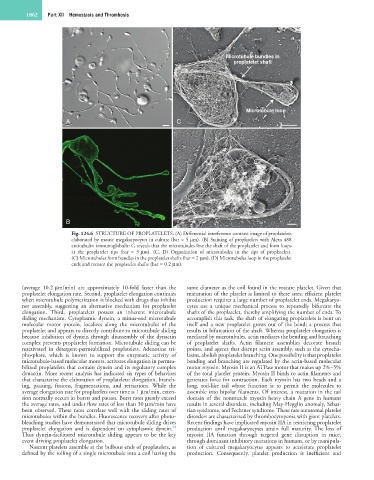
                        Fig. 124.6  STRUCTURE OF PROPLATELETS. (A) Differential interference contrast image of proplatelets
                        elaborated by mouse megakaryocytes in culture (bar = 5 µm). (B) Staining of proplatelets with Alexa 488
                        antitubulin immunoglobulin G reveals that the microtubules line the shaft of the proplatelet and form loops
                        at  the  proplatelet  tips  (bar  =  5 µm).  (C,  D)  Organization  of  microtubules  in  the  tips  of  proplatelets.
                        (C) Microtubules form bundles in the proplatelet shafts (bar = 2 µm). (D) Microtubules loop in the proplatelet
                        ends and reenter the proplatelet shafts (bar = 0.2 µm).


        (average  10.2 µm/min)  are  approximately  10-fold  faster  than  the   same diameter as the coil found in the mature platelet. Given that
        proplatelet elongation rate. Second, proplatelet elongation continues   maturation of the platelet is limited to these sites; efficient platelet
        when microtubule polymerization is blocked with drugs that inhibit   production requires a large number of proplatelet ends. Megakaryo-
        net  assembly,  suggesting  an  alternative  mechanism  for  proplatelet   cytes  use  a  unique  mechanical  process  to  repeatedly  bifurcate  the
        elongation.  Third,  proplatelets  possess  an  inherent  microtubule   shafts of the proplatelet, thereby amplifying the number of ends. To
        sliding mechanism. Cytoplasmic dynein, a minus-end microtubule   accomplish this task, the shaft of elongating proplatelets is bent on
        molecular  motor  protein,  localizes  along  the  microtubules  of  the   itself and a new proplatelet grows out of the bend; a process that
        proplatelet and appears to directly contribute to microtubule sliding   results in bifurcation of the shaft. Whereas proplatelet elongation is
        because  inhibition  of  dynein  through  disassembly  of  the  dynactin   mediated by microtubules, actin mediates the bending and branching
        complex prevents proplatelet formation. Microtubule sliding can be   of  proplatelet  shafts.  Actin  filament  assemblies  decorate  branch
        reactivated  in  detergent-permeabilized  proplatelets.  Adenosine  tri-  points, and agents that disrupt actin assembly, such as the cytocha-
        phosphate,  which  is  known  to  support  the  enzymatic  activity  of   lasins, abolish proplatelet branching. One possibility is that proplatelet
        microtubule-based molecular motors, activates elongation in permea-  bending and branching are regulated by the actin-based molecular
        bilized proplatelets that contain dynein and its regulatory complex   motor myosin. Myosin II is an ATPase motor that makes up 2%–5%
        dynactin. More recent analysis has indicated six types of behaviors   of the total platelet protein. Myosin II binds to actin filaments and
        that characterize the elaboration of proplatelets: elongation, branch-  generates force for contraction. Each myosin has two heads and a
        ing,  pausing,  fusions,  fragmentations,  and  retractions.  While  the   long,  rod-like  tail  whose  function  is  to  permit  the  molecules  to
        average elongation rate for proplatelets over time is 1 µm/min, exten-  assemble into bipolar filaments. Of interest, a mutation in the tail
        sion normally occurs in bursts and pauses. Burst rates greatly exceed   domain  of  the  nonmuscle  myosin  heavy  chain  A  gene  in  humans
        the average rates, and under flow rates of less than 30 µm/min have   results in several disorders, including May-Hegglin anomaly, Sebas-
        been  observed. These  rates  correlate  well  with  the  sliding  rates  of   tian syndrome, and Fechtner syndrome. These rare autosomal platelet
        microtubules within the bundles. Fluorescence recovery after photo-  disorders are characterized by thrombocytopenia with giant platelets.
        bleaching studies have demonstrated that microtubule sliding drives   Recent findings have implicated myosin IIA in restricting proplatelet
                                                         32
        proplatelet  elongation  and  is  dependent  on  cytoplasmic  dynein.    production  until  megakaryocytes  attain  full  maturity.  The  loss  of
        Thus  dynein-facilitated  microtubule  sliding  appears  to  be  the  key   myosin  IIA  function  through  targeted  gene  disruption  in  mice,
        event driving proplatelet elongation.                 through dominant inhibitory mutations in humans, or by manipula-
           Nascent platelets assemble at the bulbous ends of proplatelets, as   tion  of  cultured  megakaryocytes  appears  to  accelerate  proplatelet
        defined by the rolling of a single microtubule into a coil having the   production.  Consequently,  platelet  production  is  inefficient  and

