


Page 2097 - Hematology_ Basic Principles and Practice ( PDFDrive )
P. 2097
1860   Part XII  Hemostasis and Thrombosis


                                                      PP


                                                                                         CB


                       A


                                  Distance
                           0       (µm)       10
                          0


                      Time
                      (sec)


                                                   C
                      B 60
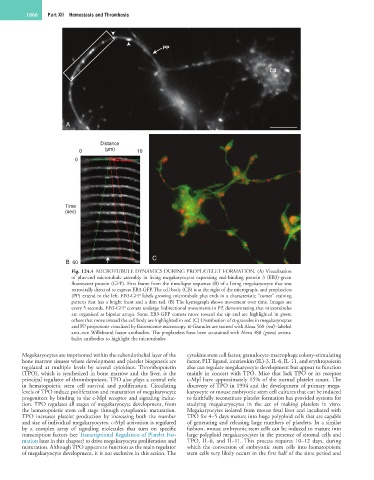
                        Fig. 124.4  MICROTUBULE DYNAMICS DURING PROPLATELET FORMATION. (A) Visualization
                        of plus-end microtubule assembly in living megakaryocytes expressing end-binding protein 3 (EB3)-green
                        fluorescent protein (GFP). First frame from the time-lapse sequence (B) of a living megakaryocyte that was
                        retrovirally directed to express EB3-GFP. The cell body (CB) is at the right of the micrograph, and proplatelets
                        (PP) extend to the left. EB3-GFP labels growing microtubule plus ends in a characteristic “comet” staining
                        pattern that has a bright front and a dim tail. (B) The kymograph shows movement over time. Images are
                        every 5 seconds. EB3-GFP comets undergo bidirectional movements in PP, demonstrating that microtubules
                        are organized as bipolar arrays. Some EB3-GFP comets move toward the tip and are highlighted in green;
                        others that move toward the cell body are highlighted in red. (C) Distribution of α-granules in megakaryocytes
                        and PP projections visualized by fluorescence microscopy. α-Granules are stained with Alexa 568 (red)–labeled
                        anti–von Willebrand factor antibodies. The proplatelets have been co-stained with Alexa 488 (green) antitu-
                        bulin antibodies to highlight the microtubules.


        Megakaryocytes are imprisoned within the subendothelial layer of the   cytokine stem cell factor, granulocyte-macrophage colony-stimulating
        bone marrow sinuses where development and platelet biogenesis are   factor, FLT ligand, interleukin (IL)-3, IL-6, IL-11, and erythropoietin
        regulated  at  multiple  levels  by  several  cytokines.  Thrombopoietin   also can regulate megakaryocyte development but appear to function
        (TPO), which is synthesized in bone marrow and the liver, is the   mainly  in  concert  with TPO.  Mice  that  lack TPO  or  its  receptor
        principal regulator of thrombopoiesis. TPO also plays a central role   c-Mpl have approximately 15% of the normal platelet count. The
        in  hematopoietic  stem  cell  survival  and  proliferation.  Circulating   discovery of TPO in 1994 and the development of primary mega-
        levels of TPO induce proliferation and maturation of megakaryocyte   karyocyte or mouse embryonic stem cell cultures that can be induced
        progenitors by binding to the c-Mpl receptor and signaling induc-  to faithfully reconstitute platelet formation has provided systems for
        tion. TPO regulates all stages of megakaryocyte development, from   studying  megakaryocytes  in  the  act  of  making  platelets  in  vitro.
        the hematopoietic stem cell stage through cytoplasmic maturation.   Megakaryocytes isolated from mouse fetal liver and incubated with
        TPO increases platelet production by increasing both the number   TPO for 4–5 days mature into huge polyploid cells that are capable
        and size of individual megakaryocytes. c-Mpl activation is regulated   of generating and releasing large numbers of platelets. In a similar
        by  a  complex  array  of  signaling  molecules  that  turn  on  specific   fashion, mouse embryonic stem cells can be induced to mature into
        transcription factors (see Transcriptional Regulation of Platelet For-  large polyploid megakaryocytes in the presence of stromal cells and
        mation later in this chapter) to drive megakaryocyte proliferation and   TPO,  IL-6,  and  IL-11. This  process  requires  10–12  days,  during
        maturation. Although TPO appears to function as the main regulator   which  the  conversion  of  embryonic  stem  cells  into  hematopoietic
        of megakaryocyte development, it is not exclusive in this action. The   stem cells very likely occurs in the first half of the time period and

