


Page 2100 - Hematology_ Basic Principles and Practice ( PDFDrive )
P. 2100
Chapter 124  Megakaryocyte and Platelet Structure  1863


                                                                  contrast, mice lacking the actin turnover protein ADF have normal
                                                                                                                   −/−
                                                                                          34
                                                                  platelet counts and morphology.  On the other hand, when ADF
                                                                  mice are crossed with cofilin-1 knockout mice, platelet production is
                                                                  severely reduced and morphologies of platelets are highly variable.
                                                                  Mice that contain megakaryocytes that specifically lack profilin 1, a
                                                                  small  protein  that  promotes  actin  filament  assembly,  have  macro-
                                                                                                         35
                                                                  thrombocytopenia  with  reduced  platelet  counts.   Profilin-null
                                                                  platelets  have  a  thickened  microtubule  coil  with  hyperacetylated
                                                                  microtubules, and in some ways, the profilin 1 knockout phenotype
                                                                  is similar to the behavior of platelets in Wiskott-Aldrich syndrome,
                                                                  or in WASp knockout mice. Defective proplatelet production has also
                                                                  been observed in mice in which the small regulatory GTPases Rho,
                                                                  Cdc42, and Rac have been deleted in the megakaryocyte lineage. 36,37
                                                                    In addition to playing an essential role in proplatelet elongation,
                                                                  the microtubules lining the shafts of proplatelets serve a secondary
                                                                  function: transport of membrane, organelles, and granules into pro-
             A                                                    platelets and assembling platelets at proplatelet ends (see Fig. 124.4C).
                                                                  Organelles are sent individually from the cell body into the proplate-
                                                                  lets, where they move bidirectionally until they are captured at pro-
                                                                           14
                                                                  platelet tips.  Immunofluorescence and electron microscopic studies
                                                                  indicate that organelles are intimately associated with microtubules,
                                                                  and actin poisons do not diminish organelle motion. Thus movement
                                                                  appears to involve microtubule-based forces. Bidirectional organelle
                                                                  movement is conveyed in part by the bipolar arrangement of micro-
                                                                  tubules  within  the  proplatelet  because  kinesin-coated  latex  beads
                                                                  move in both directions over the microtubule arrays of permeabilized
                                                                  proplatelets.  Of  the  two  major  microtubule  motors,  kinesin  and
                                                                  cytoplasmic dynein, only the plus end-directed kinesin is localized in
                                                                  a pattern similar to organelles and granules, and is likely responsible
                                                                  for transporting these elements along microtubules. It appears that
                                                                  two mechanisms of organelle and granule movement are involved in
                                                                  platelet assembly: first, organelles and granules travel along microtu-
                                                                  bules, and second, the microtubules themselves slide bidirectionally
                                                                  in  relation  to  other  motile  filaments,  indirectly  moving  organelles
                                                                  along proplatelets in a piggyback manner.
             B                                                      Although the roles of microtubules and actin filaments in pro-
                                                                  platelet development have been extensively studied, our understand-
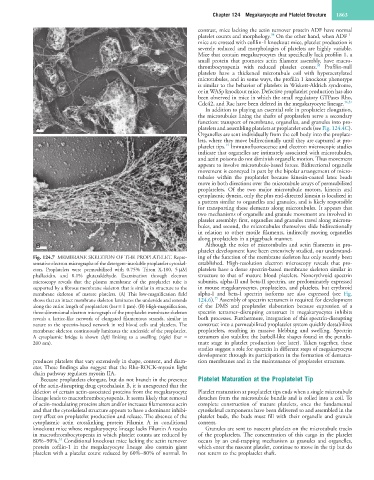
            Fig. 124.7  MEMBRANE SKELETON OF THE PROPLATELET. Repre-  ing of the function of the membrane skeleton has only recently been
            sentative electron micrographs of the detergent-insoluble proplatelet cytoskel-  established.  High-resolution  electron  microscopy  reveals  that  pro-
            eton.  Proplatelets  were  permeabilized  with  0.75%  Triton  X-100,  5 µM   platelets have a dense spectrin-based membrane skeleton similar in
            phallacidin,  and  0.1%  glutaraldehyde.  Examination  through  electron   structure  to  that  of  mature  blood  platelets.  Nonerythroid  spectrin
            microscopy  reveals  that  the  plasma  membrane  of  the  proplatelet  tube  is   subunits, alpha-II and beta-II spectrin, are predominately expressed
            supported by a fibrous membrane skeleton that is similar in structure to the   in mouse megakaryocytes, proplatelets, and platelets, but erythroid
            membrane  skeleton  of  mature  platelets.  (A)  This  low-magnification  field   alpha-I  and  beta-I  spectrin  isoforms  are  also  expressed  (see  Fig.
                                                                       15
            shows that an intact membrane skeleton laminates the underside and extends   124.6).  Assembly of spectrin tetramers is required for development
            along the entire length of proplatelets (bar = 1 µm). (B) High-magnification,   of  the  DMS  and  proplatelet  elaboration  because  expression  of  a
            three-dimensional electron micrograph of the proplatelet membrane skeleton   spectrin  tetramer–disrupting  construct  in  megakaryocytes  inhibits
            reveals  a  lattice-like  network  of  elongated  filamentous  strands,  similar  in   both processes. Furthermore, integration of this spectrin-disrupting
            nature to the spectrin-based network in red blood cells and platelets. The   construct into a permeabilized proplatelet system quickly destabilizes
            membrane skeleton continuously laminates the underside of the proplatelet.   proplatelets,  resulting  in  massive  blebbing  and  swelling.  Spectrin
            A  cytoplasmic  bridge  is  shown  (left)  linking  to  a  swelling  (right)  (bar  =   tetramers also stabilize the barbell-like shapes found in the penulti-
            200 nm).                                              mate stage in platelet production (see later). Taken together, these
                                                                  studies suggest a role for spectrin in different steps of megakaryocyte
                                                                  development through its participation in the formation of demarca-
            produces platelets that vary extensively in shape, content, and diam-  tion membranes and in the maintenance of proplatelet structure.
            eter. These findings also suggest that the Rho-ROCK-myosin light
            chain pathway regulates myosin IIA.
              Because proplatelets elongate, but do not branch in the presence   Platelet Maturation at the Proplatelet Tip
            of the actin-disrupting drug cytochalasin B, it is unexpected that the
            deletion of certain actin-associated proteins from the megakaryocyte   Platelet maturation at proplatelet tips ends when a single microtubule
            lineage leads to macrothrombocytopenia. It seems likely that removal   detaches from the microtubule bundle and is rolled into a coil. To
            of actin-modulating proteins alters and/or increases filamentous actin   complete  construction  of  mature  platelets,  once  the  fundamental
            and that the cytoskeletal structure appears to have a dominant inhibi-  cytoskeletal components have been delivered to and assembled in the
            tory effect on proplatelet production and release. The absence of the   platelet  buds,  the  buds  must  fill  with  their  organelle  and  granule
            cytoplasmic  actin  crosslinking  protein  Filamin  A  in  conditional   content.
            knockout mice whose megakaryocyte lineage lacks Filamin A results   Granules are sent to nascent platelets on the microtubule tracks
            in macrothrombocytopenia in which platelet counts are reduced by   of the proplatelets. The concentration of this cargo in the platelet
                    33
            80%–90%.  Conditional knockout mice lacking the actin turnover   occurs  by  an  end-trapping  mechanism  as  granules  and  organelles,
            protein  cofilin-1  in  the  megakaryocyte  lineage  also  contain  giant   which enter the nascent platelet, continue to move in the tip but do
            platelets with a platelet count reduced by 60%–80% of normal. In   not return to the proplatelet shaft.

