


Page 2102 - Hematology_ Basic Principles and Practice ( PDFDrive )
P. 2102
Chapter 124  Megakaryocyte and Platelet Structure  1865

            PLATELETS                                             localized  in  the  OCS  of  the  resting  platelet,  awaiting  movement
                                                                  to the surface when the cells are activated. Although contiguous with
            Structure of the Resting Platelet                     the plasma membrane, not all proteins on the cell surface can enter
                                                                  the OCS. Factors controlling movement into the OCS remain to be
            Megakaryocyte  development  culminates  in  the  release  of  mature   defined but likely depend on the actin cytoskeleton. Entry restriction,
            discoid platelets having dimensions of approximately 3.0 × 0.5 µm   however, occurs at the necks of OCS infoldings. The third function
                                     23
            and a cytoplasmic volume of 7 fL.  The evolutionary explanation for   of the OCS is to serve as a source of redundant plasma membrane
            the  discoid  shape  of  the  platelet  is  unknown.  Discoid  shape  may   for cell spreading. OCS membrane initially is disgorged to the surface
            permit more efficient flow or dispersion of clot-promoting elements   following cell activation. When cells are activated in solution, much
            or may simply reflect the microtubule-based mechanism by which   of this membrane is subsequently reabsorbed into the remnants of
            platelets are produced. In humans, platelets, once released from the   the OCS.
            ends  of  proplatelets,  normally  circulate  for  7–10  days.  Given  that   A small thin zone of cytoplasm separates the plasma membrane
            nearly 1 trillion platelets circulate in an adult human, each day an   of  the  resting  platelet  from  a  marginal  microtubule  coil  and  the
            adult produces approximately 100 billion platelets.   general intracellular space, which contains all inclusion bodies and
              The precise morphology of newly released platelets is unknown.   the  internal  cytoskeleton  of  the  cell.  This  zone  is  filled  with  the
            However, when released into the circulation or maintained in culture,   spectrin-based  membrane  skeleton  (see  Fig.  124.9A).  Beneath  this
            platelets have a very reproducible structure. Although they are het-  zone  sits  a  microtubule  coil. Then  follows  the  cytoplasmic  space,
            erogeneous in size, presumably because of changes in size as they age,   which is filled with filaments of actin that embed granules, organelles,
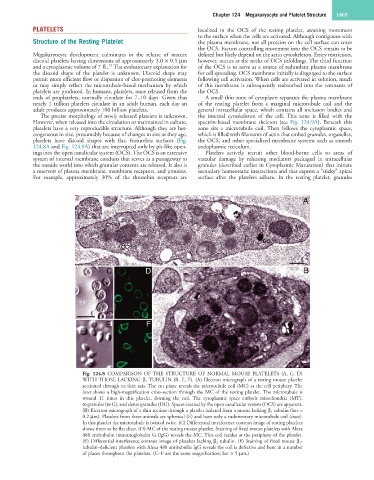
            platelets  have  discoid  shapes  with  flat,  featureless  surfaces  (Fig.   the OCS, and other specialized membrane systems such as smooth
            124.8A and Fig. 124.9A) that are interrupted only by pit-like open-  endoplasmic reticulum.
            ings into the open canalicular system (OCS). The OCS is an extensive   Platelets  actively  recruit  other  blood-borne  cells  to  areas  of
            system of internal membrane conduits that serves as a passageway to   vascular  damage  by  releasing  mediators  packaged  in  intracellular
            the outside world into which granular contents are released. It also is   granules (described earlier in Cytoplasmic Maturation) that initiate
            a reservoir of plasma membrane, membrane receptors, and proteins.   secondary homeostatic interactions and that express a “sticky” apical
            For  example,  approximately  30%  of  the  thrombin  receptors  are    surface  after  the  platelets  adhere.  In  the  resting  platelet,  granules


                            Fig.  124.8  COMPARISON  OF THE  STRUCTURE  OF  NORMAL  MOUSE  PLATELETS  (A,  C,  D)
                            WITH THOSE LACKING β 1  TUBULIN (B, E, F). (A) Electron micrograph of a resting mouse platelet
                            sectioned through its thin axis. The cut plane reveals the microtubule coil (MC) at the cell periphery. The
                            inset shows a high-magnification cross-section through the MC of the resting platelet. The microtubule is
                            wound  11  times  in  this  platelet,  forming  the  coil.  The  cytoplasmic  space  embeds  mitochondria  (MT),
                            α-granules (α-G), and dense granules (DG). Spaces created by the open canalicular system (OCS) are apparent.
                            (B) Electron micrograph of a thin section through a platelet isolated from a mouse lacking β 1  tubulin (bar =
                            0.2 µm). Platelets from these animals are spherical (E) and have only a rudimentary microtubule coil (inset).
                            In this platelet the microtubule is twisted twice. (C) Differential interference contrast image of resting platelets
                            shows them to be flat discs. (D) MC of the resting mouse platelet. Staining of fixed mouse platelets with Alexa
                            488 antitubulin immunoglobulin G (IgG) reveals the MC. This coil resides at the periphery of the platelet.
                            (E) Differential interference contrast image of platelets lacking β 1 tubulin. (F) Staining of fixed mouse β 1-
                            tubulin–deficient platelets with Alexa 488 antitubulin IgG reveals the coil is defective and bent in a number
                            of places throughout the platelets. (C–F are the same magnification; bar = 5 µm.)

